


Could a single administrative error by your moving company cost you thousands in unreimbursed expenses? Finding reliable government employee relocation services shouldn’t feel like a gamble against federal compliance. For federal and military personnel, the logistics of a move are tied to a rigid framework of GSA regulations where there’s no room for guesswork. You shouldn’t have to spend your transition worrying about whether a middleman broker is outsourcing your life’s work to an unvetted third party. It’s frustrating to manage strict weight limits while trying to decipher complex inventory tracking requirements that seem designed to fail an audit.
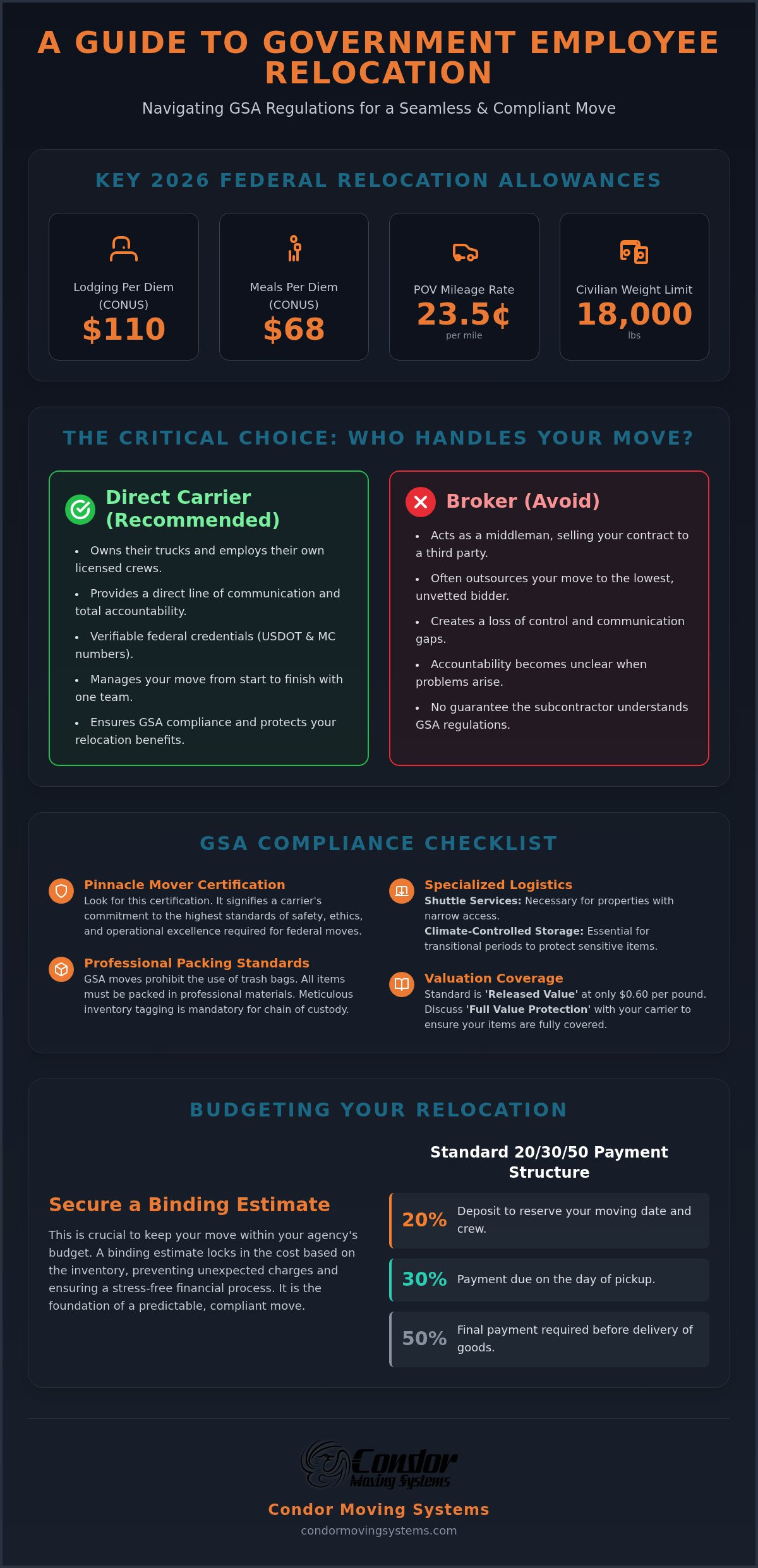
This guide simplifies the process by showing you how to prioritize direct carrier accountability and total transparency. We’ll provide the 2026 updates on CONUS per diem rates, currently set at $110 for lodging and $68 for meals, and explain how working with a licensed carrier ensures your documentation is airtight for expense administration. You’ll learn how to navigate the 2026 POV mileage rate of 23.5 cents per mile while maintaining a seamless, stress-free move within your agency’s budget and timeframe.
Key Takeaways
- Learn how to identify Pinnacle Mover certified carriers to ensure your move adheres to strict GSA schedules and federal weight restrictions.
- Discover why choosing direct government employee relocation services over a broker prevents unvetted subcontractors from handling your household goods.
- Understand specific packing standards, including why professional materials are required and why items in trash bags are prohibited for transport.
- Identify when shuttle services are necessary for narrow housing access and how to utilize climate-controlled storage for transitional needs.
- Master the 20/30/50 payment structure and learn how to secure a binding estimate to keep your relocation package within budget.
Understanding Government Relocation Standards and Compliance
Government relocation is a precise logistical operation governed by the General Services Administration (GSA) and specific agency mandates. It isn’t a standard household move. It requires strict adherence to GSA schedules and federal weight restrictions that can vary depending on your specific orders. For many civilian roles, federal weight limits are capped at 18,000 lbs. This is a hard limit that dictates every aspect of move planning, from the size of the truck to the number of crew members required. Choosing professional government employee relocation services ensures that these boundaries are respected from day one, preventing costly overages that could fall on you personally.
Accountability starts with choosing a carrier that holds the ‘Pinnacle Mover’ certification. This isn’t just a badge; it’s a commitment to a higher standard of safety, ethics, and operational excellence. When you work with a certified carrier, you’re working with a team that understands the gravity of a federal move. They handle the complex documentation required for reimbursement, including the Bill of Lading and detailed inventory tagging. These documents are the backbone of your relocation package. They provide the evidence needed for expense administration and ensure that every item is accounted for during transit.
GSA Guidelines vs. General Residential Moves
Government moves demand higher insurance and valuation standards than typical residential transitions. A licensed crew must maintain a clear chain of custody from the moment they enter your home until the final box is unpacked. This level of oversight is essential for employee relocation services that specialize in federal and military transitions. You’ll need to decide between ‘Full Value Protection’ and ‘Released Value’ coverage. It’s vital to remember that standard coverage is typically Released Value, which is $0.60 per lb per item. While this meets basic requirements, it may not cover the full replacement cost of high-value items, so discussing your specific needs with the carrier is essential for total peace of mind.
Weight and Inventory Management for Federal Employees
Personalized inventory tagging is your primary defense against loss during long-distance moves. Every item receives a unique tag that corresponds to a master list, ensuring nothing is left behind or misplaced. This system is especially important during interstate transit where shipments may be consolidated. Accurate inventory management helps you avoid extra charges on moving day by ensuring the estimated weight aligns with the actual load. For federal compliance, the inventory process is a systematic recording and tagging of every household item to establish a verifiable chain of custody throughout the relocation. This meticulous approach ensures that your move remains within budget and meets all agency reporting requirements.
Using a direct carrier instead of a broker is the best way to ensure these standards are met. When you communicate directly with the crew handling your items, there’s no room for the ambiguity that often comes with outsourced subcontractors. This direct line of communication is a hallmark of reliable government employee relocation services, providing the transparency you need for a stress-free transition. By maintaining control over the entire process, a direct carrier protects your relocation benefits and ensures every GSA guideline is followed to the letter.
Direct Carrier vs. Broker: Protecting Your Relocation Benefit
Choosing the right partner for government employee relocation services often comes down to one question: who actually owns the truck? Many companies you find online are brokers, not carriers. A broker acts as a middleman, selling your contract to the lowest bidder. This often results in unvetted subcontractors handling your personal belongings, leading to a complete loss of accountability. When your move is handled by a direct carrier like Condor Moving Systems, which has managed transitions with its own licensed crews since 2003, you maintain a direct line of communication with the people actually touching your furniture.
Accountability is non-negotiable for federal personnel. You can verify a carrier’s legitimacy through their federal filings. Reliable providers should openly display their credentials, such as USDOT 1126171 and MC 458180, which are required for legal interstate moves. Beyond licensing, direct carriers offer 24-hour answering services. This accessibility is vital for moving personnel who may need to coordinate logistics across different time zones or address urgent changes during transit. It provides a level of security that a detached brokerage office simply cannot match.
The Risks of Relocation Brokerage
Brokers are notorious for changing quotes after the items are loaded. They often use “estimates” that aren’t legally binding, leading to hidden fees that can jeopardize your Reimbursable Relocation Expenses. In contrast, direct carriers provide binding estimates. These are guaranteed flat-rate quotes that protect your budget from unexpected spikes. If you are planning reliable long-distance moves, a binding estimate ensures your agency’s relocation benefit covers the costs as expected without administrative friction.
Accountability in Texas and Beyond
For moves originating in the Southwest, local expertise is a major asset. Condor maintains a strong Texas footprint, serving major hubs like Dallas, Austin, Houston, and San Antonio directly. This local presence means the crew that packs your home in Texas is part of the same organization that delivers it to your new destination. This continuity is essential for complex government relocations where inventory tracking and GSA compliance are paramount. You don’t have to worry about your items being handed off at a distribution center to a stranger. If you want to ensure your transition is handled by a single, accountable team, you can request a direct carrier estimate to start your planning process with total transparency.
Direct carriers take full ownership of the move from start to finish. This disciplined approach mirrors the organized nature of federal operations. By avoiding the ambiguity of a broker, you secure a partner that values precision and stability. This ensures your move stays on schedule and your documentation remains audit-ready for your relocation expense administration.
Packing and Specialty Handling for Government Moves
Packing for a federal or military transition requires a disciplined approach to ensure every item arrives intact and meets agency standards. You’ll need to choose between full-service and partial packing based on your specific orders and personal timeline. For those seeking total peace of mind, full-service packing involves our licensed crews handling every item from kitchenware to bedroom sets using professional-grade materials. If you prefer partial packing, you can manage the non-fragile items while we secure the larger or more delicate pieces. Regardless of the level you choose, we strictly enforce a ‘No Trash Bags’ rule. Trash bags offer zero protection against shifting loads and are prohibited as packing material for all government employee relocation services.
Specialty items like pianos, pool tables, and custom bikes require specialized equipment and techniques. These aren’t standard boxes; they need the expertise of a carrier that understands the mechanics of heavy or high-value assets. Our crews are trained in the specific disassembly and reassembly processes required for these items, ensuring they remain functional and undamaged. For a comprehensive overview of how to protect these irreplaceable pieces, our guide on specialty item moving details the precise protection strategies required for a successful transition. By treating these assets with the precision they deserve, we help maintain the integrity of your entire shipment during interstate transit.
Custom Crating for Fragile Government Assets
Fragile government assets, including fine art and sensitive electronics, often require custom wood crating. These crates are built to the exact dimensions of the item to prevent any internal movement or pressure. It’s important to understand that boxes packed by the owner (PBO) have limited valuation coverage compared to those packed by professionals. To ensure your items are fully protected under our operational standards, remember that concealed damage claims require Condor packing. This requirement ensures that our team has verified the condition and security of the items before they are loaded onto the truck. For a deeper understanding of how to protect your most delicate belongings during transit, our guide on packing services for fragile items explains the engineering principles behind custom crating and current federal valuation regulations.
Prohibited Items and ‘Non-Allowables’
Certain items cannot be transported due to safety regulations and federal liability rules. This list includes high-value personal items like jewelry, cash, and legal deeds, which you should keep in your personal possession at all times. Hazardous materials such as propane tanks, chemicals, and ammunition are strictly prohibited for transport. We also don’t move plants, perishable food, or firearms. Please be aware that debris and trash disposal is not handled by the crew. You are responsible for clearing any packing materials or unwanted items from your residence after the move is complete, as our services do not include hoisting furniture or delivery to attics and basements.
Maintaining a clear understanding of these packing standards prevents delays on moving day. When you follow these guidelines, you ensure that your relocation remains compliant with GSA standards and that your reimbursement documentation is accurate. Our goal is to provide a transparent process where every item is handled with the highest level of accountability from start to finish.
Logistics and Access: Shuttle, Storage, and Long-Carry
Physical logistics are where the best-laid plans meet reality. For those utilizing government employee relocation services, understanding the physical constraints of your new destination is as important as the paperwork. Transit times generally fall within a 1 to 10 business day window for standard deliveries, though extended areas may require up to 21 business days. These timelines are calculated to ensure safe passage and allow for the methodical inventory checks required by GSA standards. Unlike brokers who might provide vague arrival dates, a direct carrier manages the fleet to provide specific delivery windows you can rely on.
Every phase of the transit is handled by our own crews to maintain a verifiable chain of custody. This eliminates the uncertainty that comes with third-party hand-offs. We don’t just move boxes; we manage a timeline that respects your agency’s reporting requirements and your family’s need for a predictable schedule. This disciplined approach ensures that your household goods are tracked and handled with the same level of accountability from the moment they’re loaded until they reach your new front door.
Storage-in-Transit (SIT) for Military Families
Many federal transitions involve a gap between vacating an old residence and the availability of new housing. Storage-in-Transit (SIT) provides a secure bridge during these periods. We offer climate-controlled storage solutions that protect sensitive household goods from extreme temperatures and humidity. While the first month of storage is often part of the initial logistics plan, additional months are billed at $0.50 per cubic foot. This provides a predictable cost structure for families waiting on housing assignments or closing dates. For a deeper look at how to coordinate these overlapping timelines without accountability gaps, our complete guide to integrated moving and storage services explains how a direct carrier model eliminates the risks of split logistics. If you’re moving within the state, our local movers in Texas can coordinate these transitions with precision.
Overcoming Access Obstacles
Access hurdles are a common but often overlooked part of relocation budgeting. Many government housing areas or historic neighborhoods have narrow streets that can’t accommodate a full-sized 18-wheeler. In these cases, a shuttle service is required to move items from the large van to a smaller truck for final delivery. Shuttle fees are calculated at $0.75 per cubic foot, with a minimum charge of $450. Identifying these needs early prevents delays on delivery day and ensures the crew has the right equipment for the job.
Other logistical factors include Long-Carry and stair fees. A Long-Carry fee applies when the distance from the truck to the residence exceeds 150 feet. Stair fees start at $75 for specific access challenges that require extra labor and time. It’s important to remember that our standard services exclude hoisting furniture or making deliveries to attics and basements. By accounting for these obstacles during the initial estimate, you ensure a transparent budget that adheres to federal reimbursement guidelines without unexpected out-of-pocket costs.
Your Relocation Timeline: Estimates and Final Delivery
Successful execution of government employee relocation services relies on a clear, predictable timeline from the initial quote to the final signature on the Bill of Lading. Everything begins with a free, no-obligation binding estimate. This document is a legal safeguard that ensures your relocation package stays within the projected budget. Unlike non-binding estimates that can fluctuate, a binding estimate provides a fixed price based on the inventory and services agreed upon. This transparency is essential for federal employees who must justify every expense for agency reimbursement.
Once you’ve secured your estimate, the booking process follows a disciplined 20/30/50 payment structure. This model is designed to maintain operational stability throughout the transit. A 20% booking deposit is required to reserve your moving date and crew. This deposit is non-refundable, reflecting the commitment of resources required to manage a high-compliance relocation. The remaining balance is split between the pickup and delivery phases, ensuring that the carrier remains accountable for the condition and arrival of your goods at every stage of the journey.
Payment and Booking Protocols
Understanding the specific payment methods at each stage prevents unnecessary delays. At the time of pickup, you can pay your 30% balance via cash, personal check, or credit card. However, delivery day requirements are much stricter. We don’t accept cash, personal checks, or credit cards at the destination. You must have a Cashier’s Check, money order, or Zelle payment ready to finalize the delivery. If there’s a delay in transit beyond the estimated window, we provide a $15 per day reimbursement provision, offering a small measure of protection for your schedule and budget.
Post-Move Accountability
The final delivery is not just about unloading boxes; it’s about verifying the integrity of your shipment. You must note any visible damages on the Bill of Lading (BOL) at the time of delivery while the crew is still on-site. If you encounter service issues that weren’t immediately apparent, you have a 72-hour window to report them to our office. For formal damage claims, we work with Anthem Claim Management to provide a 9-month window for filing. This extended period ensures you have ample time to unpack and inspect your items thoroughly. For more information on choosing a partner for your transition, see our guide on the Best Long Distance Moving Companies of 2026.
Direct communication remains your best tool for a successful move. By following these protocols, you ensure that your relocation is documented correctly for your agency’s administrative requirements. This methodical approach to the final stages of your move provides the peace of mind that comes from working with a disciplined, professional carrier. From the initial deposit to the final delivery, every step is designed to protect your interests and your belongings.
Secure Your Federal Transition with Expert Guidance
Managing the complexities of federal and military moves requires more than just a truck; it demands a partner with a deep understanding of GSA compliance and logistical precision. By prioritizing a direct carrier over a detached broker, you ensure that your household goods are handled by licensed crews who take full ownership of the process. This approach eliminates the risk of unvetted subcontractors and provides the transparent documentation necessary for seamless reimbursement administration. With over 20 years of relocation experience, Condor Moving Systems provides the stability you need for a stress-free transition.
Choosing Pinnacle Mover certified government employee relocation services means your move is managed by professionals who respect federal weight limits and strict delivery timelines. Our status as a fully licensed and insured carrier (USDOT 1126171 and MC 458180) guarantees that your relocation benefit is protected from start to finish. Whether you need to overcome narrow housing access with a shuttle service or require a professional moving and storage service that keeps your household goods under one accountable roof, we provide the resources to meet every hurdle. You deserve a move that is as disciplined and organized as the agency you serve.
Take the first step toward a successful relocation by securing an estimate that respects your budget and your timeline. We’re here to ensure your next assignment starts on solid ground.
Frequently Asked Questions
Does Condor Moving Systems offer military and senior discounts?
Yes, we provide specialized discounts for active-duty military personnel, veterans, and seniors aged 65 and older. These savings apply to both local relocations in Dallas and long-distance moves originating from our Texas hubs. To qualify for these discounts, you must present a valid military or state ID at the time of your estimate. We prioritize these groups to ensure that those who have served our country or community receive reliable and cost-effective moving solutions.
What are ‘non-allowable’ items for government relocation?
Prohibited items include high-value personal assets like jewelry, cash, and legal deeds, along with hazardous materials such as propane, ammunition, and chemicals. We also cannot transport plants or perishable food items due to safety and liability regulations. For a successful transition using government employee relocation services, we recommend keeping all irreplaceable documents and valuables in your personal possession. A full list of non-allowables is available to help you plan a compliant shipment that meets federal safety standards.
How do I pay the final balance on my moving day?
Your final balance at delivery must be paid using a Cashier’s check, money order, or Zelle. We do not accept cash, personal checks, or credit cards at the destination to ensure a secure and documented transaction. This policy applies to all deliveries, whether you are moving into a new home in Houston or a government housing unit in San Antonio. Please ensure your payment method is ready before the driver arrives to avoid any delays in unloading your belongings.
What is the difference between valuation and insurance?
Valuation is the tariff liability a mover assumes for your goods, while insurance is a separate policy purchased through a third party. Standard valuation, known as Released Value Protection, is provided at no cost and covers $0.60 per pound per item. For comprehensive coverage, you can opt for Full Value Replacement through an external provider. This distinction is vital for government employee relocation services, as it determines how claims for damaged or lost items are processed and reimbursed.
Can I use trash bags to pack my belongings?
No, trash bags are strictly prohibited and will not be accepted as packing material for any move. They offer no protection against the pressures of transit and can lead to damage that isn’t covered by valuation. Our crews in Fort Worth and Austin require all items to be packed in professional-grade boxes or custom crating. This standard ensures that your household goods remain secure and organized throughout the entire relocation process from loading to final delivery.
What happens if my delivery is delayed beyond the estimate?
If your delivery is delayed beyond the estimated transit window, Condor Moving Systems provides a reimbursement of $15.00 per day. This provision helps offset the inconvenience of a late arrival and reflects our commitment to maintaining a disciplined schedule. Standard transit times range from 1 to 10 business days depending on the distance. While we strive for punctuality, this daily credit ensures you have some financial protection if logistical hurdles extend the timeframe of your interstate move.
Does Condor offer same-day moving services for local relocations?
Yes, we offer same-day moving services based on current crew availability, which is ideal for small or local relocations within the Dallas or Plano areas. While these requests are handled on a case-by-case basis, we recommend booking as far in advance as possible to guarantee your preferred date. Our local teams are experienced in rapid transitions, but the complexity of government moves often requires more lead time to ensure all compliance documentation is properly prepared.
Are there weight limits for my government-funded move?
Yes, your move must comply with the federal weight limits specified in your official orders. For many civilian roles, this limit is capped at 18,000 pounds, and any weight exceeding this amount may result in personal out-of-pocket costs. Our team performs meticulous inventory tagging to help you stay within these boundaries. Accurate weight management is a core component of our service, ensuring that your relocation remains fully reimbursable by your agency without unexpected financial penalties.