


The most expensive mistake you can make when relocating is treating a five-bedroom estate move like a simple transport job. For a high-volume household, the real challenge isn’t just the mileage; it’s the accountability of the hands touching your heirlooms. If you are researching how to move a large house full of furniture long distance, you’ve likely realized that the traditional broker model often leaves families in the dark. You deserve more than a middleman who outsources your life’s work to an unknown crew and leaves you guessing about delivery dates.
We understand the deep anxiety that comes with handing over the keys to a truck containing your grand piano, antique wardrobes, and every piece of your family history. It’s stressful to wonder if your quote will change at the state line or if you’ll ever speak to the actual moving crew again. This guide promises to strip away that uncertainty by providing a professional framework for a damage-free relocation. We’ll show you how to secure a guaranteed flat-rate price and maintain total control over your transit timeline, ensuring your transition is handled with disciplined, carrier-direct precision from start to finish.
Key Takeaways
- Identify the critical differences between a direct moving carrier and a broker to ensure your inventory remains under the care of a single, accountable crew throughout the journey.
- Secure your relocation budget with a binding estimate and a transparent 20/30/50 payment structure, eliminating the risk of unexpected price hikes during transit.
- Master the logistics of how to move a large house full of furniture long distance by adhering to professional packing standards and the mandatory use of specialized moving boxes.
- Coordinate your arrival timeline with confidence by understanding standard transit windows and the equipment required for homes with difficult access or narrow entry points.
- Prioritize operational integrity by selecting a provider with verifiable credentials, such as Pinnacle Mover certification, to handle specialty items like pianos and antiques.
The Complexity of High-Volume Long-Distance Relocation
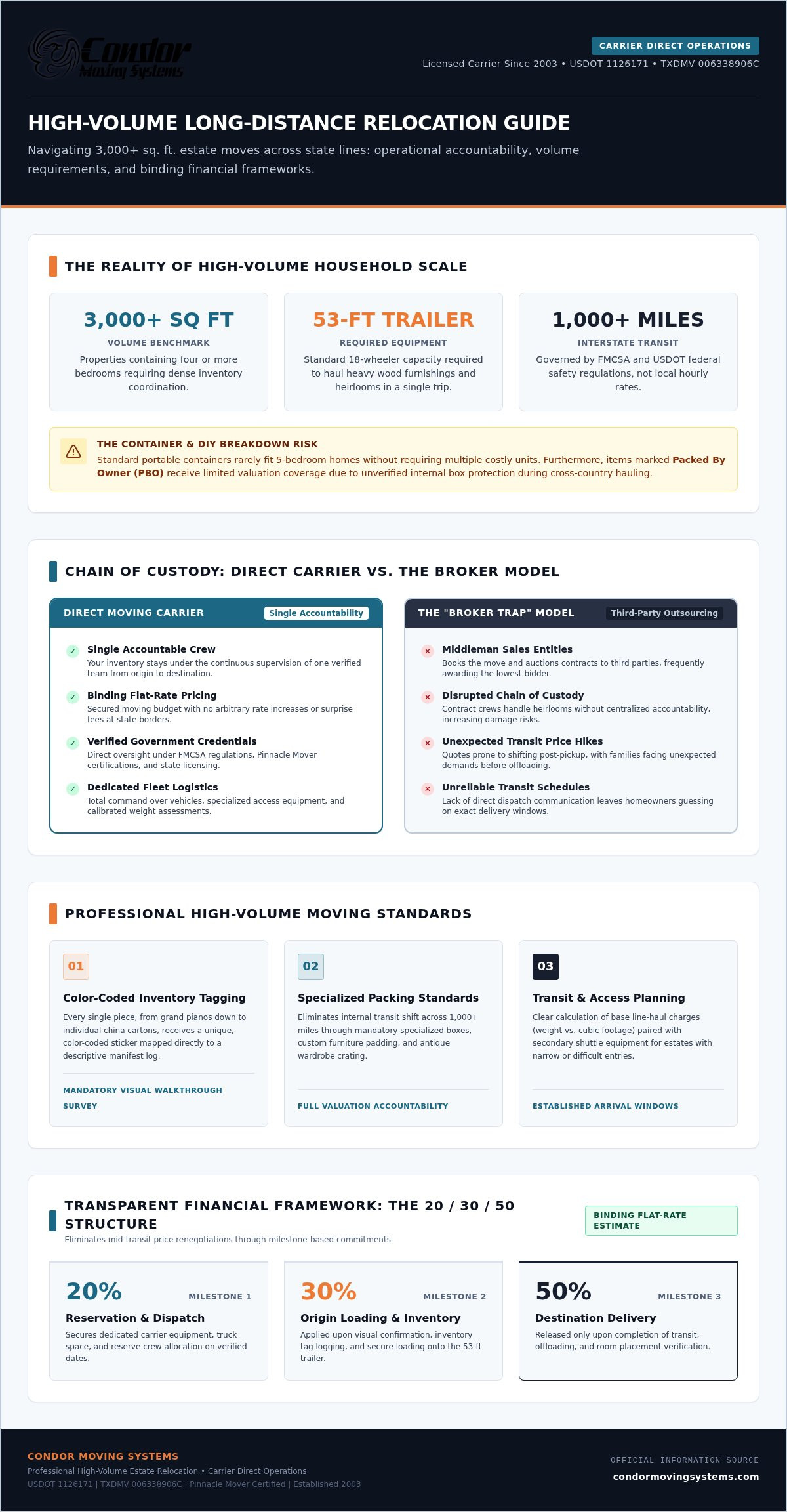
Relocating a high-volume estate involves more than just loading a truck; it is a complex logistical operation. When we discuss how to move a large house full of furniture long distance, we are typically referring to properties exceeding 3,000 square feet or containing four or more bedrooms. Unlike local moves that rely on hourly rates, interstate relocations are governed by strict federal regulations. Both the Federal Motor Carrier Safety Administration (FMCSA) and the USDOT provide the regulatory framework that protects your goods during transport. Professional full-service moving companies must adhere to these standards to ensure every item is tracked accurately across state lines.
Many homeowners consider portable containers, but these often fail once you cross a specific volume threshold. A five-bedroom home rarely fits into standard containers without significant risk of damage or the need for multiple expensive units. Full-service carriers offer the structural integrity of 53-foot trailers designed for heavy, dense inventories. This equipment is essential for maintaining the safety of your belongings during a cross-country journey.
Assessing Your Household Volume
Movers evaluate long-distance costs based on either weight or cubic footage. High-density furniture, such as solid wood dining sets or oversized sectional sofas, requires a precise inventory to determine the necessary equipment. For most large estates, an 18-wheeler is the standard requirement to accommodate the total volume in a single trip. Line-haul charges represent the base cost of interstate transport before any additional services are applied. Understanding this base cost helps you evaluate the total investment required for your relocation.
The Risks of DIY for Large Homes
Attempting a DIY move for a large home introduces significant liability, particularly regarding valuation. Most insurance options provide limited coverage for items “Packed By Owner” (PBO), as the carrier cannot verify the internal protection of the box. Beyond the financial risk, the physical strain of loading a 1,000-mile journey is immense. Improperly secured furniture can shift during transit, leading to structural damage that professional crews are trained to prevent. You can learn more about the benefits of professional movers to understand how they mitigate these specific risks and provide the necessary security for your household goods.
Inventory Management and Avoiding the “Broker Trap”
The biggest risk to your timeline and budget is often the hidden middleman. Many families researching how to move a large house full of furniture long distance unknowingly contact brokers rather than actual carriers. A broker is a sales entity that books your move and then sells the contract to a third-party company, often the lowest bidder. This creates a massive gap in accountability. To protect your estate, referencing the FMCSA guide on movers versus brokers is a critical first step in identifying who will actually be inside your home on move day.
A professional inventory tagging system is the only way to manage a high-volume relocation. Every item, from the grand piano to the last box of china, receives a unique, color-coded sticker and is logged on a descriptive inventory sheet. This prevents loss during the multi-day transit across state lines and ensures that every piece that leaves your old home is accounted for at the destination. For a house of this size, a visual survey is mandatory. Whether performed in person or via a virtual walk-through, a visual assessment is the only way to guarantee the accuracy of your quote.
Why Direct Carriers Offer Superior Accountability
Direct carriers provide a seamless chain of command from the initial estimate to the final delivery. Condor Moving Systems has operated as a licensed carrier since 2003, maintaining total control over the crews and equipment used for every project. Before you sign any contract, you should verify the mover’s credentials, such as USDOT 1126171 and TXDMV 006338906C. Choosing a carrier with decades of experience ensures that the team packing your valuables is the same team held responsible for their safe arrival. You can start this process by requesting a comprehensive inventory assessment to see the difference a direct provider makes.
Securing a Binding Flat-Rate Quote
For large-scale moves, a binding estimate is essential to prevent price hiking. This quote should be all-inclusive, covering the line-haul, labor, tolls, and fuel surcharges, which typically range from 10% to 20%. When you receive your Bill of Lading, review it carefully to ensure the inventory matches your visual survey; this prevents “extra volume” fees at the time of pickup. We operate on a transparent 20/30/50 payment structure: a 20% non-refundable deposit to secure your date, 30% at pickup, and the remaining 50% at delivery. Remember that professional carriers do not accept cash or personal checks at the destination; you’ll need a cashier’s check, money order, or Zelle to finalize the move.
Professional Packing Strategies for High-Value Furniture
When determining how to move a large house full of furniture long distance, the packing phase is where most damage risks are either mitigated or invited. High-volume households often face a choice between full-service and partial packing. While partial packing might seem like a cost-saving measure, full-service packing by a direct carrier ensures that every item is professionally secured for the vibrations of a cross-country haul. Professional crews use specialized techniques like double-padding and shrink-wrapping to create a protective “skin” around overstuffed furniture and delicate wood finishes. This prevents the scuffs and structural stress common in DIY efforts. It’s about building a load that can withstand a 1,000-mile journey without shifting.
One non-negotiable standard in professional relocation is the “No Trash Bags” rule. Professional movers require all non-furniture items to be placed in sturdy, stackable boxes. Trash bags rip easily. They provide zero protection against crushing and cannot be secured in a high-density load. Beyond the risk of damage, bags create logistical delays because they don’t stack, which can compromise the stability of the entire trailer. Adhering to these standards is a key part of following FTC moving scam prevention guidelines, as legitimate carriers will always insist on proper materials to protect your shipment.
Protecting Large and Fragile Items
Specialty items like pianos and pool tables require more than just strength; they require technical expertise and specialized equipment. For example, pianos are moved strictly on a ground-floor to ground-floor basis. Our crews don’t perform hoisting, nor do they move these heavy instruments into attics or basements due to the structural risks involved. For high-value art, glass tabletops, or oddly shaped antiques, custom crating is the only reliable solution. These wooden crates are built to the exact dimensions of the item, providing a rigid shell that absorbs the impact of transit better than any cardboard box ever could. This level of care is essential for maintaining the integrity of your most valuable pieces.
Packing Materials and Prohibited Items
Safety regulations and insurance policies dictate a strict list of “Non-Allowable” items that cannot be loaded onto a long-distance trailer. You should plan to transport jewelry, cash, and important documents personally. Additionally, Condor Moving Systems does not move ammunition, firearms, or perishable food items. Hazardous chemicals, including cleaning supplies and pressurized canisters, are also prohibited for the safety of the crew and the other goods on the truck. Utilizing professional moving kits with dish-packs for china and wardrobe boxes for clothing ensures your belongings are organized and protected throughout the journey. Proper labeling of these boxes also facilitates a much faster and more organized move-in process at your new destination.
Managing the Long-Distance Timeline and Financials
Planning how to move a large house full of furniture long distance requires a clear understanding of the logistics behind the drive. Standard transit times for a high-volume relocation typically range from 1 to 10 business days. This window depends on the total mileage and the specific route requirements for an 18-wheeler. While smaller shipments might be combined with others, a large house often occupies a significant portion of a trailer, which can help streamline the schedule. However, it’s important to remain flexible during this period as weather and road conditions can impact the arrival date.
Financial transparency is the foundation of a stress-free move. We utilize a 20/30/50 payment structure to ensure clarity and security for both parties. This includes a 20% non-refundable deposit to secure your moving date, 30% due at the time of pickup, and the final 50% balance collected at delivery. For valuation, every interstate move includes basic Released Value protection at $0.60 per pound per article at no extra cost. For high-value estates, we recommend exploring Full Value Replacement through a third-party provider to ensure comprehensive coverage for your investment.
The Delivery Phase Logistics
Our communication process keeps you informed throughout the journey. You’ll receive a transit update followed by a final 24 to 48 hour delivery window notification. Large homes often require an 18-wheeler for transport, but these vehicles cannot always enter residential neighborhoods with narrow streets or low-hanging trees. In these cases, a shuttle service is required to transfer your goods from the trailer to a smaller truck for final delivery. You should also account for potential long-carry fees if the truck must park more than 150 feet from your door, or stair fees if the crew must navigate more than 14 steps.
Financial Preparation for Moving Day
Payment protocols at the destination are strict to maintain operational integrity. We do not accept personal checks, credit cards, or cash at the time of delivery. The final balance must be paid via cashier’s check, money order, or Zelle. Preparing these funds in advance prevents delays during the offloading process. If a delivery is delayed beyond the contractually agreed window, we provide a reimbursement of $15 per day. This policy reflects our commitment to accountability and respects the value of your time.
Executing Your Move with Condor Moving Systems
Success in high-volume relocation depends on the strength of the provider’s operational foundation. Since 2003, Condor Moving Systems has cultivated deep Texas roots, providing specialized logistics for families in Dallas, Fort Worth, Austin, Houston, and San Antonio. We are a Pinnacle Mover certified carrier, a distinction that reflects our commitment to the highest standards of integrity and safety in the industry. If you are coordinating how to move a large house full of furniture long distance, you need a partner that offers more than just transport; you need a team that manages the entire lifecycle of your relocation with disciplined precision.
Large estate moves often involve complex timelines where the closing dates of two homes don’t perfectly align. To bridge this gap, we provide climate-controlled storage solutions designed specifically for high-value household goods. This ensures that your furniture remains in a stable environment, protected from the elements, until your new residence is ready for offloading. Our facility is managed with the same professional oversight as our transit operations, providing a seamless transition between locations without the risks associated with public storage units.
The Condor Difference: Full-Service Accountability
We eliminate the uncertainty of third-party outsourcing by using our own licensed crews for every phase of the project. This direct handling model ensures that the individuals who pack your home are the same professionals responsible for its safe delivery. We also provide a 24-hour emergency answering service to give you peace of mind while your life is in transit. You can find more details on selecting a reliable partner in our Long Distance Moving Buying Guide, which outlines the critical standards for modern interstate relocations.
Final Preparation Checklist
The 48 hours leading up to your move are critical for final coordination. You should perform a final walk-through to confirm your inventory accuracy against your binding estimate, ensuring no new items have been added that might impact your flat-rate price. This is also the time to secure your non-allowable items, such as property deeds, cash, and jewelry, for personal transport. While we handle the heavy lifting, these sensitive items must stay in your direct possession. If your journey starts within the state before heading across the country, our Local Texas Moving Services team can assist with the initial stages of your transition. When you are ready to proceed, contact us to request a free, no-obligation binding estimate and secure your relocation date on our 2026 calendar.
Securing Your Family’s Next Chapter
Relocating an entire estate is a significant milestone that requires more than just a truck; it demands a disciplined logistical strategy. By prioritizing direct carrier accountability over broker intermediaries, you ensure your inventory remains in professional hands from the first box to the final delivery. Success in mastering how to move a large house full of furniture long distance ultimately comes down to transparency. This means insisting on a binding estimate, adhering to a clear 20/30/50 payment structure, and verifying your mover holds essential credentials like Pinnacle Mover certification.
As a licensed carrier (USDOT 1126171) and a proud member of the Southwest Movers Association, Condor Moving Systems provides the operational integrity needed for high-volume relocations. We take full ownership of the process, protecting your investment with the same care we’d give our own. It’s our mission to turn a complex transition into a predictable, damage-free arrival.
Your new home is waiting. Let us handle the complexity so you can focus on the journey ahead.
Frequently Asked Questions
How long does it take to move a large house long distance?
Standard transit times for a long-distance relocation typically range from 1 to 10 business days. For extended service areas, this window can reach up to 21 days. The specific duration depends on the total mileage from your origin in Dallas or Houston to your final destination. We provide two specific notifications during this period: one when your shipment is in transit and a final update 24 to 48 hours before the crew arrives.
Can I use trash bags to pack clothes for my long-distance move?
No; we do not accept trash bags as packing material for any items. Trash bags offer zero structural protection and often tear during the loading process, which puts your belongings at risk. To ensure the safety of your wardrobe, we require all clothing and non-furniture items to be packed in sturdy boxes. We offer specialized wardrobe boxes and moving kits through our online store to help you prepare your inventory correctly.
What is the difference between valuation and moving insurance?
Valuation is a level of liability that a mover assumes for your goods, whereas insurance is a separate policy purchased through a third-party provider. Under federal law, we provide Released Value protection at no extra cost, which covers items at $0.60 per pound. For those moving a large house full of furniture long distance, we recommend purchasing Full Value Replacement coverage. This ensures your high-value items are protected based on their replacement value.
Will the same crew load and unload my furniture?
Not necessarily; the pick-up crew may differ from the delivery crew on a long-distance route. While we always use our own licensed employees rather than outsourced laborers, logistical requirements for interstate travel often involve different regional teams. Regardless of the specific crew members involved, every stage of your move is managed under our direct carrier authority to maintain high operational standards and total accountability for your inventory throughout the journey.
Do you offer storage if my new home isn’t ready yet?
Yes; we provide both short-term and long-term climate-controlled storage solutions for our clients. If your new residence in Austin or San Antonio isn’t ready for immediate delivery, we can securely hold your shipment in our facility. Our storage rates are calculated at $0.50 per cubic foot per month. This service allows you to manage your transition timeline without the stress of finding a secondary provider or moving your items multiple times.
What items are movers not allowed to transport?
We are prohibited from transporting hazardous materials, perishables, and specific high-value personal items. This list includes explosives, flammable gases, propane, paint, and cleaning chemicals. We also do not move jewelry, cash, deeds, plants, ammunition, or firearms. You should plan to transport these items personally to ensure their security. For a complete list of non-allowable items, you can visit our resource center to verify your inventory before the packing crew arrives at your home.
How is the final price of a long-distance move calculated?
The final price is determined by a binding estimate based on the total volume of your inventory and the distance of the haul. We provide a guaranteed flat-rate quote that includes the line-haul charges, fuel surcharges, and any additional services like custom crating. When learning how to move a large house full of furniture long distance, it’s vital to understand our 20/30/50 payment structure, which ensures your costs are transparent and fixed.
Can I pay for my move with a credit card at delivery?
No; we do not accept credit cards, personal checks, or cash at the time of delivery. The final 50% balance must be paid using a cashier’s check, money order, or Zelle. While you can use a credit card for your initial 20% deposit or the 30% pickup payment, federal regulations and our internal security protocols require specific payment methods at the destination. Preparing these funds in advance ensures a smooth offloading process.