

Most people don’t realize that the “moving company” they hired is actually a broker who will never touch their belongings, often leaving specialty item moving tasks in the hands of unvetted third parties. This lack of accountability is exactly why the fear of damage to irreplaceable items remains the biggest stressor during a relocation. You’ve spent years acquiring pieces like fine art, heirloom pianos, or custom equipment, so the worry over a single cracked frame or a scratched finish is completely justified. Hidden fees for heavy goods and the uncertainty of outsourced labor only add to the frustration of the move.
This guide will help you master the logistics of relocating high-value goods by detailing the precise protection strategies required for a successful transition. We’ll provide a clear plan for item preparation and explain the benefits of professional custom crating. By the end of this article, you’ll understand why a direct-service carrier is the only logical choice for maintaining a strict chain of custody. We’ll also cover how to navigate federal regulations and basic liability coverage to ensure your assets are protected from start to finish.
Key Takeaways
- Learn to identify which high-value or heavy items require specialized logistics to avoid the common pitfalls of standard moving services.
- Discover the critical differences between direct carriers and brokers to ensure your belongings remain under the care of a single, accountable crew.
- Master the essential preparation steps, including high-resolution documentation and professional appraisals, to protect your investment during specialty item moving.
- Understand the technical advantages of custom crating for fragile goods and why certain DIY packing methods are strictly prohibited by professional movers.
- Gain clarity on the financial and logistical timeline, from obtaining a binding estimate to navigating the standard deposit and payment structure.
What Defines Specialty Item Moving: Why Standard Service Isn’t Enough
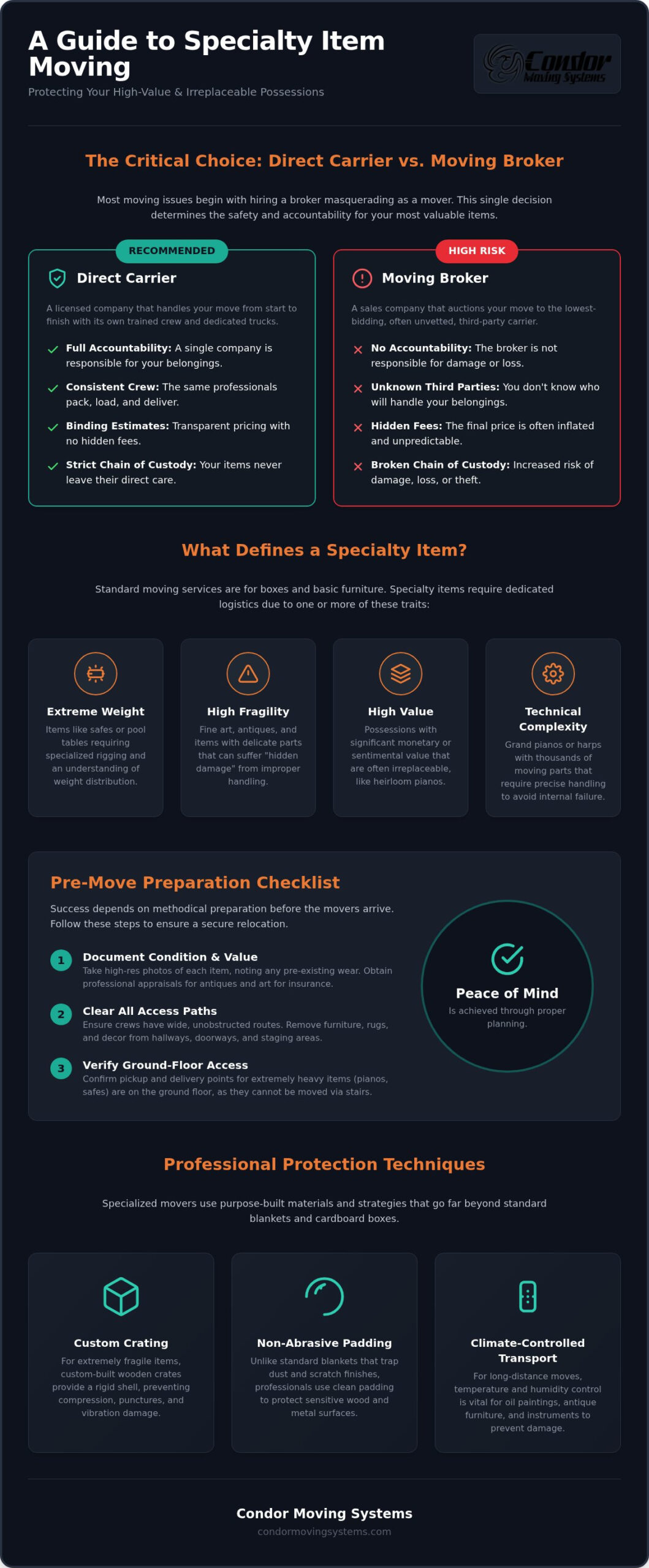
Standard household moving focuses on volume and speed, but specialty item moving requires a focus on precision and physics. This dedicated logistics process is defined by four specific pillars: extreme weight, high fragility, significant monetary or sentimental value, and technical complexity. When an item possesses even one of these traits, standard moving techniques become insufficient. Standard crews often lack the specialized rigging and specific training required to manage these variables simultaneously without risking the integrity of the object.
Standard techniques often result in structural stress or internal mechanical failure. For example, a grand piano contains thousands of precision-engineered moving parts that can be knocked out of alignment by improper vibration dampening. This is known as “hidden” damage. It isn’t visible on the surface like a scratch or a dent, but it ruins the item’s functionality and value. Without the right equipment, the sheer weight of a safe or a pool table can also cause structural damage to your home’s flooring or door frames.
Common Examples of Specialty Items
High-value assets require a professional Art handler or a specialized crew to ensure safe passage. These items aren’t just heavy; they’re often irreplaceable. Common examples include:
- Musical instruments: Grand pianos, upright pianos, and harps. It’s vital to remember that professional piano transport is restricted to ground-floor to ground-floor moves only.
- Recreational equipment: Pool tables and custom motorcycles. Pool tables require professional disassembly to protect the slate, though they are not re-assembled at the destination.
- High-value collections: Fine art, antiques, and fragile sculptures that cannot be packed in standard cardboard boxes.
The Technical Challenges of Heavy and Fragile Goods
Managing heavy safes or large sculptures requires a deep understanding of center of gravity and weight distribution. If a crew miscalculates the balance point, it can lead to catastrophic equipment failure or property damage. Standard moving blankets often fail to protect high-polish finishes on instruments or fine furniture because they can trap abrasive dust. Instead, specialized non-abrasive padding and climate-controlled transport are necessary for sensitive materials like oil paintings or antique wood. If you are planning long-distance moves involving these complex items, accountability through a direct carrier is the most important factor in preventing loss. This ensures the same licensed crew handles your belongings from the moment they are crated until they reach their final destination.
How to Prepare Your Specialty Items for Relocation
Successful specialty item moving depends on the work you do before the truck even arrives. You must take a methodical approach to documentation and site preparation to ensure a seamless transition. Start by clearing all access paths within your home. Professional crews require wide, unobstructed routes to move heavy or oversized objects safely. Because large assets like pianos or pool tables are restricted to ground-floor locations, verify that your pickup and delivery points don’t involve stairs, attics, or basements. If you have questions about specific logistical constraints, you can get a detailed inventory assessment to clarify your needs.
Documenting Condition and Value
You should create a comprehensive digital inventory of every high-value item scheduled for transport. Take high-resolution photographs from multiple angles, specifically capturing the current condition of corners, surfaces, and mechanical joints. If there are existing scratches or signs of wear, document them clearly to prevent confusion during the post-move inspection. For antiques or items of historical significance, professional appraisals provide the necessary valuation for insurance purposes. While we handle domestic transport, high-value assets are often subject to strict oversight; referencing the federal regulations for exporting cultural property provides a solid baseline for how the government categorizes and protects significant cultural assets.
Condor only assumes liability for the physical protection and integrity of items that their own trained crews have professionally packed and crated. If you choose to pack a fragile item yourself, you assume the risk for any internal damage. Keep all original receipts, appraisal certificates, and titles in a personal folder that stays with you throughout the move. Never pack these documents inside the moving truck.
Addressing Non-Allowables and Restrictions
Certain items are classified as non-allowables due to legal restrictions or safety protocols. You must personally transport jewelry, firearms, cash, and sensitive legal documents such as deeds or birth certificates. Hazardous materials, including cleaning chemicals, propane tanks, and aerosols, are strictly prohibited from the moving van. It’s also your responsibility to manage personal electronics and data storage devices independently. Ensure all data is backed up and that small, high-value electronics are moved in your personal vehicle. Finally, remember that specialized equipment like pool tables will be professionally disassembled for transit, but re-assembly at the destination is not included in the standard service scope.
Evaluating Specialty Movers: Direct Carrier vs. Broker
You need to know exactly who is loading your truck before the moving day arrives. In the relocation industry, companies generally fall into two categories: direct carriers and brokers. A direct carrier like Condor Moving Systems owns the fleet, employs the crews, and manages the logistics from the initial estimate to the final delivery. In contrast, a broker is a sales entity that books your move and then sells the contract to a third-party provider. For specialty item moving, the distinction is critical because it determines the level of accountability you can expect if a high-value item is mishandled.
Maintaining a strict chain of custody is the only way to prevent “finger-pointing” during the claims process. When one company handles the entire shipment, there is no ambiguity regarding responsibility. You can verify a company’s authority by checking their registration with the Federal Motor Carrier Safety Administration (FMCSA) and state agencies. For example, Condor operates under USDOT 1126171 and TXDMV 006338906C. Choosing a provider with Pinnacle Mover or ProMover certifications further ensures you’re working with a team that meets high ethical and operational standards.
The Risks of Outsourced Labor
Brokers often outsource labor to local day laborers or smaller subcontractors who may lack specific training in handling complex items like grand pianos or heavy safes. This creates a significant security gap. These temporary workers often don’t have the experience required to use specialized rigging or vibration-dampening tools. Condor has operated for over 20 years using its own licensed crews, ensuring that the people inside your home are trained professionals who understand the company’s strict safety protocols. This continuity is especially important for long-distance moves, where the risk of transit-related stress is higher.
Understanding Valuation vs. Insurance
Federal law requires interstate movers to provide basic liability coverage, known as “Released Value Protection,” at a rate of $0.60 per pound per item. For a 500-pound piano, this would only provide $300 in compensation, which is clearly insufficient for high-value assets. To protect your investment, you should consider Full Value Replacement Coverage. This option ensures the mover is liable for the replacement value of lost or damaged goods. It’s vital to remember that valuation choices must be finalized before the move begins; you cannot modify these terms once the crew has started the loading process. If you’re moving heirloom pieces, always verify that your chosen coverage applies to the specific crating and handling requirements of those items.
Custom Crating and Professional Packing Techniques
Standard cardboard boxes are designed for uniform household goods, but specialty item moving requires a more rigorous approach to containment. Custom crating is the gold standard for high-value protection. The process involves building a reinforced wooden enclosure specifically around the dimensions of an item to achieve zero-movement transit. This precision engineering prevents the internal shifting that causes structural stress during long-haul transport. By securing the item to the base of the crate, we ensure it remains stationary regardless of road conditions or vehicle vibrations.
Professional standards dictate that certain materials are strictly prohibited because they jeopardize the safety of your belongings. Trash bags are never allowed for packing; they offer zero impact protection and can trap moisture, which leads to mold or surface degradation. Instead, we utilize industry-specific padding. Fine art requires acid-free paper to prevent chemical reactions with oil or acrylic finishes, while pianos are wrapped in heavy-duty felt to protect high-polish wood from abrasions. Using the correct materials is a non-negotiable part of our operational philosophy.
Given the intense Texas heat and humidity, climate-controlled storage is often a necessity for sensitive materials. Wood, leather, and canvas can warp, crack, or expand when exposed to extreme temperature fluctuations. Maintaining a stable environment ensures that your belongings remain in the exact condition they were in when they left your home. This level of environmental control is essential for any items slated for short or long-term storage during a transition.
When is Custom Crating Necessary?
Crating is essential for items that are too fragile for standard stacking or possess irregular shapes that compromise their structural integrity. We measure and construct bespoke crates for delicate sculptures, large chandeliers, and ornate mirrors. This level of detail is a core part of our packing services for fragile items. By isolating these pieces from the rest of the load, we eliminate the risk of pressure-related damage from adjacent cargo.
Specialized Equipment for Heavy Items
Moving heavy assets like safes or grand pianos requires more than just physical strength. Our crews use specialized equipment including piano boards, heavy-duty dollies, and reinforced ramps to navigate ground-floor transitions safely. It’s vital to note that Condor does not perform hoisting or use cranes for any relocation. All moves must be ground-floor to ground-floor to ensure maximum control and safety. Additionally, while we professionally disassemble pool tables to ensure they can be transported without cracking the slate, re-assembly at the destination is not provided. This clear division of labor allows our team to focus entirely on the safe transport of the components.
Navigating the Logistics of Your Specialty Move with Condor
Transparency in pricing and scheduling is the final safeguard in a successful specialty item moving operation. We provide a free, no-obligation binding estimate to ensure you have a clear understanding of the costs before any work begins. This eliminates the uncertainty of hidden fees that often plague the industry. Our payment schedule is structured to maintain accountability throughout the entire relocation process. You’ll provide a 20% non-refundable deposit to secure your move dates, followed by 30% at the time of pickup, and the final 50% upon delivery.
At the point of delivery, we maintain strict financial protocols for the security of both our crews and your assets. We accept payment via cashier’s check, money order, or Zelle. Please be aware that we do not accept cash, personal checks, or credit cards at delivery. Our standard delivery window ranges from 1 to 10 business days. If a delay occurs beyond this window, we provide a $15 per day reimbursement as part of our commitment to reliability and professional accountability.
Inventory Tagging and Tracking
Every piece of high-value cargo receives a personalized inventory tag as part of our comprehensive tracking system. This ensures that every component of your shipment is accounted for at every transfer point. You’ll receive two specific notifications regarding your shipment’s status: once when the truck is in transit and again 24 to 48 hours before the scheduled delivery. If you have urgent questions during the transit phase, our 24-hour answering service is available to provide emergency logistical updates. This ensures you’re never left without a direct line of communication with the team handling your assets.
Available Discounts and Final Steps
We recognize the unique needs of different client groups and offer dedicated military and senior (65+) discounts for eligible customers. Whether you require local movers in Texas for a regional transition or are planning long distance moves for interstate transport, our direct-service model remains consistent. By choosing a provider that manages its own licensed crews and equipment, you ensure that the specialized protection protocols discussed in this guide are followed from the first crate to the final delivery. Your most valuable belongings deserve the security of a professional, hands-on carrier that takes full ownership of the work.
Secure Your High-Value Assets for the Road Ahead
Relocating your most valuable possessions requires more than standard logistics; it demands a disciplined approach to technical protection and a transparent chain of custody. By prioritizing custom crating and choosing a direct carrier instead of a broker, you eliminate the ambiguity that often leads to damage and lost value. You now have the framework to document your inventory effectively and navigate the specific financial protocols required for a secure, predictable transition.
Condor Moving Systems brings over 20 years of experience to every specialty item moving project. As a Pinnacle Mover Certified carrier that’s fully licensed, bonded, and insured, we handle every aspect of your relocation using our own professional crews. We take full ownership of the work from the initial binding estimate to the final ground-floor delivery, ensuring your peace of mind throughout the entire process.
Trust your heirlooms and high-value equipment to a seasoned provider that values precision and operational integrity. We’re ready to help you execute a seamless move that protects your investment and your legacy.
Frequently Asked Questions
Do you move pianos to the second floor of a home?
No, we move pianos exclusively from ground-floor to ground-floor locations. Our safety protocols prohibit delivering pianos to second floors, and we don’t perform hoisting or crane services. This policy protects the instrument’s internal mechanics and ensures the safety of our crews in cities like Dallas and Houston. By focusing on ground-floor transitions, we maintain the structural integrity of your instrument without the risks associated with multi-story maneuvers.
Can I pay the final balance with a credit card upon delivery?
No, we don’t accept credit cards for the final balance at the time of delivery. Accepted payment methods for the remaining 50% balance include cashier’s checks, money orders, or Zelle. While credit cards are accepted for the initial deposit and pickup payments with a 3% fee, delivery payments must follow these specific methods. This ensures a transparent and secure financial transaction for your relocation in Fort Worth or San Antonio.
Will Condor re-assemble my pool table after the move?
No, we only provide disassembly services for pool tables to ensure they’re safely prepared for transport. Our crews will carefully take the table apart at the origin, but re-assembly at the destination is the customer’s responsibility. This allows our team to focus on the specialized logistics of specialty item moving while ensuring the delicate slate components are handled with maximum care during the loading and transit phases of your move.
What happens if my specialty item is damaged during transit?
If damage occurs, you must note it on the Bill of Lading at the time of delivery and file a written claim with Anthem Claim Management. You have a nine-month window to file your claim. Standard Released Value Protection provides coverage at $0.60 per pound per item. For higher-value protection, we recommend purchasing Full Value Replacement Coverage through a third-party provider before the move begins to ensure your investment is fully secured.
Do you provide real-time GPS tracking for my high-value shipment?
No, we don’t provide real-time GPS tracking or live location updates for shipments. Instead, we offer a reliable notification system that includes two specific updates: once when your shipment is in transit and again 24 to 48 hours before delivery. This methodical approach ensures you’re prepared for the arrival of your belongings in Plano or Irving without the ambiguity of constant, often inaccurate, live data streams.
Can I use trash bags to pack my fragile items if they are well-padded?
No, trash bags are strictly prohibited and will not be accepted by our crews for any items, including fragile goods. They provide zero structural protection and can cause moisture-related damage to sensitive materials. We require professional packing materials or custom crating for all assets. This standard is part of our commitment to operational integrity, ensuring that your belongings aren’t compromised by insufficient or unsafe DIY packing methods.
Do you offer same-day service for specialty item moving?
Yes, we offer same-day service for specialty item moving based on current crew and truck availability. This service is typically best suited for local moves within the Dallas-Fort Worth metroplex or other major Texas hubs. Because these moves require specific equipment and trained handlers, we recommend contacting our office as early as possible to verify if we can accommodate your specific timeline and logistical requirements on short notice.
What items are strictly prohibited from being moved?
Certain items are classified as non-allowables and cannot be transported by our crews for safety or legal reasons. Prohibited items include jewelry, cash, deeds, securities, plants, and perishable food. Additionally, we don’t move animals, firearms, ammunition, or hazardous materials like propane, paint, and chemicals. You must handle these items independently to ensure compliance with federal regulations and to protect the safety of the entire shipment during transit.