

What if the most significant risk to your belongings isn’t the long road ahead, but the moment they change hands between two different companies? Many homeowners and business managers realize too late that split logistics often lead to damaged items and accountability gaps. It’s natural to feel overwhelmed by the stress of aligning move-out dates with storage unit availability, particularly when you’re also trying to decipher the difference between basic valuation and comprehensive insurance coverage.
By choosing a professional, integrated moving and storage service, you eliminate the uncertainty of third-party handoffs and hidden broker fees. This guide will help you master the complexities of relocation in 2026, a year where new FMCSA financial responsibility rules for brokers and the widespread adoption of digital bills of lading have shifted the industry landscape. We’ll provide a clear roadmap for securing a seamless transition, explaining how a direct carrier model protects your interests from the first box packed to the final item delivered. You’ll learn how to identify total reliability in a provider and why a single-source solution is the most effective way to ensure your peace of mind during a high-stakes move.
Key Takeaways
- Learn how a single-source logistical provider eliminates the “gap period” by managing every phase of your relocation from packing to final delivery.
- Discover the critical differences between direct carriers and brokers, including how to verify USDOT credentials to ensure full accountability for your belongings.
- Master the technical requirements for different storage needs, such as choosing between Storage-in-Transit (SIT) or long-term climate control for a secure moving and storage service.
- Identify professional packing standards and custom crating strategies that protect high-value items while adhering to essential safety protocols like the “no trash bags” rule.
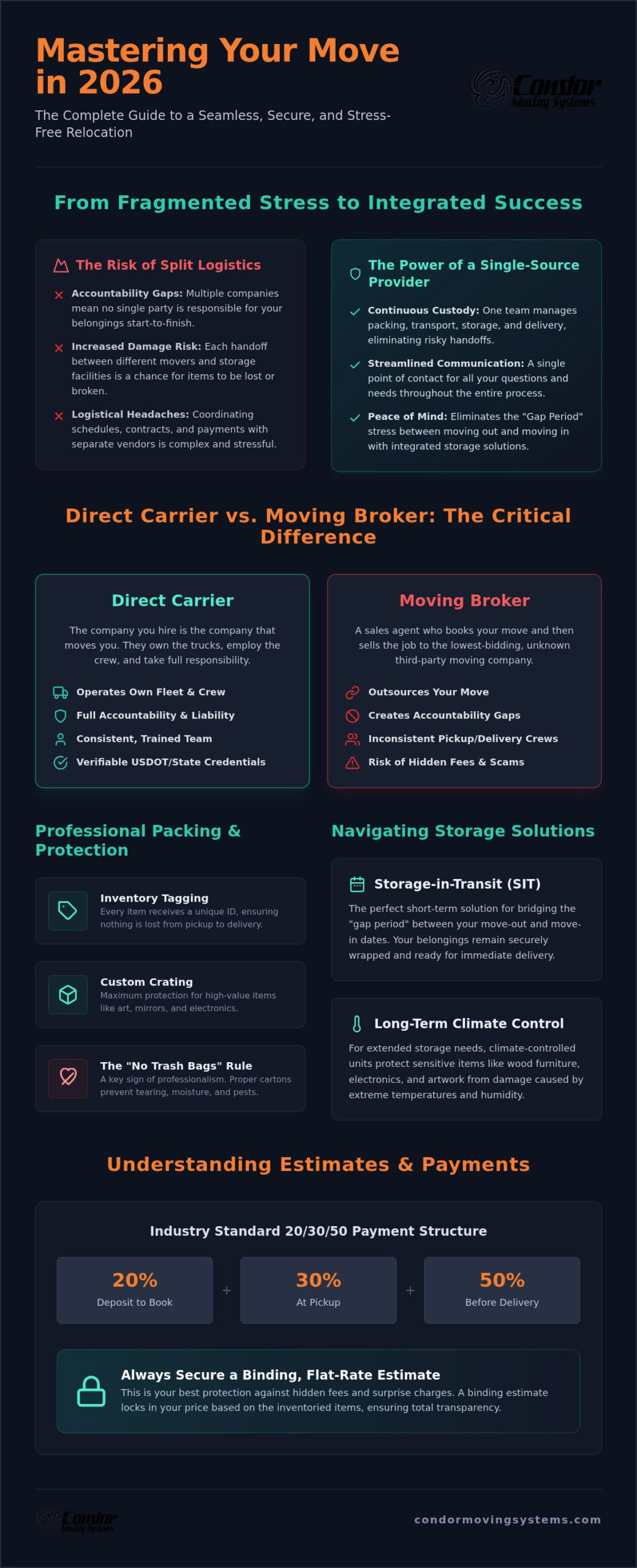
- Gain a clear understanding of the industry-standard 20/30/50 payment structure and how to secure a binding, flat-rate estimate to avoid hidden fees.
Understanding the Synergy of Integrated Moving and Storage Services
An integrated moving and storage service represents a closed-loop logistical ecosystem where a single team manages packing, transportation, and warehousing. This model differs from traditional methods where clients must hire separate entities for each phase. A comprehensive Relocation service provides a seamless transition by maintaining custody of your belongings from the moment they are packed until they are placed in your new home. This continuity significantly reduces the risk of loss or damage that often occurs during third-party handoffs.
Relocations rarely happen in a single day. The “Gap Period” describes the window between vacating a current property and gaining access to the new one. Most families and businesses require at least short-term storage during this transition. By utilizing a single-source provider, you secure continuous accountability and streamlined communication. You don’t have to worry about whether the truck will arrive at the storage facility on time or if the unit is large enough. This approach is particularly effective for local moving services in Texas, where rapid real estate closings often leave clients in need of immediate, secure holding facilities.
Why DIY Moving and Storage Often Fails
Choosing the DIY route introduces hidden financial burdens that aren’t immediately apparent. Truck rentals come with variable fuel surcharges, which have fluctuated between 10% and 20% in recent years. Beyond cost, the physical risk of double-handling items is significant. When you manage your own storage, you load a truck and unload it into a unit, then repeat the process later. This quadruple handling increases the likelihood of breakage. Selecting a professional moving and storage service eliminates the stress of coordinating multiple contracts and conflicting schedules.
The Role of Professional Inventory Tagging
Precision is the foundation of a successful move. Professional crews use a personalized inventory tagging system to track every piece of furniture and carton throughout the journey. Each item receives a unique identifier that corresponds to the Bill of Lading, the legal contract between the carrier and the client. This level of detail ensures nothing is lost during the storage phase. It also prevents disputes regarding the volume of items delivered, protecting you from unexpected charges. Accuracy in documentation isn’t just about organization; it’s a protective measure for your assets.
The Carrier Advantage: Why Direct Service Providers Beat Moving Brokers
Distinguishing between a broker and a carrier is the most critical step in protecting your shipment. A broker acts as a sales agent that books your relocation and sells the contract to a third-party carrier. This creates a dangerous accountability gap. If items are lost or damaged, the broker often lacks the legal authority or operational control to resolve the issue. In contrast, a direct carrier takes full ownership of the process. When you hire a professional moving and storage service that operates its own fleet, you’re dealing with the same company from the initial estimate to the final delivery.
The risks of a broker network are amplified during complex transitions. Brokers often use a “pick-up crew” that is entirely different from the “delivery crew,” meaning no single entity maintains a consistent standard of care for your belongings. A direct-crew model eliminates this uncertainty. Internal teams undergo standardized training to ensure that packing and handling techniques remain consistent throughout the journey. This reliability is backed by a 24-hour emergency customer service line, providing a level of accessibility that detached intermediaries simply cannot match.
Verifying Licensing and Credentials
Legitimate carriers must display their credentials transparently. You should always verify a provider’s status through the FMCSA database. For example, our operations are fully certified under USDOT 1126171 and TXDMV 006338906C. These aren’t just administrative numbers; they represent a commitment to rigorous federal and state safety standards. Being a Pinnacle Mover and ProMover certified company means we adhere to a strict code of ethics and professional conduct. Understanding Your Rights and Responsibilities When You Move is essential for any consumer to ensure they’re protected against predatory “rogue” operators who lack these vital certifications.
Personalized Service vs. Outsourced Logistics
Our direct-crew model ensures that internal teams handle your belongings with the care they deserve. This is especially vital for long distance moves where items spend more time in transit and require expert loading. We provide a dedicated moving consultant to act as your single point of contact. This direct line of communication eliminates the “lost in transit” horror stories common with broker networks. Most direct carriers offer reliable transit windows, typically ranging from 1 to 10 business days depending on the distance and destination. Before you sign a contract, ensure you’re speaking with a carrier that owns its fleet. You can request a transparent moving quote to see how a direct service provider manages a relocation with total accountability.
Navigating Storage Solutions: Short-Term SIT vs. Long-Term Climate Control
Relocation logistics often involve a waiting period that requires a flexible moving and storage service. One of the most common solutions is Storage-in-Transit (SIT), which is designed for shipments that cannot be delivered immediately to their final destination. SIT is typically used when a new home isn’t ready or when a closing date shifts unexpectedly. Unlike permanent storage, SIT is a temporary holding phase within the carrier’s custody, often limited to 90 days or less. For those requiring longer durations, our climate-controlled facilities provide a stable environment with a transparent billing structure of $0.50 per cu ft per month. This flat rate ensures that you can budget accurately without worrying about the fluctuating prices common in the retail storage market.
Selecting the right environment is vital for maintaining the integrity of your property. You can find more information on national standards and provider comparisons in our guide to the Best Long Distance Moving Companies of 2026. When evaluating providers, it’s beneficial to consult the FMCSA’s Protect Your Move resources to understand how storage regulations protect consumers. Using a professional moving and storage service that manages its own facilities ensures that your belongings never leave the oversight of a single, accountable team.
Protecting Sensitive Items in Storage
In the extreme heat of a Texas summer, non-insulated storage units can reach temperatures that warp wood furniture, degrade leather, and damage internal electronic components. Climate-stabilized environments are non-negotiable for these high-value items. We utilize professional packing materials, such as heavy-duty moving blankets and specialized wrapping, to create a barrier against mold and dust accumulation. This proactive approach ensures that your belongings emerge from storage in the same condition they entered, regardless of the outdoor humidity levels. Our team takes extra care with temperature-sensitive assets to prevent the expansion and contraction that leads to structural damage in antiques and musical instruments.
Security and Access Protocols
A professional warehouse offers a significantly higher level of protection than a standard self-storage facility. Our facilities feature 24-hour surveillance and restricted access; this means only authorized personnel handle your inventory. Unlike self-storage, where public traffic is frequent and individual units are often vulnerable, professional warehousing is a controlled environment designed for maximum safety. Your items are inventoried, tagged, and placed in secure vaults that are not accessible to the general public. For commercial clients, these protocols are especially important to protect sensitive data and equipment. You can review our 2026 Office Moving Checklist to see how we integrate these security measures into business relocation strategies. This restricted-access model ensures that your items remain undisturbed until you are ready for final delivery.
Maximizing Protection: Professional Packing and Custom Crating Strategies
Effective protection begins with high-quality materials and professional techniques. When you book a moving and storage service, you must decide between full-service or partial packing. Full-service packing involves our team securing every item in your home, while partial packing allows you to manage non-fragile goods yourself. Regardless of the level you choose, we strictly enforce a “No Trash Bags” rule. Trash bags lack structural integrity and cannot be stacked safely in a moving truck or storage vault. Using professional-grade boxes is non-negotiable because it ensures the stability of your shipment and maximizes space efficiency during transit.
Understanding the difference between valuation and insurance is essential for total transparency. Every professional move includes Released Value Protection at no additional cost. This industry standard provides coverage at $0.60 per pound per article. While this provides a baseline of protection, it’s not the same as full-replacement insurance. We encourage clients with high-value items to review our Professional Fragile Item Packing Guide to understand how specialized packing mitigates risk. This knowledge helps you make an informed decision about whether you need third-party insurance for your most prized possessions.
Specialty Item Handling and Custom Crating
Certain items require more than just a standard box. For fine art, large mirrors, and fragile high-value goods, we provide custom crating solutions tailored to the item’s specific dimensions. Our teams are trained in specialty handling for pianos, pool tables, and custom bikes, though these services are restricted to ground-floor locations. We don’t perform hoisting or attic and basement deliveries for these heavy assets. Standard furniture disassembly and re-assembly are included in our core services; this ensures that large pieces are transported in their safest, most compact configuration.
The Non-Allowables List: What Your Mover Cannot Take
To maintain safety and regulatory compliance, there are specific items we cannot transport. Hazardous materials, including propane tanks, paint, and household chemicals, are strictly prohibited. These items pose a significant fire risk to the entire shipment. Additionally, federal regulations and company policy prevent us from moving living things like plants or perishable food items. Identifying these items early prevents confusion and delays on your scheduled move day.
Personal valuables require separate handling. You must transport your own jewelry, cash, and firearms, as these are excluded from our liability coverage and are prohibited from our trucks. By following these guidelines, you ensure that our crews can focus on the heavy lifting while you maintain control of your most sensitive personal items. This clear division of responsibility is a hallmark of a disciplined, professional relocation.
Planning Your Relocation: How to Secure an Accurate Moving Estimate
Securing a binding estimate is the only way to ensure your relocation costs remain predictable. A no-obligation binding estimate serves as a flat-rate quote, protecting you from the unexpected price hikes often associated with non-binding estimates or broker intermediaries. When you engage a professional moving and storage service, the accuracy of this quote depends heavily on the inventory you provide. It’s vital to list every item, from large furniture to the number of boxes, to prevent supplemental charges on move day. If the volume of your shipment changes significantly between the estimate and the loading phase, the carrier has the right to revise the quote before work begins.
Financial transparency continues through a structured payment schedule. We require a 20% non-refundable deposit to secure your moving date on our calendar. The remaining balance follows a standard split:
- 30% at Pickup: This portion is payable when the crew arrives to begin loading your shipment.
- 50% at Delivery: The final balance must be cleared before the unloading process commences at your new destination.
You should prepare your payment method well in advance. We do not accept cash, personal checks, or credit cards at the time of delivery. All final payments must be made via Postal Money Order or Cashier’s Check to ensure a smooth handoff of your belongings. This policy is a standard security measure for direct carriers and helps maintain a disciplined logistical flow.
Preparing for Move Day Logistics
Physical access to your residence can impact the final cost of your moving and storage service. If your street cannot accommodate a full-sized 18-wheeler, a shuttle service may be required to transport items from a smaller vehicle to the long-haul truck. Additionally, you should be aware of access fees for “Long-Carry” or “Stairs” maneuvers, which typically start at $75. These fees account for the additional labor required when the walking distance from the truck to your door exceeds standard limits. If you’re moving into a high-rise or a gated complex, review our Professional Apartment Moving Services guide for specific tips on managing restricted access and elevator reservations.
Finalizing Your Move and Filing Claims
The relocation process isn’t complete until every item is unpacked and inspected. While our internal crews maintain a high standard of accountability, it’s essential to know how to proceed if an issue arises. You must note any visible damage or missing items on the Bill of Lading at the time of delivery. This document serves as the official record of the shipment’s condition. If you discover concealed damage later, you have a 9-month window to file a formal claim through Anthem Claim Management. Maintaining your original inventory tags and packing materials can help expedite this process if a claim becomes necessary.
Securing Your Future with Disciplined Relocation Logistics
Mastering a professional relocation requires more than just boxes; it demands a closed-loop system where accountability is never outsourced. By choosing an integrated moving and storage service, you eliminate the risks associated with moving brokers and fragmented logistics. You’ve learned how a direct carrier model, supported by climate-controlled storage and professional packing, provides the security your belongings deserve during the critical “gap period” of a move.
Condor Moving Systems brings over 20 years of direct carrier experience to every shipment. As a Pinnacle Mover Certified provider with full USDOT 1126171 licensing, we take total ownership of your transition from the initial estimate to the final delivery. Our disciplined approach ensures that your assets are protected by internal crews who follow rigorous safety standards and transparent inventory protocols.
Take the first step toward a stress-free move by partnering with a team that values precision and operational integrity. We look forward to providing the steady hand and professional expertise you need for a successful relocation.
Frequently Asked Questions
What is the difference between a moving broker and a direct moving carrier?
A moving broker is a sales entity that books your move and sells the contract to a third party; whereas a direct moving carrier like Condor Moving Systems owns the trucks and employs the crews. By working with a carrier, you maintain a direct line of communication and accountability. This is essential for residents in Dallas or Houston who want to ensure their inventory is handled by a single, licensed team rather than an unknown subcontractor.
Does a moving and storage service include insurance for my belongings?
Standard moving and storage service includes Released Value Protection at $0.60 per pound per item, which is a form of valuation rather than insurance. This baseline coverage is provided at no extra cost. For those moving high-value items between Austin and San Antonio, Full Value Protection is available through third-party providers. It’s important to understand these liability levels before your move begins to ensure your assets are properly protected from the start.
Can I use trash bags to pack my clothes for the move?
No, you cannot use trash bags for any part of your relocation. We strictly enforce a “no trash bags” policy because they lack structural integrity and cannot be safely stacked in our vehicles or storage vaults. To protect your clothing and linens, we recommend using professional moving boxes or wardrobe cartons. This standard helps our crews maintain a safe and organized environment for all shipments traveling through the Fort Worth and Plano areas.
Are there items that a professional moving company refuses to transport?
Yes, there are several items we cannot transport due to safety regulations and liability restrictions. These include jewelry, cash, firearms, ammunition, and hazardous materials like propane tanks or paint. We also do not move living plants or perishable food. For families in Frisco or McKinney, we suggest transporting these personal valuables and sensitive items in your personal vehicle to ensure they remain secure and within your direct control throughout the move.
How much does climate-controlled storage cost per month?
Our climate-controlled storage is billed at a transparent rate of $0.50 per cubic foot per month. This flat-rate structure allows you to budget accurately for long-term or short-term needs without the price spikes common in retail self-storage. Whether you are storing office equipment in Irving or household goods in Grapevine, this rate remains consistent. Please note that a $25 late fee applies after the 5th of the month for any unpaid balances.
What happens if my delivery is delayed beyond the estimated transit time?
If your delivery arrives beyond the estimated transit time, we provide a reimbursement of $15.00 per day. Our standard transit times typically range from 1 to 10 business days; however, we acknowledge that logistical delays can occasionally occur. This provision offers a degree of financial accountability for our clients in Southlake and Arlington. It’s our way of ensuring that we remain committed to the schedules provided in your signed Estimate of Charges.
Can I pay for my move with a personal check or credit card upon delivery?
No, we do not accept personal checks, credit cards, or cash at the time of delivery. All final balances must be paid via cashier’s check, money order, or Zelle before our crew begins the unloading process. While we accept credit cards for the initial 20% non-refundable deposit and pickup payment, these methods are prohibited at the destination. This policy ensures a secure and efficient closing to your moving and storage service.
Do you offer discounts for military families or senior citizens?
Yes, we proudly offer specialized discounts for military families and senior citizens. Active-duty service members, veterans, and seniors aged 65 or older are eligible for these cost-saving options. We value the contributions of our military community and older residents across the Dallas-Fort Worth metroplex and beyond. When requesting your binding estimate, please mention your status to our moving consultants so we can apply the appropriate discount to your final guaranteed flat-rate quote.