



Did you know that the costs of decommissioning your old office space can reach three to five times the expense of the physical move itself? It’s a staggering figure that highlights why a standard to-do list won’t suffice for a modern corporate transition. As businesses in 2026 grapple with complex hybrid infrastructure and the trend of cloud repatriation, the need for a detailed office moving checklist has never been more critical for protecting your bottom line and maintaining operational integrity.
We recognize the immense pressure involved in relocating an entire organization. You’re likely managing the stress of potential data loss, equipment damage, and the significant logistical anxiety of your employees. This strategic guide provides a professional framework to master every phase of your commercial relocation with total accountability. By following this expert-backed roadmap, you will gain a clear timeline of tasks designed to minimize business downtime and protect your high-value assets. We will explore the essential steps for a secure transition, from vetting direct carriers to managing the technical complexities of your physical IT infrastructure.
Key Takeaways
- Establish a six-month strategic timeline and form an internal committee to ensure every department lead is aligned on relocation goals.
- Protect your high-value IT infrastructure through specialized logistics and custom crating designed for sensitive servers and workstations.
- Identify the operational risks of using moving brokers versus the security of hiring a direct, full-service carrier with FMCSA-regulated crews.
- Leverage a phase-by-phase office moving checklist to manage complex inventory tagging and final delivery protocols with precision.
- Secure business continuity on Day One by prioritizing network stability and a structured unpacking strategy for common areas and workstations.
Strategic Planning: Setting the 6-Month Relocation Timeline
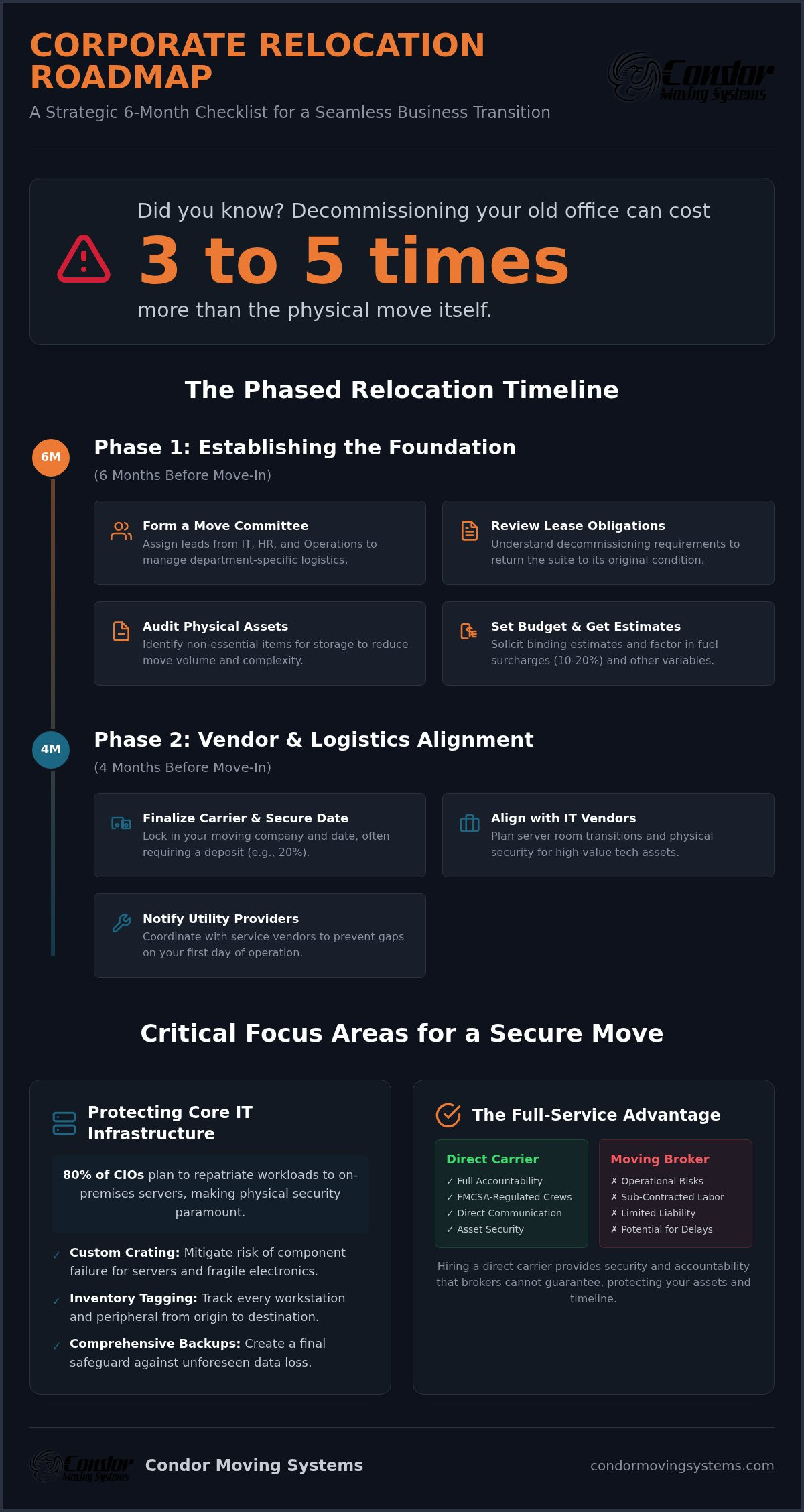
A commercial relocation requires a disciplined six-month lead time to prevent operational paralysis. While residential moves might wrap up in weeks, the complexity of a business transition demands a longer window to navigate commercial lease restoration requirements and technical infrastructure shifts without rushing critical decisions. Every item on your office moving checklist should start with a thorough review of your current lease obligations. Most agreements require the suite to be returned to its original condition. These decommissioning costs, which include removing cabling and furniture disposal, can often be three to five times more expensive than the physical move itself.
Successful moves are rarely the work of a single individual. You should form an internal Move Committee early, assigning department leads from IT, HR, and Operations. These leads take ownership of department-specific logistics, such as sensitive file handling or server downtime schedules, ensuring that workflows remain intact. When setting your preliminary budget, account for variables beyond basic labor. In the current market, fuel surcharges typically range between 10% and 20%. You must also factor in specialized services like custom crating for high-value electronics to ensure full protection of your assets. A structured approach to office move project management is essential for keeping every department aligned and on schedule throughout this process.
Phase 1: Establishing the Foundation (6 Months Out)
Start with a comprehensive audit of your physical assets to identify non-essential items that can be moved into short or long-term storage. This reduces the active move volume and simplifies the transition. You should also review the floor plans of your new space to determine furniture placement before the move begins. During this phase, solicit binding estimates from a licensed Moving company. A binding estimate from a full-service carrier like Condor Moving Systems provides a fixed price based on a documented inventory, which is essential for corporate financial planning.
Phase 2: Vendor and Logistics Alignment (4 Months Out)
Four months before your target date, you must finalize your choice of carrier and secure the move date. Condor Moving Systems requires a 20% non-refundable deposit to lock your relocation into the professional schedule. This is also the critical window for aligning with IT vendors to plan server room transitions. With 80% of CIOs currently planning to repatriate workloads from public cloud platforms to on-premises infrastructure, the physical security of your servers is paramount. If you are coordinating with local movers in Texas for a Dallas or Houston relocation, notify your utility providers and service vendors now to prevent any service gaps on your first day of operation.
Managing High-Value Assets: IT Infrastructure & Inventory Logistics
Protecting your physical data and hardware is the most technically demanding phase of any relocation. IT logistics involves the specialized handling of servers, rack-mounted equipment, and networking hardware that form the backbone of your operations. With 80% of CIOs planning to move workloads back to on-premises infrastructure in 2026, the physical transport of servers has become a high-stakes operation. A robust office moving checklist must prioritize packing services for fragile items such as custom crating for these fragile electronics to mitigate the risk of internal component failure during transit.
Transparency regarding liability is essential for a secure move. Many businesses opt for “Pack by Owner” (PBO) to save on labor, but it’s vital to understand that PBO items typically lack valuation coverage unless there’s visible damage to the exterior of the box. To ensure full accountability, we utilize a personalized inventory tagging system. This allows our crews to track every workstation from its origin to its precise destination in the new suite, preventing the loss of peripherals or docking stations. If you’re concerned about the safety of your high-value assets, you can request a detailed estimate for professional packing services.
Server Room and Data Migration
Before any hardware is disconnected, your IT team must create a comprehensive backup of all business data. This redundancy is your final safeguard against unforeseen technical issues. Relocating rack-mounted equipment and UPS systems requires specialized handling and, in many cases, climate-controlled storage to maintain hardware integrity. Integrating these steps into your office moving checklist ensures that your technical infrastructure remains operational throughout the transition. For more project management insights, pair a strategic business move checklist with Condor’s office movers to align your vendor coordination.
Workstation Decommissioning
Clear communication with your staff is necessary to standardize the decommissioning process. Employees should be instructed to clear all personal items from their desks; however, they must take responsibility for jewelry, cash, and plants as these are not covered by carrier liability. Standardizing the packing of monitors and peripherals ensures that every workstation is handled with the same level of care. We recommend a strict labeling protocol. This allows our team to reconnect hardware efficiently, ensuring your staff enjoys full workstation functionality on day one without hunting for missing cables or docking stations.
The Full-Service Advantage: Carrier vs. Broker Accountability
Choosing the right partner is a critical decision that belongs at the top of your office moving checklist. Many organizations mistakenly hire a broker, believing they’re working directly with a moving company. A broker is essentially a sales entity that sells your contract to the highest bidder; they own no trucks and employ no movers. This creates a dangerous gap in accountability, especially when you’re handling sensitive corporate data or expensive infrastructure. In contrast, Condor Moving Systems operates as a full-service carrier. We take full ownership of your relocation from the initial 20% deposit to the final delivery. For smaller organizations navigating these same risks, understanding the distinction between brokers and direct carriers is equally critical, as outlined in our guide to small business moving services for 2026.
Verification is your first line of defense against logistical failure. You should always verify that your mover holds a valid USDOT number and TXDMV license. Condor Moving Systems (USDOT 1126171) is a licensed, full-service carrier, meaning we adhere to the highest operational standards in Texas. Dealing with a direct carrier ensures that the team planning your move is the same team executing it. This eliminates the risk of “shuttle service” delays where your assets are transferred between multiple trucks, a common practice among brokers that increases the likelihood of damage. Federal and military personnel face even stricter documentation requirements in this area, which is why understanding compliant government employee relocation services is essential for ensuring GSA-regulated moves are handled by a licensed direct carrier.
Why Direct Crews Matter for Business Security
Accountability is the primary benefit of working with direct crews. You maintain one point of contact throughout the entire process, ensuring clear communication. Our direct crews are trained on our personalized inventory tagging system, which prevents the confusion that occurs when outsourced laborers handle complex office setups. Consistency in personnel means that the professionals who pack your server room are the same ones who unload it, providing a level of reliability that brokered loads simply cannot match. This continuity is essential for maintaining the security of your high-value assets during long-distance moves.
Commercial Valuation and Liability
It’s vital to understand that standard coverage in the moving industry is “valuation,” not “insurance.” Federal law requires movers to provide Released Value Protection, which covers your items at $0.60 per pound. For high-value office electronics, this may be insufficient, so we recommend considering Third-Party Full Value Replacement for comprehensive protection. To understand exactly how these federal valuation regulations apply to your most delicate assets, our guide on professional packing services for fragile items explains the critical differences between standard soft-pack layering and specialized custom crating. If a discrepancy occurs, written claims must be filed within nine months via Anthem Claim Management. To ensure an accurate estimate and avoid unexpected long-carry or stair fees, you must provide a full inventory disclosure during the planning phase. Remember that we cannot accept cash or personal checks at delivery; only Zelle, cashier’s checks, or money orders are accepted for the final balance.
The Master Office Moving Checklist: Phase-by-Phase Execution
Transitioning from strategy to physical execution requires a high level of operational discipline. As you reach the final stages of your office moving checklist, your focus must shift to the immediate logistics of the move week. You should expect a delivery notification call 24 to 48 hours before the crew arrives. This is the time to finalize your inventory list; any last-minute additions must be documented to ensure the binding estimate remains accurate and to avoid complications during loading. Maintaining this level of precision prevents the “hidden costs” that often plague poorly planned relocations. For organizations managing large teams across multiple departments, a dedicated office move project management strategy can provide the structured accountability needed to keep every phase on track.
Strict adherence to safety protocols is mandatory for a successful transition. We don’t accept certain items on our trucks for liability and safety reasons. You must ensure that no hazardous materials, plants, or cash are included in your packed goods. Additionally, jewelry and high-value personal items should remain with the owner. It’s also a firm policy that trash bags are never used as packing material; items must be properly boxed or crated to prevent damage and ensure stability during transport. This protective measure is a standard operational requirement that distinguishes professional carriers from casual laborers.
The Week Before the Move
Conduct a final walkthrough of your current facility, paying close attention to often-overlooked areas like attics, basements, or storage closets. It’s your responsibility to ensure the space is entirely cleared. During this week, distribute new keys, keycards, or RFID access codes to your staff so they can access the new office on day one. You should also confirm any specific re-assembly needs with your move coordinator. While our crews handle the disassembly and re-assembly of standard office furniture, having a clear plan for complex workstations prevents day-one delays.
Move Day: On-Site Management
On move day, you must designate an on-site lead to supervise the loading process and sign the inventory sheets. This individual will also manage the Bill of Lading, which is the official contract for the transportation of your goods. If the moving truck cannot park within 150 feet of the office entrance, a long-carry service fee will apply, so clear the loading zone in advance. Finally, prepare for payment logistics. The 50% balance is due at the time of delivery. We don’t accept cash or personal checks; you must have a cashier’s check, money order, or be ready to pay via Zelle to complete the transaction.
Post-Move Continuity: Ensuring a Seamless Day One
The completion of the physical move marks the beginning of the operational transition. A strategic approach to unpacking is the final, vital component of your office moving checklist. You should prioritize common areas such as the reception desk, conference rooms, and break areas first. This establishes an immediate sense of normalcy and organization for the entire staff. Once communal spaces are functional, shift your attention to individual workstations to restore full employee productivity. This structured approach prevents the chaotic environment that often follows a large-scale relocation.
Testing network stability and workstation functionality should happen immediately after the equipment is positioned. Since your IT infrastructure was handled through specialized logistics, this phase serves as a validation of connectivity. If any service issues arise during the transition, you must file a report within the 72-hour window following delivery. This protocol ensures total accountability and allows our team to address discrepancies with the same precision applied to the move itself. Clear communication with your staff during this orientation phase helps them navigate the new layout and local amenities with confidence.
Settling into the New Office
While we handle the heavy lifting, coordinating debris and packing material removal remains a customer responsibility. You should conduct a thorough post-move audit of all inventory items using the personalized tagging system established during the planning phase. This ensures that every asset is present and undamaged before you finalize your internal records. Don’t forget to update your business address on all digital platforms; this includes your website, social media profiles, and marketing materials to maintain seamless client communication.
Partnering with Condor for Long-Term Success
Relocation often reveals the need for additional space or specialized handling. You can utilize our climate-controlled storage facilities for archived files or surplus furniture that isn’t required in the new layout. Our team is also equipped to handle specialty moves for high-value items like pianos or fine art, ensuring they receive the same direct-carrier care as your office equipment. If you’re planning a future transition within the region, Explore our local moving services in Texas to maintain a consistent standard of reliability.
Securing Your Corporate Future through Strategic Relocation
Executing a successful move requires more than just physical labor; it demands a disciplined strategy and a commitment to direct accountability. By establishing a six-month lead time and following a rigorous office moving checklist, you can mitigate the risks of data loss and excessive decommissioning costs. It’s vital to choose a direct carrier rather than a broker to ensure your sensitive IT infrastructure remains under the protection of a single, professional team throughout the transition.
Condor Moving Systems offers over 20 years of Texas commercial moving experience. We’re a licensed, FMCSA-regulated carrier, providing the operational integrity your business deserves. Our direct crews handle every detail, from custom crating to personalized inventory tagging, so you can focus on your core operations without the stress of logistical ambiguity.
Your relocation is a significant milestone for your organization’s growth. We’re ready to provide the reliable, professional support you need to ensure this next chapter begins with total peace of mind.
Frequently Asked Questions
How far in advance should we book office moving companies?
You should ideally begin the booking process six months in advance to secure your preferred date and ensure business continuity. For commercial relocations in major Texas hubs like Dallas or Houston, high demand for professional carriers makes early planning essential. Secure your date with a 20% non-refundable deposit to lock in your move. This lead time allows you to finalize your office moving checklist and coordinate with IT vendors without rushing.
What is the difference between a moving broker and a full-service carrier like Condor?
A moving broker is a sales entity that sells your contract to third-party movers, while a full-service carrier like Condor Moving Systems owns the trucks and employs the crews. We manage the entire process directly, providing a single point of accountability from pickup to delivery. This direct-handling model eliminates the communication gaps and shuttle service delays common with brokered loads, ensuring your corporate assets are handled by licensed, FMCSA-regulated professionals.
Are office moving companies responsible for packing our employees’ personal desks?
Employees are typically responsible for clearing their own personal items from their desks before the moving crew arrives. While we provide professional packing and custom crating for organization-owned assets, items like jewelry, cash, and plants are prohibited on our trucks. It is a standard operational requirement that staff take personal responsibility for these high-value or perishable items, as they are not covered under standard carrier valuation or liability.
Can we use credit cards to pay the final balance on the day of delivery?
No, credit cards are not accepted for the final 50% balance due at the time of delivery. To complete your transaction, you must provide payment via cashier’s check, money order, or Zelle. While credit cards can be used for the initial deposit and pickup payment with a 3% fee, federal regulations and our internal security protocols prohibit card payments, cash, or personal checks at the final destination to ensure secure funds.
What items are prohibited from being moved in a commercial relocation?
Prohibited items include hazardous materials such as paint, chemicals, and propane, as well as firearms, ammunition, and perishable food. We also don’t move plants, jewelry, cash, or sensitive legal documents like deeds and securities. Additionally, we have a strict prohibition against using trash bags as packing material. Ensuring these items are excluded from your office moving checklist is essential for maintaining safety and compliance with federal transportation regulations during your transition.
How do we handle the moving of sensitive IT equipment and servers?
Sensitive IT equipment requires specialized handling and custom crating to protect against internal component damage. Before the move begins, your internal team must perform a comprehensive data backup to ensure redundancy. Our crews utilize a personalized inventory tagging system to track every server and workstation from origin to destination. If your new suite isn’t ready, we offer climate-controlled storage solutions to protect your hardware from temperature fluctuations and humidity.
Is there a specific protocol for filing a claim if an office item is damaged?
You must first note any visible damage on the Bill of Lading at the time of delivery. Following this, you have nine months to file a formal written claim through Anthem Claim Management. For general service issues, we require a report within a 72-hour window. Please remember that owner-packed items are not covered for internal damage unless the exterior of the box shows clear signs of mishandling by the professional crew.
Does Condor Moving Systems provide storage solutions if our new office isn’t ready?
Yes, we provide secure, climate-controlled storage solutions for both short-term and long-term needs. This is an ideal solution for businesses in Dallas or Austin whose new office space isn’t ready for immediate occupancy. Storage is billed at a rate of $0.50 per cubic foot per month. This allows you to keep surplus furniture or archived files in a protected environment until your new facility is fully prepared for final setup and installation.