



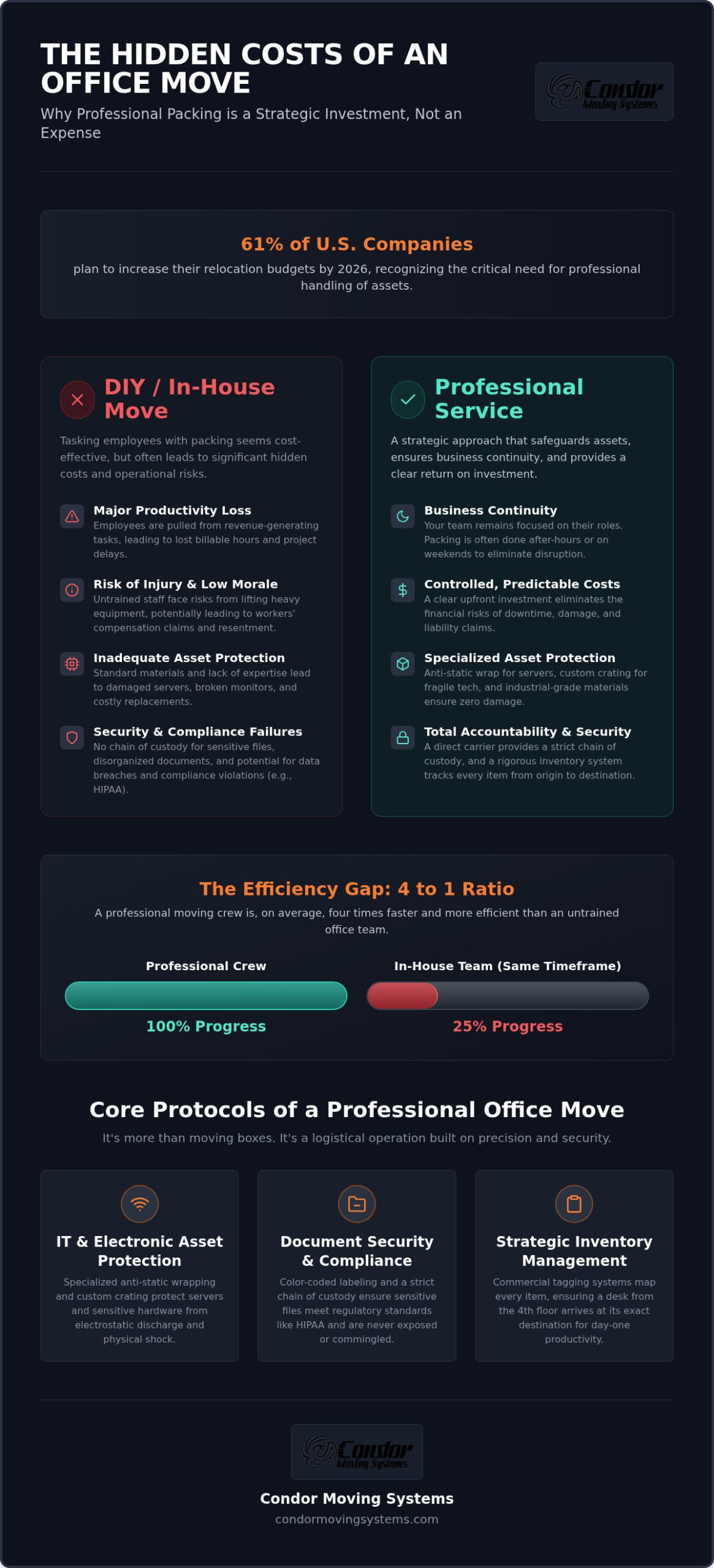
With 61% of U.S. companies planning to increase their relocation budgets in 2026, the stakes for a successful move have never been higher. Most executives view a relocation as a simple change of address, but the reality is that your transition’s success depends entirely on the physical integrity of your equipment and data. Utilizing professional office packing services is no longer just a convenience; it’s a fundamental strategy for maintaining business continuity. You’ve likely felt the weight of responsibility that comes with moving sensitive IT infrastructure and proprietary files, worrying that a single misplaced crate or a damaged server could lead to days of expensive, unplanned downtime.
We understand that the anxiety over disorganized boxes and the high cost of employee distraction are significant barriers to your company’s growth. This article demonstrates how a disciplined approach to packing eliminates these risks by securing high-value assets and implementing a rigorous inventory system. We’ll explore the specific protocols used to protect fragile hardware and the logistical workflows that ensure a seamless, zero-damage relocation for a productive first day in your new headquarters.
Key Takeaways
- Learn why specialized office packing services focus on protecting mission-critical hardware and confidential data rather than just moving boxes.
- Uncover the hidden financial impact of employee downtime and the insurance limitations that often accompany self-packed office equipment.
- Explore how professional inventory tagging systems and custom crating provide a clear roadmap for day-one productivity in your new workspace.
- Discover why choosing a direct carrier instead of a broker is the most effective way to maintain strict chain-of-custody over your company’s physical assets.
Why Specialized Office Packing Services Differ from Residential Moving
While residential moving focuses on the safe transport of personal effects, a professional relocation service for a business operates under a completely different risk profile. Your office isn’t just a collection of furniture; it’s a hub of mission-critical assets, proprietary data, and specialized hardware. If a residential mover breaks a lamp, it’s an inconvenience. If a server is mishandled during an office move, it can paralyze your entire operation. Specialized office packing services address these risks through rigorous security protocols and industrial-grade inventory management.
We use commercial tagging systems designed for multi-floor relocations. Every item is tracked using a proprietary system that ensures a desk in Department A on the 4th floor ends up exactly where it belongs in the new facility. A residential move typically focuses on filling a single truck, but a commercial relocation involves a coordinated logistics plan that accounts for elevators, loading docks, and strict building management rules. Our crews work around your business hours, often performing the bulk of the work during evenings or weekends to minimize workplace disruption. This methodical approach ensures that your staff leaves the old office on Friday and returns to a functional workspace on Monday.
IT and Electronic Asset Protection
Standard bubble wrap isn’t enough for modern infrastructure. We utilize specialized anti-static wrapping for servers and workstations to prevent electrostatic discharge, which can silently destroy internal components. Our packing process includes detailed cable management and peripheral organization. Disorganized cables are one of the leading causes of day-one delays; our team ensures every workstation is ready for immediate reconnection by labeling and bagging every connector with its parent device. For high-value or fragile technology like 3D printers or large-scale plotters, we provide custom crating solutions built to the exact specifications of the equipment.
Document Security and Compliance
Data security is a primary concern for legal and medical offices where HIPAA or other regulatory standards apply. We maintain a strict chain of custody for all sensitive files throughout the packing process. Our background-checked crews use color-coded labeling to organize documents by department, ensuring that private information is never commingled or exposed. Professional office packing services provide the structured environment necessary to meet audit requirements, giving you total accountability from the moment a file leaves the cabinet until it’s secured at the new destination.
Comparing Office Packing Companies: DIY vs. Professional Services
Many business owners assume that tasking employees with packing their own desks will save on relocation expenses. However, this approach often yields hidden costs that far outweigh the initial savings. Professional office packing services operate with a level of speed and precision that untrained staff simply cannot match. On average, a professional crew outpaces a standard office team by a 4-to-1 ratio. This efficiency isn’t just about speed; it’s about specialized training in commercial logistics. While your staff might struggle with finding appropriate materials or securing fragile monitors, professionals execute a proven workflow that keeps the project on schedule.
Keeping your team focused on revenue-generating tasks is essential for business continuity. Every hour a developer or project manager spends wrapping peripherals is an hour of lost productivity. By delegating these tasks, you ensure that your most valuable human resources remain dedicated to their primary roles. If you’re planning a move, you can request a detailed estimate to see how professional handling compares to your internal labor costs.
The True Cost of Employee Downtime
The financial impact of a DIY move extends beyond lost billable hours. There’s a significant risk of workplace injuries when non-professionals attempt to lift heavy filing cabinets or maneuver awkward ergonomic equipment. These incidents can lead to workers’ compensation claims and long-term staffing gaps. Additionally, forcing employees into manual labor roles often creates a negative morale impact. Staff members frequently resent being pulled away from their professional duties to handle dusty storage rooms or heavy lifting; this can lead to friction during an already stressful transition.
Liability and Valuation Coverage
One of the most overlooked risks of DIY packing is the impact on insurance. In the moving industry, items labeled as ‘Packed by Owner’ (PBO) are rarely covered for internal damage during transit. If a server fails to boot after the move because it was improperly cushioned by an employee, the carrier is typically not liable. Professional office packing services provide the necessary documentation and packing standards to support high-value transit claims. It’s vital to understand the two primary types of coverage:
- Released Value Protection: This is the basic option, providing minimal coverage based on the weight of the item.
- Full Value Replacement: This provides comprehensive protection, ensuring that the carrier is responsible for the replacement value of lost or damaged items.
To better understand your rights and the regulations governing these protections, you should review the resources provided by the FMCSA to Protect Your Move. In a commercial setting, most carriers require service issues to be reported within a 72-hour window, making organized, professional packing even more critical for a quick inventory audit.
Strategic Inventory Management and Custom Crating Solutions
Effective inventory management is the foundation of any successful corporate relocation. At Condor Moving Systems, we utilize a proprietary inventory tagging and tracking system that goes far beyond simple box counts. Every asset is categorized and labeled according to its specific destination in your new floor plan, ensuring that day-one productivity is never compromised by lost files or misplaced equipment. This methodical approach is a core component of comprehensive Business Continuity Planning, as it allows your leadership team to account for every piece of company property throughout the transition. Our background-checked crews manage the entire process, maintaining a strict chain of custody that protects your operational integrity.
Commercial buildings often present logistical hurdles that residential movers aren’t equipped to handle. Long-carry distances from the office suite to the loading dock or the necessity of using stairs when freight elevators are unavailable require specific labor allocations. We assess these facility-specific challenges during the initial planning phase to ensure our office packing services include the necessary resources to keep the move on schedule. By identifying these variables early, we prevent the “hidden” delays that often plague poorly planned commercial moves.
The Science of Custom Crating
Standard cardboard boxes are insufficient for high-value or oversized business assets. When your inventory includes glass conference tables, fine art, or specialized laboratory equipment, custom crating becomes essential. We build crates to the exact dimensions of your items, using industrial-grade materials to provide maximum transit security. This is particularly critical for oversized monitors and server racks where traditional packing materials cannot provide adequate structural support. For a deeper look at how we handle these sensitive items, refer to our Professional Fragile Item Packing: 2026 Protection Guide.
Storage-in-Transit (SIT) for Businesses
Office renovations or staggered lease dates often require temporary holding solutions. We provide climate-controlled storage units specifically designed for sensitive electronics and paper archives that are vulnerable to temperature fluctuations. Unlike standard self-storage, our office packing services integrate seamlessly with our Storage-in-Transit (SIT) options. We offer monthly pro-rated billing to provide maximum corporate flexibility, allowing you to scale your storage needs based on your project’s timeline. Our facilities meet high security standards, ensuring your assets remain protected until your new workspace is ready for occupancy.
How to Prepare Your Team for the Office Packing Crew
Preparing your internal team for a relocation is as critical as the physical labor itself. A successful transition requires clear communication and a proactive approach to decluttering. Before our office packing services team arrives, we recommend a thorough audit of your current inventory. This is the ideal time to shred outdated sensitive documents, donate furniture that won’t fit the new floor plan, and keep only what’s essential for future operations. By reducing the volume of items to be moved, you streamline the entire process and lower your overall logistical footprint.
Direct communication with department heads and stakeholders is vital for maintaining a predictable timeline. Everyone should understand their specific roles and the deadlines for clearing out communal spaces. Additionally, you must coordinate with building management at both your current and future locations. Most commercial properties in 2026 require a Certificate of Insurance (COI) and strictly reserved times for loading dock and freight elevator access. Securing these windows early prevents costly delays and ensures our background-checked crews can operate efficiently without obstructing other tenants.
Creating an Office Packing Map
A clear organizational strategy prevents the chaos often associated with the first day in a new facility. We suggest creating a detailed office packing map that defines specific zones in the new headquarters for immediate box placement. Establish labeling protocols that distinguish between personal items and communal supplies. This ensures that every crate is delivered to the correct department, allowing your staff to resume work immediately. For a step-by-step breakdown of these tasks, you can consult our 2026 Office Moving Checklist: Strategic Relocation Guide.
Handling Prohibited and Sensitive Items
Safety and accountability are our top priorities, which is why we enforce a strict “No Trash Bag” rule. All items must be secured in professional-grade boxes or crates to prevent damage and ensure stable stacking during transit. It’s also essential to identify “Non-Allowable” items that our crews cannot legally or safely handle. These include:
- Financial and Legal Documents: Cash, deeds, stocks, and bonds.
- Personal Valuables: Jewelry and high-value personal collections.
- Hazardous Materials: Flammable cleaners, pressurized cans, and chemicals.
Employees should take full responsibility for their personal belongings and high-value small electronics, such as tablets or personal cameras. By keeping these items in their possession, you maintain a clear chain of custody and avoid potential liability issues for the business. For employees managing their own kitchen items during a combined office and residential transition, following professional guidance on how to pack dishes for moving can prevent breakage of fragile personal items that staff transport themselves.
Direct Carrier vs. Broker: Why Accountability Matters for Office Packing
Choosing between a direct carrier and a broker is the most consequential decision in your relocation strategy. A moving broker acts as a middleman, selling your contract to the highest bidder without ever touching your equipment. For corporate clients, this model introduces unacceptable risks to data security and asset protection. When you hire office packing services from a broker, you lose the ability to verify the background of the crew entering your facility. Condor Moving Systems operates as a full-service carrier, ensuring that every individual handling your mission-critical hardware is a background-checked member of our own team.
Accountability starts with verifiable credentials. We maintain total transparency with our licensing, holding USDOT 1126171 and TXDMV 006338906C certifications. These aren’t just numbers; they represent our commitment to federal and state compliance. Our direct-crew model allows us to provide binding estimates, which are essential for corporate budgeting. Unlike brokers who may offer low-ball estimates only for the third-party mover to demand more at the loading dock, we provide a guaranteed flat-rate quote that reflects the true scope of your project.
Full-Service Accountability in Texas
Our localized expertise allows us to provide superior Local Moving Services in Texas across major hubs like Dallas, Houston, Austin, and San Antonio. We understand the specific logistical requirements of these metropolitan areas, from navigating downtown loading zones to meeting the insurance requirements of Class A office buildings. As a Pinnacle Mover certified carrier and a member of the Southwest Movers Association, we adhere to the highest ethical and operational standards in the industry. This level of certification provides an extra layer of security for businesses that require total reliability.
The Condor Difference: 20+ Years of Corporate Excellence
Since 2003, we’ve built our reputation on direct handling from origin to destination. We don’t outsource our labor or our responsibility. This ownership of the entire process allows us to offer 24-hour emergency customer service, giving you a direct line of communication for logistical peace of mind throughout the move. We manage every detail, ensuring that your transition to a new office is handled with the precision that only two decades of experience can provide. If you’re ready to secure your business continuity with a trusted partner, contact us today for a free, no-obligation commercial estimate.
Securing Your Corporate Future through Strategic Relocation
A successful office move in 2026 requires more than just logistical coordination. It demands a rigorous commitment to business continuity and asset protection. By prioritizing specialized office packing services, you eliminate the hidden costs of employee downtime and ensure that your mission-critical IT infrastructure is handled with technical precision. We’ve explored how professional inventory systems and custom crating are essential for maintaining productivity from day one in your new headquarters.
Choosing a direct carrier over a broker is the only way to maintain a strict chain of custody and total operational accountability. As a Pinnacle Mover Certified carrier (USDOT 1126171), Condor Moving Systems provides the stability and expertise necessary for a seamless transition. We don’t outsource our responsibility. Our own background-checked crews manage every aspect of your relocation, from the initial inventory tagging to the final placement of your sensitive data assets. This direct-handling model ensures that your security protocols remain intact throughout the entire transit process.
Your new workspace represents a significant opportunity for company growth and renewed collaboration. We’re here to ensure you arrive there ready to work without the setbacks of damaged equipment or lost files. Trust our experience to turn a complex logistical challenge into a streamlined success.
Frequently Asked Questions
Are office packing services worth the cost for small businesses?
Professional office packing services are a vital investment for small businesses because they eliminate the risk of employee injury and maximize billable hours. While the upfront cost is a consideration, the protection of expensive technology and the speed of professional execution prevent the costly downtime associated with disorganized DIY moves. In Texas cities like Plano and Irving, local businesses rely on these services to ensure their staff remains focused on revenue-generating tasks.
How long does it typically take to pack a 5,000-square-foot office?
Packing a 5,000-square-foot office typically requires one to two full business days, depending on the density of workstations and the volume of specialized equipment. A professional crew works systematically through defined zones to maintain organization. For businesses in the Dallas or Austin areas, scheduling these services during off-peak hours can further streamline the process. Factors like the number of server racks and the need for custom crating will influence the final timeline.
What items are office movers prohibited from packing and transporting?
We are prohibited from packing or transporting items that pose safety risks or have extreme financial value. This includes hazardous materials like flammable cleaners and propane, as well as perishable foods and live plants. Additionally, our crews cannot handle cash, deeds, jewelry, or securities. We advise our clients in Houston and San Antonio to transport these sensitive items personally to maintain a secure chain of custody throughout the entire relocation process.
Do professional office packing services include unpacking at the new location?
Yes, we offer both full and partial unpacking services to help your business resume operations as quickly as possible. Our team can assist with the organized placement of communal supplies and the setup of workstations in your new facility. This service is particularly beneficial for large-scale moves in Fort Worth or Arlington, where a quick transition is essential for maintaining client service standards and internal workflow efficiency during the transition.
How does a moving carrier differ from a moving broker for office relocations?
A moving carrier like Condor Moving Systems owns its trucks and employs its own background-checked crews, providing direct accountability for your assets. In contrast, a broker is a middleman that sells your contract to third-party movers. For office relocations in Texas, hiring a direct carrier ensures consistent data security and fixed pricing. Brokers often lack control over the final service quality, which can lead to complications with valuation and inventory management.
Does professional packing cover the loss of digital data or mechanical failure?
No, standard valuation and professional packing do not cover the loss of digital data or internal mechanical and electrical failure. Our liability is limited to the physical integrity of the items we handle. We strongly recommend that businesses in the McKinney and Frisco areas perform full data backups before the move begins. While we use specialized anti-static wrap to protect hardware, the functional integrity of software and internal circuits remains the owner’s responsibility.
Can I pay for my office move with a corporate credit card at delivery?
No, we don’t accept corporate credit cards, personal checks, or cash at the time of delivery. The final balance must be paid using a cashier’s check, money order, or Zelle. While you can use a credit card for your initial deposit or at the time of pickup, subject to a 3% fee, delivery payments are strictly limited to these secure methods. This policy ensures a transparent and documented financial transaction for all our commercial clients.
How do office packing services handle high-value IT equipment and servers?
We handle high-value IT equipment using industrial-grade anti-static wrapping and custom crating for oversized or fragile components. Each workstation’s peripherals are bagged and labeled to ensure a seamless setup at the new destination. For complex server environments in tech hubs like Austin or Dallas, our methodical approach prevents the physical damage and cable confusion that often leads to extended downtime. We prioritize the security of your hardware through every stage of transit. The same disciplined vertical-packing principles that professionals use when learning how to pack dishes for moving apply broadly to fragile items of all kinds, reinforcing why trained crews consistently outperform DIY efforts.