


The most common way people stack their dinnerware is actually the most dangerous method for a moving truck. While it feels natural to pile plates high, professional standards dictate that verticality is the only way to ensure structural integrity during transit. Learning how to pack dishes for moving correctly means abandoning the flat-stacking habit that puts your fragile items at risk. Stacking dishes flat creates a pressure point at the center of the stack that often leads to cracks when the truck hits a single bump.
We understand that moving your kitchen is often the most stressful part of a relocation. You’ve likely spent years collecting fine china or heirloom sets, and the thought of unwrapping a box only to hear the rattle of broken porcelain is enough to cause immediate anxiety. If you want to avoid the heartbreak of lost heirlooms, you must adopt a disciplined approach to packing. This guide will show you how to master the same high-level techniques employed by our expert crews to guarantee a damage-free arrival. We cover the edge-on stacking method, the multi-layer protection strategies that meet 2026 professional standards, and the specific box types that provide the security your kitchenware deserves.
Key Takeaways
- Utilize professional-grade materials like double-walled dish barrels and unprinted newsprint to provide a structural foundation that standard boxes cannot match.
- Master the industry-standard technique of vertical loading, as placing plates on their edges is the most critical step in learning how to pack dishes for moving safely.
- Implement the “burrito” wrapping method for individual pieces and create dedicated “crush zones” at the top and bottom of each carton to absorb transit shocks.
- Secure every container using the H-tape sealing method and ensure boxes are “quiet” by eliminating internal movement with supplemental cushioning.
- Understand the liability implications of owner-packed items and when to leverage professional packing services for high-value or fragile heirloom collections.
Essential Supplies: Building a Foundation for Fragile Items
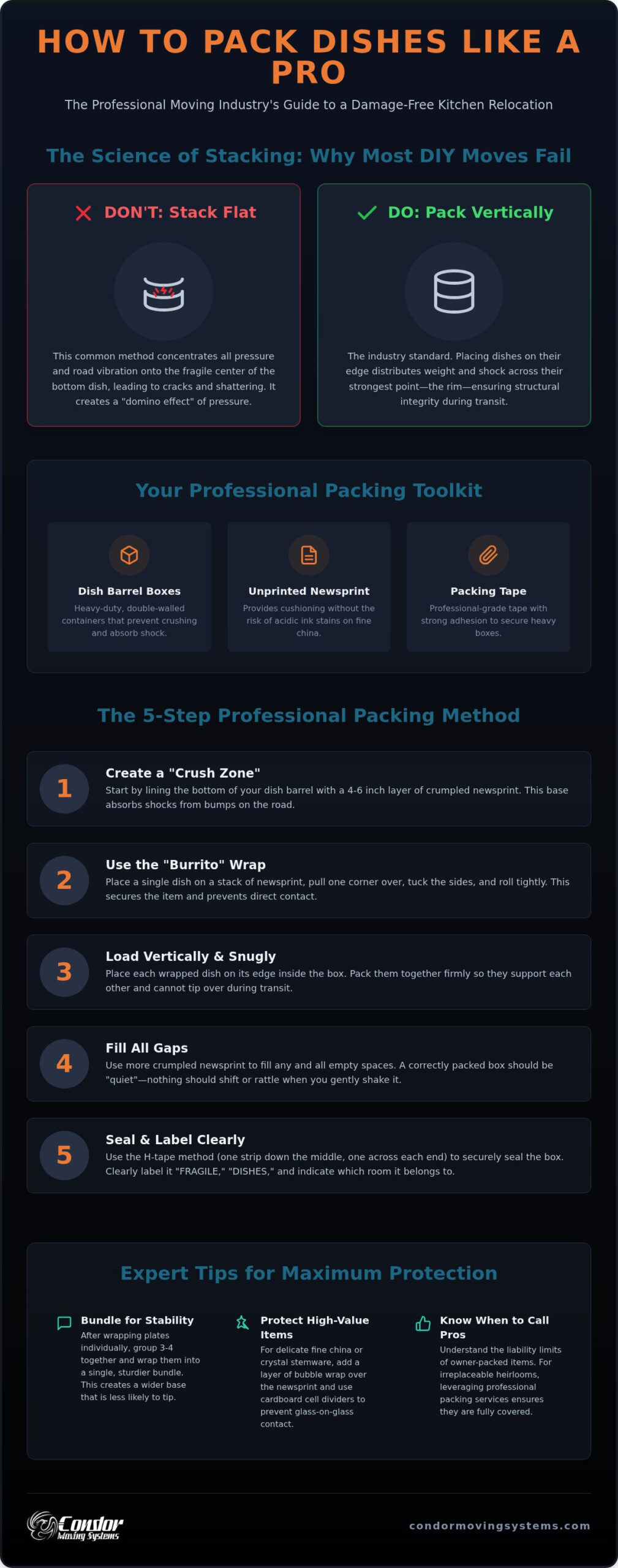
Successful relocation starts with professional-grade materials. If you’re researching how to pack dishes for moving, you’ll quickly find that standard recycled shipping cartons are insufficient. Expert movers rely on the “Dish Barrel” box, a heavy-duty, double-walled container specifically designed to withstand the vertical pressure of stacked ceramics. Standard single-wall boxes often collapse under the weight of a full dinner set, leading to catastrophic breakage during transport.
We maintain a strict policy against using trash bags for any part of the packing process. Beyond offering zero shock absorption, trash bags are easily mistaken for actual refuse, leading to accidental loss. Similarly, while household tape might seem convenient, it lacks the tensile strength to secure heavy kitchen cartons. Only professional-grade packing tape ensures the bottom of your box remains intact during the lifting and loading process.
One of the most common mistakes is using old newspapers for wrapping. The acidic ink used in newsprint can permanently stain fine china and porous ceramics, necessitating professional cleaning or causing permanent damage. We recommend unprinted newsprint, which provides the necessary friction and cushioning without the risk of ink transfer. For those looking for a streamlined start, professional moving kits containing these specific materials are available through our online inventory.
The Anatomy of a Dish Barrel Box
A true dish barrel features a double-walled corrugated construction that acts as a shock absorber. This extra layer of cardboard provides the structural integrity needed to prevent the box from crushing when other items are stacked on top in the moving truck. While it’s tempting to use large boxes for everything, smaller, heavy-duty boxes are often better for plates. They prevent over-packing and ensure the weight remains manageable for the crew, reducing the risk of accidental drops.
Choosing the Right Cushioning Materials
Professional packing requires a variety of textures to address different fragile needs. Unprinted newsprint is your primary tool for wrapping individual plates and bowls using the “burrito” method. For high-value stemware or delicate fine china, bubble wrap provides an additional layer of air-filled security. We also recommend using cardboard cell dividers for glasses and crystal. These inserts prevent glass-on-glass contact, which is the leading cause of “spiderweb” cracks during long-distance transit.
The Science of Vertical Packing: Why Plates Break
Understanding the physics of a moving truck is essential to learning how to pack dishes for moving without incident. Most people assume that stacking plates flat, as they sit in a kitchen cabinet, is the safest method. However, this horizontal orientation is the primary cause of breakage during transit. When plates are stacked flat, the weight of the entire set rests on the center of the bottom dish. This center point is the most vulnerable area of any ceramic or porcelain piece. During a move, road vibrations and unexpected bumps act as repetitive hammer blows to that central point, eventually causing it to snap.
Professional movers utilize vertical loading because the rim of a plate is its strongest structural element. By placing dishes on their edges, the weight is distributed across the strongest part of the material. We also employ the “bundle” technique to reinforce this stability. After wrapping each plate individually, wrap three or four together into a single, cohesive unit. This bundle creates a wider, sturdier base that is less likely to tip over inside the carton, ensuring your items remain in their safest orientation from origin to destination.
Why You Should Never Stack Plates Flat
Flat stacking creates a “domino effect” of pressure that increases with every item added to the pile. In a moving environment, the constant shifting of the truck makes horizontal stacks unstable. Vertical packing is the undisputed industry standard for protecting fragile kitchenware during transit. By using the “edge-on” technique, you ensure that any downward pressure from boxes stacked above is absorbed by the reinforced edges of your dishes rather than their delicate centers. If the technical requirements of secure packing feel overwhelming, you can always request a professional packing assessment to see how an expert crew would handle your specific inventory.
Creating a Protective Cushioning Base
A secure box requires more than just careful wrapping; it needs “crush zones” to absorb kinetic energy. We follow the three-inch rule: fill the bottom of every dish barrel with at least three inches of tightly crumpled unprinted newsprint. This layer acts as a shock absorber, isolating your dishes from the vibrations of the truck floor. You should test the “bounce” of your base by pressing down firmly; if the paper stays flat and doesn’t spring back, you need more material. A firm foundation prevents the weight of the dishes from compressing the bottom of the box, which is a common failure point in how to pack dishes for moving successfully. Remember to repeat this three-inch cushioning layer at the very top of the box before sealing to provide 360-degree protection.
Step-by-Step: Packing Plates, Bowls, and Fine China
Executing a damage-free move requires a transition from theoretical physics to disciplined, repetitive action. When you master how to pack dishes for moving, you’re essentially creating a custom suspension system for every item in your kitchen. This process demands patience, as every individual piece must be isolated from its neighbors to prevent the friction that leads to chips and hairline fractures. We recommend setting up a dedicated packing station at waist height to maintain focus and efficiency throughout the project.
The Plate Packing Process
Start with a clean, flat workspace. Place your stack of unprinted newsprint on the table and center a single dinner plate on the top sheet. Pull the corners of the paper toward the center of the plate, tucking them firmly to create a protective “burrito” wrap. Repeat this for three more plates of identical size. Once you have four individually wrapped plates, wrap them together into a single bundle using a double layer of paper. This grouping provides a wider base for the vertical stacking we discussed in the previous section. Place these bundles into the dish barrel on their edges. Never lay them flat on the bottom of the box, even if they’re heavily wrapped.
Safely Nesting Bowls and Saucers
Bowls require a different approach due to their hollow centers and varied depths. Wrap the first bowl completely, then place it right-side up. Take a second bowl, wrap it individually, and nest it inside the first. You must place a layer of crumpled paper between the two to prevent them from locking together under pressure. A critical step often missed by DIY movers is filling the hollow center of the top bowl with tightly packed paper. This internal support prevents the sides of the bowl from collapsing if the box is compressed. Because bowls are typically lighter than dinner plates, they should form the middle layer of your dish barrel, sitting atop the heavy plate bundles below.
Heirloom china and delicate crystal require an extra level of accountability. For these high-value items, we suggest double-wrapping: first with a layer of silk tissue or newsprint, followed by a layer of small-cell bubble wrap. This multi-textured approach provides both surface protection and impact resistance. For a deeper look at securing your most prized possessions, consult our Professional Fragile Item Packing: 2026 Protection Guide. By following these professional-grade standards, you ensure that even the most delicate porcelain arrives at your new home in pristine condition.
Securing the Box: Cushioning, Sealing, and Labeling
Once your dishes are vertically positioned and bundled, the final stage of security involves stabilizing the entire load. Mastering how to pack dishes for moving involves more than just wrapping; it requires ensuring the container itself functions as a rigid, protective shell. A “quiet” box is the hallmark of a professional pack. If you can hear any movement when the box is shifted, the items inside are at risk of colliding during transit. Every air pocket is a potential failure point that must be eliminated before the carton is loaded onto the truck.
Structural integrity depends heavily on your sealing technique. We exclusively use the H-tape method for all heavy kitchen cartons. This involves applying a long strip of professional-grade tape across the center seam of the box, followed by two perpendicular strips along the side edges. This creates an “H” pattern that reinforces the box’s weakest points and prevents the bottom from blowing out under the weight of ceramics. You must keep these cartons under 50 lbs to ensure safe handling. Overloaded boxes are difficult for crews to maneuver safely and are prone to structural failure when stacked in the truck’s tier.
The “No-Shake” Test
Fill every remaining void with tightly crumpled unprinted newsprint until the contents are immobile. Before you apply the final seal, perform a gentle shake test. If you feel the internal weight shifting or hear the rustle of porcelain, you have “voids” that need more paper. However, you must avoid overfilling. A bulging box creates an uneven surface that makes stable stacking impossible and puts unnecessary pressure on the items inside. Conversely, an underfilled box will collapse when another carton is placed on top of it, so aim for a flat, firm top surface.
Professional Labeling Standards
Clear communication is the final step in protecting your investment. Label at least two sides of the box with “Fragile” and “This Side Up” in bold markers. Our crews need to see these instructions regardless of how the box is positioned in the stack. Be specific with your room destinations. Instead of a generic “Kitchen” label, use “Kitchen – Heirloom China” or “Kitchen – Daily Plates.” This level of detail speeds up the unloading process and ensures high-priority boxes are handled with appropriate care. For a broader look at organizing your entire culinary space, see our How to Pack Your Kitchen: Professional 2026 Guide.
When to Call the Pros: Full-Service Packing and Valuation
While mastering how to pack dishes for moving can save on upfront costs, it significantly alters the liability landscape of your relocation. In the moving industry, items packed by the customer are designated as “PBO” (Packed by Owner). It’s a critical distinction because carriers generally don’t accept liability for the contents of PBO cartons unless the exterior of the box shows clear evidence of physical damage caused by the crew. If a dish breaks inside a perfectly intact box you packed yourself, the carrier is typically not responsible for the loss. This reality makes professional packing a strategic choice for high-value kitchenware and heirloom collections.
Choosing a full-service move with Condor Moving Systems ensures direct accountability. We are a carrier, not a broker, meaning our own licensed and background-checked crews handle your items from the moment they are wrapped until they are placed in your new kitchen. Since our inception in 2003, we’ve focused on maintaining operational integrity by keeping every stage of the process in-house. When our Pinnacle Mover certified crews perform the packing, you gain the peace of mind that comes with professional execution and expanded protection options.
Understanding Your Protection Options
There is a fundamental difference between valuation and insurance that every mover must understand. By federal law, moving companies provide Released Value Protection at no additional cost, which covers items at $0.60 per pound per item. For a delicate porcelain plate weighing one pound, this equates to only sixty cents of coverage regardless of its actual value. If you possess high-value sets, you should consider Full Value Replacement Coverage. This is often obtained through third-party providers or specialized policies. Professional packing is usually a prerequisite for these higher levels of protection, as it ensures the items were prepared according to industry-standard safety protocols.
The Condor Difference in Dallas and Beyond
Our specialty moving services extend beyond standard boxes. We provide custom crating for fine art, marble tabletops, and extremely fragile kitchenware that requires more than just a dish barrel. Because we operate our own fleet and crews, there is no ambiguity regarding who is responsible for your goods. This direct chain of command is essential for long-distance relocations where items might otherwise change hands multiple times. If you prefer to focus on your transition rather than the tedious details of wrapping every saucer, we can provide a comprehensive solution that manages the risk for you.
Get a free, no-obligation binding estimate for your professional move
Securing Your Kitchen for a Crack-Free Arrival
Mastering how to pack dishes for moving is a process of discipline and precision. By prioritizing double-walled dish barrels and adhering to the industry-standard vertical loading technique, you significantly reduce the risk of structural failure during transit. Remember that the “quiet” box is your ultimate goal; any internal movement suggests a vulnerability that doesn’t belong in a professional pack. Ensure every void is filled before the final seal is applied.
While DIY packing is a viable option for some, the liability benefits of professional service provide a level of security that owner-packed boxes cannot match. Condor Moving Systems has spent over 20 years refining these logistical processes as a licensed and FMCSA-regulated carrier. Our Pinnacle Mover certified crews take full ownership of your relocation, ensuring that every heirloom is handled with professional rigor. We focus on transparency and reliability so you can transition into your new home with total confidence.
You deserve the peace of mind that comes with expert handling. We look forward to helping you start your next chapter with a fully intact kitchen and a stress-free experience.
Frequently Asked Questions
Can I use clothes or towels to wrap my dishes instead of paper?
Using linens might seem like a convenient way to save on supplies, but it’s not recommended for a professional-grade relocation. Towels and clothes lack the uniform thickness and friction required to prevent dishes from shifting. Unprinted newsprint is the industry standard because it creates a tight, secure wrap that linens cannot replicate. Using soft goods often leads to over-packing and unbalanced weight distribution, which increases the likelihood of breakage during transit across Dallas or Fort Worth.
What is the best box for packing heavy kitchen plates?
The double-walled dish barrel is the only container you should use for heavy plates. These specialized boxes feature a thicker corrugated construction designed to absorb shocks and prevent the sides from collapsing under pressure. When learning how to pack dishes for moving, choosing the right vessel is as important as the wrapping itself. Standard single-wall boxes often fail when stacked in a moving truck, especially during long-distance hauls where vibrations are constant.
How many dishes should I put in one moving box?
You must prioritize weight over quantity, keeping every dish box under 50 pounds for safe handling. Typically, a standard dish barrel can hold two to three layers of bundled plates and bowls. Each layer must be separated by at least three inches of crumpled paper to provide a structural cushion. Over-packing a box makes it dangerous for the crew to lift and increases the internal pressure on your fragile items, leading to potential cracks.
Does standard moving valuation cover dishes I pack myself?
Standard Released Value Protection covers items at $0.60 per pound, but this coverage is limited for owner-packed (PBO) goods. Unless there is visible damage to the exterior of the box at the time of delivery, carriers generally don’t accept liability for broken contents inside a self-packed carton. Professional packing by our licensed crews ensures your items are eligible for broader protection and significantly reduces the risk of concealed damage claims during your Texas relocation.
How do I pack stemware and wine glasses without breaking them?
Stemware should be wrapped individually in newsprint and placed vertically in boxes with cardboard cell dividers. Never lay wine glasses flat. The stems are the most delicate part, so you must fill the bowl of the glass with crumpled paper to provide internal support. This technique ensures that road vibrations don’t cause the glass to shatter. For high-value crystal, we recommend custom crating to provide the highest level of security available.
What should I do with my “non-allowable” items like perishable food during the move?
Perishable food, plants, and hazardous materials are strictly prohibited in our moving trucks. You must dispose of or transport these “non-allowable” items yourself before the crew arrives. For residents in Plano or Frisco, we suggest donating unopened pantry goods to local food banks. This policy ensures the safety of the entire shipment and prevents issues with pests or odors during short-term or long-term storage in our climate-controlled facilities.
Is it worth paying for professional packing for a local move?
Professional packing is often worth the investment for local moves because it guarantees expertise and accountability. Even for a short trip within the Dallas-Fort Worth metroplex, road bumps can cause significant damage to poorly wrapped items. Our crews use specialized techniques for how to pack dishes for moving that save you days of tedious labor. Because we are a full-service mover and not a broker, you deal directly with our trained staff.
How far in advance should I start packing my kitchen?
You should begin packing non-essential kitchen items at least two to three weeks before your scheduled move date. The kitchen is typically the most time-consuming room to pack due to the sheer volume of fragile pieces. Start with seasonal items, fine china, and specialty appliances. Leaving the entire kitchen for the final few days often leads to rushed packing, which is the primary cause of damage during the relocation process.