



Imagine watching a truck pull away with your entire life packed inside, only to realize the representative you spoke with on the phone doesn’t actually work for the crew handling your furniture. For many homeowners, this is the moment they discover they hired a broker rather than a direct local moving co, leaving them with no clear point of contact when the final bill suddenly includes thousands in undisclosed fees. It’s a stressful realization that usually happens when you are at your most vulnerable.
We believe that accountability is the only foundation for a successful relocation, and you deserve a partner who takes full ownership of the process. This 2026 guide will teach you how to identify truly accountable movers and avoid the common pitfalls of hidden fees or damaged items with no recourse. We will provide a methodical breakdown of how to verify direct service providers, secure transparent estimates, and maintain the direct communication necessary for a damage-free move on your scheduled day.
Key Takeaways
- Identify the difference between direct carriers and brokers to ensure you have a single point of accountability for your entire relocation.
- Verify essential credentials like USDOT registration and state licensing to confirm your chosen local moving co operates within 2026 legal standards.
- Protect your budget by insisting on a binding estimate and a detailed inventory, which prevents common low-ball pricing traps and hidden fees.
- Understand why full value protection provides significantly more security than basic released value coverage for your household goods.
- Learn how professional standards from military and government relocations translate to higher reliability and care for residential moves.
The Accountability Gap: Why ‘Local Moving Co’ Search Results Can Be Deceptive
Accountability isn’t just a marketing buzzword; it’s the direct, unbreakable link between the professional who provides your quote and the crew that physically handles your furniture. When you search for a local moving co, the digital results you see are often prioritized by advertising spend rather than operational integrity. This creates a dangerous gap where homeowners believe they’re hiring a dedicated service provider, but they’re actually engaging with a lead-generation site. These platforms sell your contact details to the highest bidder, often resulting in a “low-ball” estimate designed to secure a deposit before a physical inventory is even conducted. True accountability requires a physical headquarters and a permanent, branded fleet that you can verify.
For a broader moving industry overview, it’s clear that the shift toward digital intermediaries has complicated the consumer’s ability to find a direct carrier. A company that owns its trucks and employs its staff is inherently more invested in the outcome of your move than a broker who simply passes the job to a third party. When a single entity manages the entire logistical chain, there’s no room for the “he-said, she-said” excuses that often follow a botched relocation.
Recognizing Red Flags in Local Moving Quotes
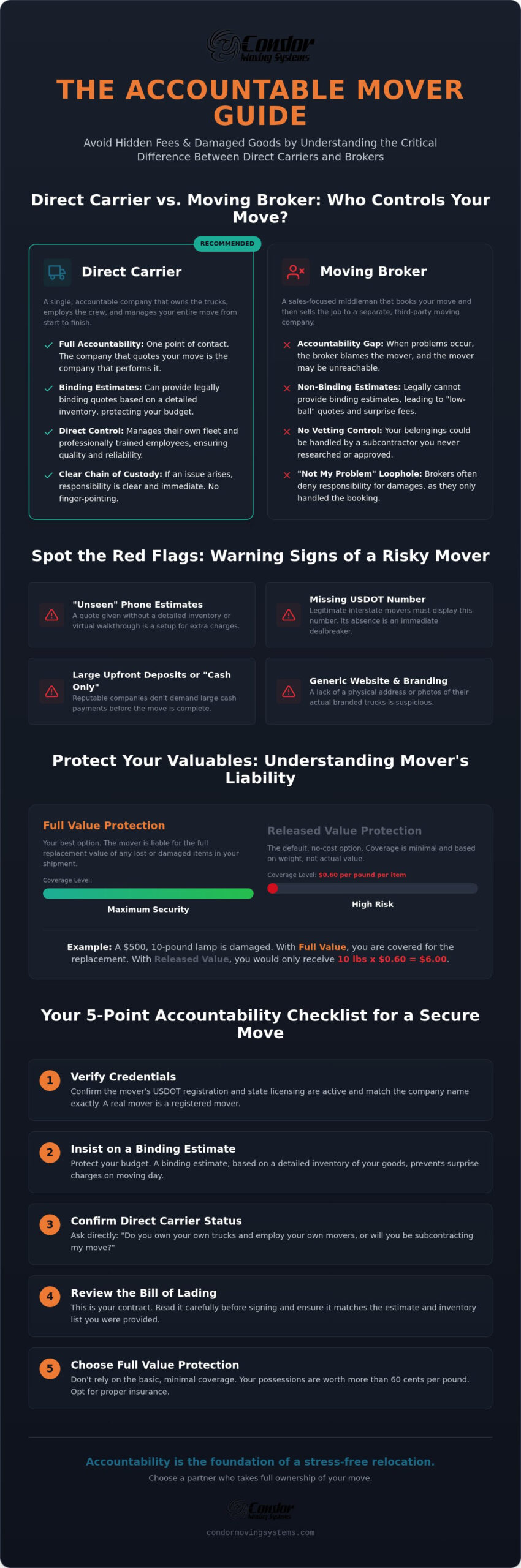
Pricing that seems too good to be true usually is. If a mover offers an “unseen” estimate over the phone without requesting a detailed inventory or a virtual walkthrough, they aren’t being thorough. It’s a major red flag that suggests they plan to add fees once the truck is loaded. Accountability also erodes when a mover lacks a USDOT number prominently displayed on their website; this is an immediate dealbreaker in 2026. You should also be wary of “cash only” demands or pricing schemes based on a “per-piece” count rather than hourly labor or weight. These tactics are frequently used by unlicensed entities to avoid the paper trail that protects you if items are damaged.
The Reality of the Local Moving Market in 2026
The digital marketplace has made it remarkably easy for unlicensed movers to appear professional. A polished website can easily hide a lack of insurance and proper equipment. While Yelp reviews offer some insight, they’re often manipulated by short-term marketing campaigns. You should prioritize checking local business registrations and USDOT status over star ratings alone. In 2026, the civil penalty for unlicensed moving activity has tripled in states like Oregon, rising to $3,000 per violation, which reflects the growing danger of these “ghost” companies. Choosing a local moving co based on their willingness to take full ownership of the process is the only way to ensure a stress-free transition. Accountability remains the most critical factor in protecting your assets and your peace of mind.
The Direct Carrier Advantage: Why Avoiding Brokers is Your Best Insurance
When you hire a local moving co, you expect the people you speak with on the phone to be the same people who carry your dresser. This isn’t always the case. A moving broker is essentially a sales office that books your move and then sells the contract to a third-party carrier. In contrast, a direct carrier like Condor Moving Systems owns the trucks, employs the crews, and manages the entire logistical chain. This distinction is vital because it maintains a clear “Chain of Custody.” If a box goes missing or a wall is scuffed, a direct carrier is immediately responsible. A broker, however, often points the finger at the subcontractor, leaving you caught in a frustrating cycle of blame.
Brokers are legally restricted in the promises they can make. Under federal guidelines, a broker cannot provide a binding estimate or guarantee a specific delivery date because they don’t control the actual movers’ schedule. The risk of “double-brokering,” where a job is sold and then re-sold, can lead to your belongings being handled by a company you never vetted. This lack of oversight is why the U.S. Department of Transportation has initiated a nationwide crackdown on moving fraud. To understand the full scope of how professional movers differ from brokers in terms of accountability and consumer protection, it’s essential to evaluate each service model carefully before signing any contract. To ensure your move is handled with professional integrity, it’s safer to partner with a direct service provider like Condor Moving Systems.
The Hidden Risks of Using a Moving Broker
The biggest risk with a broker is the “Not My Problem” loophole. When damage claims are filed, brokers typically state they’re only responsible for the booking, not the execution. They often sell your lead to the lowest bidder to maximize their commission, which means the crew arriving at your door might be under-equipped or inexperienced. Furthermore, insurance providers frequently deny claims when a third party is involved in the contract, as it’s difficult to prove when or where the damage occurred during the fragmented hand-off between companies.
Verifying Direct Ownership of Trucks and Crews
You can verify a company’s status by asking the “Truck Test.” Ask directly: “Will the truck that shows up at my house have your company’s name permanently painted on the side?” If the answer is vague or involves “rented equipment,” you’re likely dealing with a broker or an unlicensed entity. A legitimate local moving co uses uniformed, background-checked employees rather than day laborers. Direct ownership allows the company to maintain strict packing and handling standards, ensuring that every member of the crew is trained on the specific equipment and safety protocols required for a secure relocation.
Verifying the Essentials: Licensing, Insurance, and Local Credentials
A legitimate local moving co must operate within a strict legal framework designed to protect the consumer. This framework is built upon three essential pillars: USDOT registration, MC numbers, and state-specific licensing. The U.S. Department of Transportation issues USDOT numbers to track safety records and compliance, while Motor Carrier (MC) numbers grant the legal authority to transport household goods across state lines. For moves that stay within a single state, local requirements vary; however, a professional service provider will always maintain the necessary state certifications to operate legally. You can verify these credentials through the FMCSA “Protect Your Move” portal, which provides a transparent look at a company’s safety history and registration status.
For high-end residential or commercial relocations, a Certificate of Insurance (COI) is mandatory. This document proves the company carries sufficient general liability and cargo insurance to cover potential incidents on the property. Without a COI, you may be held liable for injuries that occur on your premises or damage to common areas in managed buildings. Accountability means providing this documentation without hesitation before the first box is ever lifted.
Understanding Moving Insurance Options
Full Value Protection is the gold standard for accountability because it requires the mover to repair or replace damaged items at their current market value. In contrast, the industry standard “Released Value Protection” is often a trap for the unwary. It only compensates you at a rate of 60 cents per pound per article. If a high-end television weighing 50 pounds is destroyed, you would only receive $30 in compensation. Don’t assume your homeowner’s insurance will bridge this gap. Most policies exclude items while they are in transit or being handled by a third-party service. The “Bill of Lading” serves as your binding legal contract; it should clearly state your chosen level of protection and the total inventory being moved.
Credential Check: Beyond the Website Badge
Digital marketing makes it easy to fabricate a history of excellence. Many companies display “Best of” awards or industry badges that are essentially paid advertisements with no oversight. Longevity is a far more reliable indicator of quality. A company like Condor Moving Systems, founded in 2003, offers a level of stability that newer entities can’t match. Surviving over two decades in the moving industry requires consistent operational integrity. When vetting a local moving co, check the Better Business Bureau for unresolved complaints. A high star rating is less important than how a company handles disputes. A professional mover who resolves issues directly and fairly demonstrates the accountability necessary for a successful move.
The Accountability Checklist: 5 Non-Negotiable Standards for Your Local Move
Accountability isn’t just about having the right paperwork; it’s about the specific protocols followed from the moment a consultant enters your home to the moment the last box is placed in your new living room. When vetting a local moving co, you need to look past general promises and demand specific, documented standards. These five non-negotiable steps ensure that the company remains responsible for your assets throughout the entire transition.
- The Binding Estimate: A written agreement that guarantees the total cost based on the inventory provided.
- The Detailed Inventory: A line-item list of every piece of furniture and box loaded onto the truck.
- The Order for Service: A formal document that outlines all agreed-upon dates, fees, and specific services.
- Professional Packing Standards: The use of high-quality materials and custom crating for high-value specialty items.
- Post-Move Walkthrough: A final inspection of the truck and the home to confirm all items are delivered and undamaged.
The Importance of the Binding Estimate
A “Non-Binding” estimate is often little more than an educated guess. It allows a local moving co to increase the price on move day if the shipment weighs more than expected. In contrast, a “Binding Estimate” locks in the price, provided the inventory doesn’t change. To get an accurate quote, you must insist on an in-person or virtual visual survey. This allows the estimator to identify “accessorial charges” like stairs, long carries, or elevator wait times before the move begins. Addressing these logistical hurdles upfront prevents the stressful price hiking that occurs with less accountable providers.
Inventory Management and Damage Prevention
A detailed inventory is your best defense against loss. Professional packing isn’t just about speed; it’s a layer of protection that prevents negligence disputes. For items like fine art, pianos, and antiques, custom crating is non-negotiable. These items require structural support that standard cardboard boxes cannot provide. Before the movers arrive, you should document the condition of your furniture with clear photos. This creates a baseline for accountability. If a scratch appears during transit, you have the evidence needed to file a successful claim under your Full Value Protection plan. For a deeper look at the logistical frameworks and pricing transparency required when moving locally in 2026, reviewing a comprehensive relocation guide can help you prepare every detail in advance.
For a move backed by these rigorous standards, contact the experts at Condor Moving Systems to schedule your visual survey today.
Why Condor Moving Systems Defines Accountability in Local Relocation
Condor Moving Systems has operated as a direct service provider since 2003, establishing a legacy of reliability in an industry often clouded by intermediaries. Unlike the brokers discussed in previous sections, we maintain total ownership of the logistical chain from start to finish. Our extensive experience with government and military moving has instilled a “Military Standard” across all our operations. This rigorous framework ensures that the same level of precision required for high-stakes military relocations is applied to every residential move. Accountability is a core component of our culture because we understand that a successful move requires more than just transport; it requires a disciplined approach to every detail.
Our Direct-Employee Model for Total Control
We don’t rely on day laborers or third-party contractors to staff our trucks. Every member of our crew is a background-checked, licensed professional trained to meet our strict operational standards. This direct-employee model is essential for your peace of mind. It ensures that the individuals entering your home are vetted, uniformed, and directly responsible to our management team. Our dispatch and logistical staff keep you informed in real-time, providing clear updates as your belongings move from origin to destination. By managing our own fleet of specialized vehicles, we eliminate the scheduling uncertainty that often plagues a broker-managed local moving co. This control allows us to honor our commitments and deliver results without hidden complications.
Specialty Item Expertise: Pianos, Safes, and Fine Art
Certain household goods require more than standard moving blankets and tape. We specialize in the transport of high-value specialty items like grand pianos and heavy safes, utilizing specialized equipment designed for secure transit. Our “white glove” service is a standard of care that includes custom crating for fine art and antiques. This provides a rigid layer of protection that standard cardboard boxes simply cannot offer. This level of expertise is derived from our history of handling complex office and government relocations where high-value assets are the norm. Additionally, our integrated storage solutions provide accountability that extends from transit to the warehouse. If your new home isn’t ready on move day, your belongings remain in our climate-controlled custody rather than being handed off to a third-party facility.
Get a transparent, accountable quote from Condor Moving Systems today to partner with a team that takes full ownership of your relocation.
Securing Your Relocation with Absolute Accountability
Identifying an accountable local moving co requires looking past polished digital marketing to find a partner who takes full ownership of the entire logistical chain. You now understand that true security comes from avoiding detached brokers and insisting on direct carriers who employ their own crews and manage their own fleet. By strictly verifying licensing and requiring a binding estimate, you eliminate the operational ambiguity that so often leads to hidden fees or damaged furniture. Taking these steps ensures that your transition is handled by professionals who are legally and operationally responsible for your assets.
Since 2003, Condor Moving Systems has operated as a dedicated direct service provider, bringing the high-stakes precision of military and government relocations to every residential move we handle. We don’t outsource our responsibility to third parties; we manage every detail from the initial inventory to the final walkthrough to ensure your total peace of mind. Our disciplined approach is designed to alleviate the stress of moving through factual promises and reliable execution.
Request a Free, Accountability-Backed Moving Quote and take the first step toward a disciplined, stress-free transition. You deserve a relocation partner that is as organized and reliable as the life you’re building in your new home.
Frequently Asked Questions
What is the difference between a local moving co and a moving broker?
A local moving co is a direct carrier that owns its trucks and employs its staff, while a broker is a sales entity that books the move and sells the contract to a third party. When you hire a direct carrier, you maintain a single point of accountability for your belongings. Brokers often lack control over the actual moving crew, which can lead to logistical delays and fragmented communication during your relocation process.
Is a local moving company required to be licensed by the USDOT?
Yes, any company performing interstate moves must have a USDOT number, and many states require it for local moves as well. This registration allows the Federal Motor Carrier Safety Administration to monitor safety data and compliance records. You should always verify a company’s credentials through official government databases to ensure they meet the 2026 legal standards for operating as a legitimate service provider in your specific region before any work begins.
How do I know if a local moving estimate is binding or non-binding?
You can distinguish between the two by reviewing the specific language used in your written quote. A binding estimate guarantees the total cost of the move based on the inventory provided, meaning the price won’t change on move day. A non-binding estimate is merely an approximation, and the final cost may fluctuate based on the actual weight or labor hours required. Always insist on a “Binding” or “Binding Not-to-Exceed” agreement for maximum financial protection and budget certainty.
What happens if a local mover breaks something and they don’t have insurance?
If an uninsured mover damages your property, you often have very little legal recourse beyond filing a lawsuit in small claims court. Unlicensed entities frequently disappear or change names to avoid liability, leaving homeowners to pay for repairs out of pocket. This is why verifying a Certificate of Insurance is a non-negotiable step before any furniture is moved. Professional companies carry cargo and liability insurance to protect your assets from the start of the job.
Do local movers charge by the hour or by the weight of the shipment?
Most local movers charge an hourly rate based on the number of crew members and trucks required for the job. While long-distance moves are typically calculated by weight and mileage, local relocations prioritize the time spent packing, loading, and transporting your goods. It’s common for a local moving co to include a minimum hour requirement, so you should clarify these terms before signing your Order for Service to avoid unexpected costs on the day of your move.
Can a local moving co hold my furniture ‘hostage’ for more money?
While holding goods “hostage” is illegal under federal and state regulations, unscrupulous movers may attempt to demand extra fees before unloading the truck. This usually happens when a customer hasn’t secured a binding estimate. To prevent this, ensure your contract clearly outlines all potential accessorial charges, such as stairs or long carries. If a local moving co attempts this tactic, you should immediately contact the FMCSA or local law enforcement for assistance to resolve the dispute.
What should I look for on a Bill of Lading before signing it?
You should verify that the Bill of Lading matches your original estimate and clearly lists the agreed-upon valuation coverage. This document is a binding legal contract that serves as your receipt for the goods being transported. Ensure it includes the mover’s name, USDOT number, payment terms, and a detailed inventory of your shipment. Never sign a blank or incomplete form, as this document is your primary evidence in the event of a dispute or damage claim.
How far in advance should I book a local moving company for a weekend move?
You should aim to book your move at least four to six weeks in advance, especially if you require a weekend date. Weekends and the ends of the month are the most requested time slots in the moving industry and tend to fill up quickly. Booking early ensures you secure a reputable direct carrier rather than being forced to settle for an unvetted provider due to last-minute availability issues during the busy relocation season.