

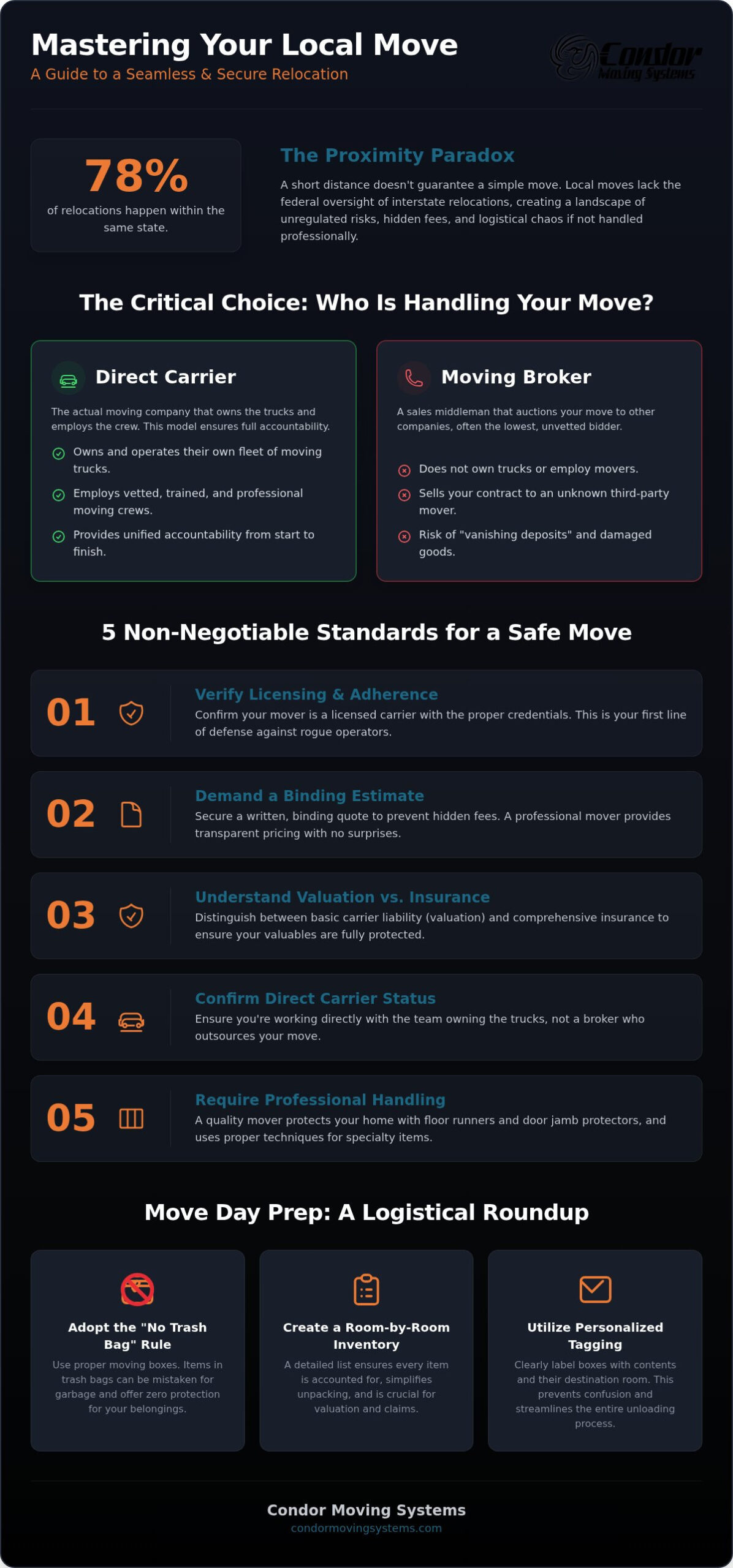
Did you know that 78 percent of people who relocate choose to stay within their home state, yet many overlook the fact that these transitions lack the federal oversight governing interstate moves? While moving locally might seem simpler than a cross-country trek, the logistical reality often involves navigating a landscape of unregulated brokers and hidden fees that can quickly derail your peace of mind. You likely believe that a short distance should guarantee a straightforward process, but you’re also rightfully concerned about entities that vanish after a deposit or surprise you with “long carry” charges at the doorstep.
This guide provides the essential logistical frameworks and accountability standards you need to execute a seamless relocation in 2026. We’ll demystify the difference between basic valuation and actual insurance, ensuring your specialty items like pianos or antiques receive professional handling without risk. By understanding the specific preparation steps and pricing transparency required of a licensed carrier, you can secure a damage-free move with no financial surprises at delivery. This roundup prepares you for total operational control, moving from initial inquiry to final execution with a steady, professional hand.
Key Takeaways
- Understand why proximity doesn’t guarantee a simple move and how to identify the risks of treating a local relocation too casually.
- Learn to distinguish between direct carriers and moving brokers to ensure you’re working with the team that actually owns the trucks.
- Verify the five non-negotiable standards for moving locally, including essential licensing requirements and the necessity of binding estimates.
- Professionalize your preparation by adopting the “no trash bag” rule and creating a room-by-room inventory for precise tracking.
- Discover how personalized inventory tagging and strict regulatory adherence prevent common industry pitfalls like hidden fees and damaged goods.
The Reality of Moving Locally: Why Proximity Doesn’t Guarantee Simplicity
Many homeowners assume that moving locally is a low-stakes endeavor simply because the destination is nearby. This proximity often creates a “proximity paradox” where the lack of a formal logistical framework leads to more chaos than a cross-country relocation. When you don’t feel the pressure of a state line, it’s easy to skip essential inventory steps or ignore professional packing standards. This mindset often results in damaged heirlooms or multiple days of exhausting, unplanned labor. A professional moving company understands that every item requires the same level of protection whether it travels five miles or five hundred.
For residents in Dallas, Fort Worth, and Austin, local transitions involve unique urban challenges. Navigating high-rise apartment regulations or tight suburban cul-de-sacs requires a mover with deep regional roots and specialized equipment. Relying on a direct carrier ensures that the same team handles your property from start to finish. This creates a level of accountability that decentralized marketplaces simply cannot match. You aren’t just moving boxes; you’re moving your life, and that requires a team that understands the local landscape.
Common Pitfalls of DIY Local Relocations
DIY moves frequently suffer from the hidden cost trap. While a rental truck seems affordable, fuel surcharges and equipment rentals add up quickly. Most DIYers also underestimate the physical toll. Without professional dollies and lift gates, the risk of personal injury or property damage increases significantly. Rental trucks also rarely offer comprehensive valuation, leaving you financially responsible if a box of electronics takes a tumble during transit. You might save on the initial quote, but the lack of protection often costs more in the long run. To avoid these risks and ensure a professional experience, you can explore Mudanzas Locales with Mudanzas Ajuar to find reliable, full-service solutions for your next move.
Understanding the Full-Service Mover Advantage
Choosing a full-service provider means you aren’t just hiring labor; you’re securing a managed process. Professional crews are trained to handle specialty items like antiques or pianos that require custom crating and delicate handling. This strategy is particularly effective when moving locally, as it eliminates the friction of handoffs between different service providers. They manage the strict requirements of apartment complex loading docks and elevator reservations. Unlike labor-only apps, a full-service mover takes ownership of the entire timeline. This unified accountability ensures that if a question arises about a specific item, you have a direct point of contact who was there for the packing, loading, and delivery.
Evaluating Your Options: Direct Carriers vs. Moving Brokers
When you’re moving locally, the first decision you’ll face is whether to hire a direct carrier or a moving broker. A direct carrier owns its fleet and employs its own crews, whereas a broker is a sales entity that auctions your contract to the lowest bidder. This distinction is critical for your financial security. Using a broker often leads to “vanishing deposits” where the middleman takes a fee and disappears, leaving you to deal with an unvetted third party on move day. For a reliable experience, consult a reputable guide on how to hire movers to ensure you’re working with a legitimate enterprise that maintains physical assets and professional staff.
Condor Moving Systems operates exclusively as a full-service carrier to maintain total control over every shipment. We don’t outsource our reputation to third parties. By owning the trucks and employing the crews, we ensure that every technician in your home has been vetted and trained to our specific operational standards. This model eliminates the ambiguity common in the moving industry, where clients often don’t know who will actually show up to handle their belongings. If you’re ready to secure a transparent estimate from a direct provider, you can request a free moving quote in Texas to see the difference a professional team makes.
The Carrier Model: Full-Service Accountability
The primary benefit of the carrier model is unified accountability. You’ll have direct communication with the team handling your inventory, rather than a customer service representative in a different state who has never seen your furniture. Licensed crews follow strict safety protocols and are held to consistent training standards across every local shipment. This direct relationship means that if an issue arises, it’s resolved by the company you actually hired. For a deeper dive into these logistical differences, see our guide on professional movers vs. moving brokers.
The Labor-Only Marketplace Model
Some residents consider labor-only marketplaces to save on costs. These platforms connect you with individual helpers but often lack centralized liability. If an item is damaged, the platform usually isn’t responsible, and the individual labor may not carry the necessary insurance to cover high-value losses. These services rarely provide professional packing materials, specialized equipment, or custom crating for antiques. Always check individual crew reviews rather than relying on the platform’s overall rating. Choosing a dedicated carrier ensures that you aren’t just hiring muscle, but a comprehensive logistical solution with the resources to protect your assets.
5 Non-Negotiable Standards for Choosing a Local Moving Co
Vetting a provider when moving locally requires more than checking a star rating on a marketplace app. You must verify legal credentials to ensure your property is in safe hands. A legitimate mover in Texas must display both a USDOT number and a TxDMV number on their equipment and marketing materials. Condor Moving Systems, for instance, operates under USDOT 1126171 and TxDMV 006338906C. These registrations prove the company meets state safety and financial responsibility requirements. Beyond licensing, look for an established operational history. Companies with over 20 years of experience, such as Condor (operating since 2003), demonstrate the stability needed to handle complex relocations. Finally, professional certifications like Pinnacle Mover status and ProMover accreditation separate dedicated specialists from temporary labor.
Inventory transparency is the second pillar of a secure move. Insist on a free, no-obligation binding estimate or a guaranteed flat-rate quote. This prevents the common industry pitfall of price hiking on move day. When moving locally, a binding estimate locks in the cost based on the specific inventory list you provide, ensuring no surprises when the truck arrives at your new home. This level of precision is essential for maintaining a stress-free transition and avoiding the bait-and-switch tactics used by unlicensed entities.
Deciphering Moving Valuation vs. Insurance
Many consumers confuse basic valuation with comprehensive insurance. Valuation is technically a tariff liability, not an insurance policy. Released Value Protection is the standard coverage provided at no extra cost, which typically covers only $0.60 per pound per item. For high-value items like antiques or electronics, this level of protection is insufficient. Full Value Replacement or third-party insurance is necessary if you want the total cost of an item covered in the event of damage. Always clarify which level of protection your mover provides before signing the contract to ensure your assets are fully protected.
Transparency in Pricing and Fees
Hidden costs often hide in the fine print of local moving contracts. Professional movers should be upfront about secondary logistical charges that can impact your final bill. For example, a “long-carry” fee may apply if the distance from the truck to your front door exceeds 150 feet. Similarly, stair fees are standard for moves involving more than 14 steps. Understanding these variables ahead of time allows for an accurate budget. For a detailed breakdown of these standards, consult our Choosing a Local Mover by Accountability guide. This helps you avoid the common pitfalls of the industry and ensures you select a partner that values precision and honesty.
Preparing for Move Day: A Logistical Roundup of Essentials
Specialty items like pianos and pool tables demand specific handling protocols to prevent damage. For pianos, we provide specialized transport services but limit these to ground-floor to ground-floor moves only. We do not perform moves into attics or basements, nor do we offer hoisting services for furniture. These restrictions are in place to protect the integrity of your property and the safety of our crews. By setting these clear operational boundaries, we ensure a higher standard of care for your most valuable possessions. If your relocation involves high-value automotive assets and you are heading to the Colorado region, The Garage Condo Guy provides specialized real estate expertise to ensure your vehicles have a secure, professional-grade home upon arrival.
The Non-Allowables List: What We Cannot Move
Similarly, if your new Texas property requires structural modifications or a professional build-out before you settle in, a commercial general contractor Crandall TX can provide the necessary oversight to ensure your residential or commercial space is fully optimized.
Safety regulations and liability standards prevent us from transporting certain categories of items. You must make separate arrangements for hazardous materials, including propane tanks, flammable gases, explosives, and paint. Perishables and living things, such as plants or food, are also excluded from our trucks. High-value personal items require your direct supervision. We do not transport jewelry, cash, deeds, or securities. Keeping these items with you ensures they remain secure throughout the transition and eliminates the risk of loss for irreplaceable assets.
Packing and Unpacking Strategies
You can choose between full-service packing or partial packing to fit your specific needs and budget. For fine art and delicate mirrors, professional custom crating provides the highest level of protection against shifting during transit. If you choose to pack your own boxes, it’s vital to understand the liability limits for “Packed by Owner” (PBO) items. Professional carriers generally do not cover internal damage to owner-packed boxes unless there is visible, external damage to the box itself. This policy emphasizes the value of professional packing for fragile or high-value inventory when moving locally.
Executing Your Transition with Condor Moving Systems
Condor Moving Systems executes every relocation with a level of operational discipline designed to eliminate ambiguity. When you’re moving locally, we implement a personalized inventory tagging and tracking system for every shipment. This ensures that every item loaded onto our trucks is accounted for throughout the entire transition. Our crews operate with strict adherence to both federal and state weight and safety regulations, maintaining the high standards expected of a licensed carrier. We provide 24-hour emergency customer service during your move, ensuring you have a direct line to support should any logistical questions arise in real-time.
While many residents focus on a specific city, sometimes plans shift. If your requirements expand beyond the immediate area, we offer specialized support for long-distance moves. This flexibility allows you to maintain the same level of accountability and professional handling regardless of your final destination. We take full ownership of the work from the initial inquiry to the final placement of your furniture.
Payment Logistics and Transparency
We maintain clear financial protocols to protect both the client and the company. A 20 percent non-refundable deposit is required to secure your moving date and initiate the logistical planning phase. It’s critical to understand our payment schedule to avoid delays at your new home. We don’t accept cash, personal checks, or credit cards at the time of delivery. To ensure a smooth handoff of your belongings, you must provide payment via cashier’s check, money order, or Zelle. This policy is a non-negotiable safety and accounting standard that ensures every transaction is documented and secure.
Post-Move Support and Claims
Our commitment to your satisfaction extends beyond the physical delivery of your items. We provide a 72-hour window for reporting any service issues or discrepancies. If you need to file a claim for damage, we work through Anthem Claim Management to provide a structured and transparent resolution process. It’s also important to note our policy regarding furniture assembly. To maintain safety and structural integrity, Condor won’t re-assemble furniture that our crews didn’t disassemble at the origin. This ensures that every piece of furniture we handle is managed according to our professional standards from start to finish. By following these methodical steps, we provide the peace of mind necessary for a successful experience when moving locally.
Secure Your Transition with Professional Accountability
Executing a successful relocation in 2026 requires moving beyond the convenience of digital marketplaces and prioritizing the accountability of a licensed direct carrier. By distinguishing between brokers and actual service providers, you ensure that your belongings are handled by a team with a physical presence and a vested interest in your move’s success. Whether you’re moving locally across Dallas or transitioning within Austin, the logistical frameworks of inventory tagging and strict packing standards remain the foundation of a damage-free experience.
Condor Moving Systems brings over 20 years of direct-carrier experience to your doorstep, operating as a Pinnacle Mover and ProMover certified entity. Our licensing, including USDOT 1126171 and TxDMV 006338906C, reflects a commitment to state and federal safety standards that unvetted labor simply cannot match. You don’t have to face the complexities of relocation alone when you have a disciplined partner dedicated to transparency and operational integrity.
Take the first step toward a predictable and organized move day. Our team is ready to provide the professional handling and peace of mind you deserve for your next local transition.
Frequently Asked Questions
How far in advance should I book local moving services?
You should book your move as soon as your date is confirmed, ideally four to six weeks in advance. While Condor Moving Systems offers same-day moving based on crew availability for smaller local transitions, early scheduling ensures you secure your preferred timeline. Booking ahead allows our team to provide a precise binding estimate and coordinate the specific logistics required for your home in Dallas or Fort Worth without last-minute complications.
Do local moving companies charge for stairs or long carries?
Yes, professional movers typically apply fees for logistical challenges like stairs or long carries. At Condor, these charges start at $75 for distances exceeding 150 feet from the truck to your door or for moves involving more than 14 steps. Being transparent about these factors during your inventory assessment helps us provide a guaranteed flat-rate quote, ensuring there are no financial surprises when our crews arrive at your new residence.
What is the difference between a moving broker and a full-service carrier?
A moving broker is a sales entity that auctions your contract to third parties, whereas a full-service carrier like Condor owns its fleet and employs its own crews. Choosing a direct carrier ensures unified accountability and consistent training standards for every technician in your home. When moving locally, working with a carrier eliminates the risk of vanishing deposits and ensures that the company you hire is the one actually performing the work.
Can I use trash bags to pack my clothes for a local move?
No, trash bags are strictly prohibited for use as packing material and won’t be accepted by our crews. They don’t provide structural protection, tear easily, and cannot be stacked safely inside the moving truck. To maintain the safety of your belongings, we require all items to be packed in sturdy, uniform boxes. This standard ensures that your wardrobe and linens remain clean and undamaged throughout the entire relocation process.
Are there items that local movers are prohibited from transporting?
Yes, certain items are classified as non-allowable for safety and liability reasons. We cannot transport hazardous materials like propane, paint, or explosives, nor can we move perishables, plants, or animals. High-value personal assets such as jewelry, cash, deeds, and securities must remain in your direct possession. Following these regulations protects your most sensitive property and ensures our crews remain compliant with federal and state safety standards during the transition.
How does valuation coverage work for a local move?
Every local move includes standard Released Value Protection at no additional cost, which covers your items at $0.60 per pound per item. It’s important to understand that this is tariff liability, not insurance. For high-value assets, you may choose to purchase Full Value Replacement through a third-party provider. This additional coverage ensures that you’re financially protected for the total replacement cost of your belongings if damage occurs during transit.
What forms of payment are accepted on move day?
On delivery day, we accept cashier’s checks, money orders, or Zelle for the final 50 percent balance. We don’t accept cash, personal checks, or credit cards at the destination. For the initial 20 percent deposit and the 30 percent pickup payment, you may use credit cards, cashier’s checks, or Zelle. This strict payment protocol ensures secure transactions and maintains a clear financial record for both the client and our professional accounting department.
Can professional movers handle specialty items like pianos or safes?
Yes, we specialize in handling high-value items like pianos, pool tables, and custom bikes. When moving locally, pianos are transported on a ground-floor to ground-floor basis only to ensure maximum safety for the instrument and our crew. While we disassemble pool tables for transport, we don’t provide re-assembly services for them. Our crews use specialized equipment and custom crating techniques to protect these sensitive assets during every stage of the move.