



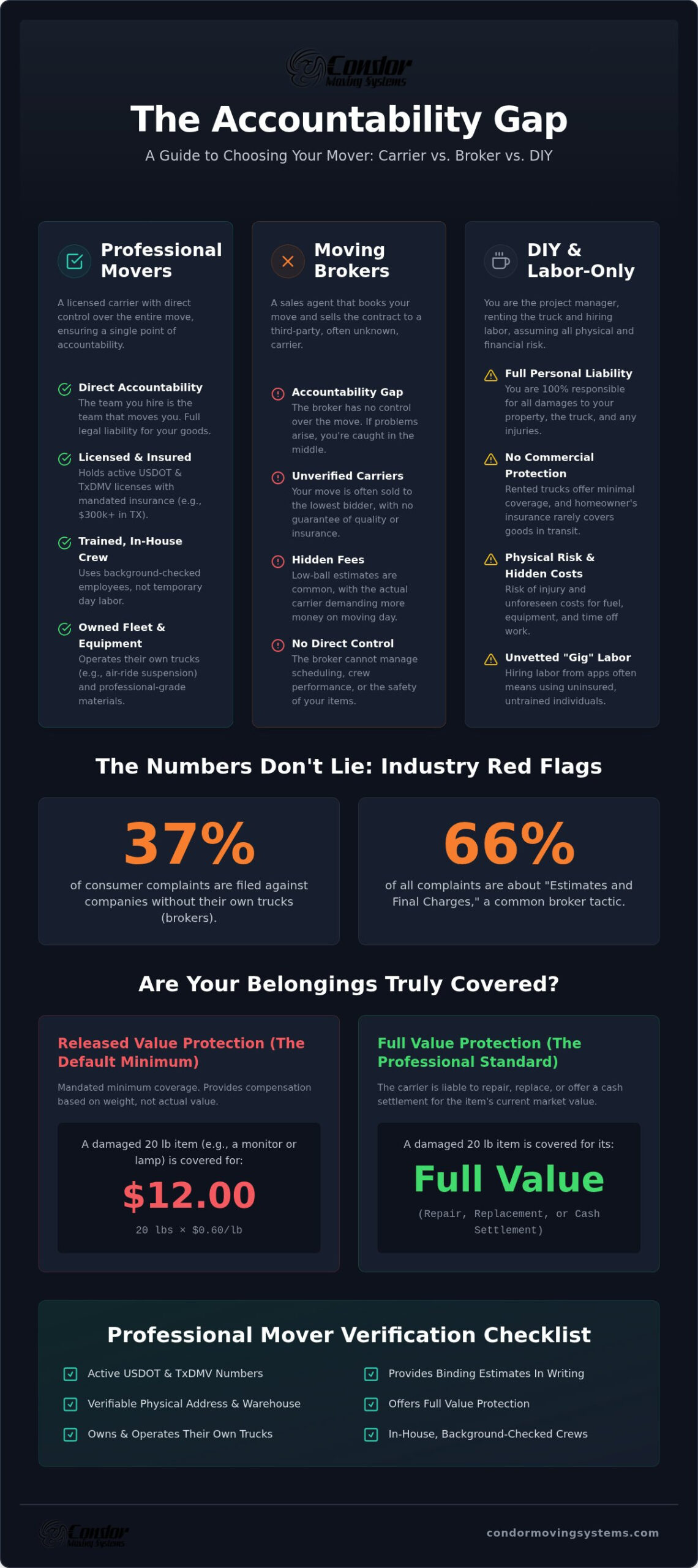
Did you know that moving companies without a single truck of their own account for nearly 37% of all consumer complaints filed with federal regulators? It’s a startling figure that highlights a growing accountability gap in the relocation industry. When you’re preparing for a major transition, the last thing you need is a middleman who disappears the moment a problem arises. Hiring genuine professional movers ensures that the team you book is the same team that handles your belongings from start to finish. To maintain this level of service, these carriers often rely on Complete Truck Services LLC for expert semi-truck repair and comprehensive fleet maintenance.
We understand that the fear of hidden fees and the anxiety over damaged items can make the planning process feel overwhelming. It’s often difficult to distinguish between different service models when every website makes similar promises. This guide will teach you how to verify credentials and separate reliable carriers from brokers or DIY risks that leave you unprotected. We’ll provide a clear framework for vetting your team, explain the specific financial protections available under Texas and federal law, and show you how to secure a move managed by a single, accountable crew.
Key Takeaways
- Identify legitimate carriers by verifying USDOT and TxDMV credentials to ensure your company has direct operational control over your relocation.
- Understand the significant accountability gap between brokers who sell contracts and professional movers who physically handle and protect your belongings.
- Evaluate the hidden costs and physical risks of DIY moving compared to the security provided by a single, accountable team managing every logistical detail.
- Learn the critical distinctions between standard released value protection and full valuation to ensure your household goods are financially protected.
- Discover why a direct-carrier model with decades of experience offers the stability and transparency required for a successful, stress-free move.
What Defines True Professional Movers in 2026?
A true moving company is more than a simple logistics coordinator; it’s a licensed carrier that maintains direct operational control over every asset involved in your relocation. In an era where digital apps often mask a lack of physical resources, distinguishing professional movers from “gig economy” labor services is essential for your security. A professional carrier owns the trucks, employs the crew, and assumes full legal liability for your household goods. This direct chain of command eliminates the ambiguity found in brokerage models, where your inventory might be handed off to an unverified third party. By choosing a full-service relocation provider, you’re opting for a comprehensive logistics solution that integrates packing, transport, and accountability into one seamless process.
The Core Elements of Professionalism
Legal compliance serves as the non-negotiable baseline for any legitimate operation. Within Texas, carriers must be registered with the Texas Department of Motor Vehicles (TxDMV), while interstate moves require active USDOT and Motor Carrier (MC) authority. These licenses aren’t just paperwork; they mandate that the company carries specific insurance minimums, including at least $300,000 in liability for intrastate Texas moves as of 2026. Beyond licensing, professionalism is defined by the quality of the workforce. Reputable firms use trained, background-checked crews rather than temporary day labor or outsourced contractors. These professionals often receive their specialized commercial driver training through institutions like lonestar-tda.com to ensure they can handle large-scale equipment safely. This expertise extends to the equipment used, such as air-ride suspension trucks that protect delicate items from road vibration and professional-grade packing materials designed to withstand the rigors of transit.
Why Credentials Matter for Your Peace of Mind
Industry certifications provide an extra layer of vetting that goes beyond basic legal requirements. For example, the ProMover designation signals that a mover has passed a rigorous review of its business practices and complaint history. In Texas, the Pinnacle Mover status represents the highest level of commitment to consumer protection and operational excellence. These credentials, combined with a verifiable physical headquarters and secure storage facilities, prove that the company has the resources to handle complex long-distance moves or local moving services without outsourcing the work. When a mover owns their facility and fleet, they have a vested interest in maintaining a high standard of service. Their reputation and physical assets are directly on the line. Choosing professional movers with these verified markers ensures your relocation is a structured logistics operation rather than a logistical gamble.
Professional Movers vs. Moving Brokers: The Accountability Gap
The fundamental difference between a moving broker and a carrier lies in who actually performs the work and who holds the legal liability. A broker is essentially a sales office that books your move and then sells the contract to a third-party carrier, often the one willing to accept the lowest rate. This model creates a significant accountability gap. If items are damaged or the delivery is delayed, the broker may claim they have no control over the physical operation. In contrast, professional movers operate as a single point of contact. They own the equipment and employ the crew, ensuring that the team providing your estimate is the same team responsible for the safety of your belongings. This direct-carrier model is the gold standard for global relocation, utilized by established firms like asiaticrelo.com to maintain quality control across international borders.
Pricing transparency is another area where the gap widens. Industry data shows that “Estimates and Final Charges” account for 66% of all consumer complaints filed between 2023 and 2025. Brokers frequently provide low-ball estimates to secure a non-refundable deposit, only for the actual carrier to demand higher fees at the time of pickup. Direct carriers provide binding estimates based on actual inventory, which protects you from unexpected financial surprises on moving day. This stability is why direct carriers are the preferred choice for those who value operational integrity over the lowest initial bid.
Direct Communication vs. Middleman Logistics
The same principles of direct control apply to large-scale shipping and logistics. You can learn more about how professional freight forwarding services move cargo reliably across North America by maintaining strict operational standards.
For those managing complex international shipments or seeking specialized consulting on global supply chains, Customs and Trade Logistics provides the necessary expertise to navigate customs regulations and ensure regulatory compliance.
Dealing with a direct carrier means you maintain a clear line of communication from the initial consultation through final unloading. These companies manage their own fleet schedules, allowing for more reliable transit windows and fewer logistical errors. You can learn more about this by reading our Choosing a Local Mover by Accountability: 2026 Guide. Because the carrier handles the entire process, they take full responsibility for any claims or issues that arise. If you want to see how a direct carrier approaches your specific needs, you can request a transparent moving estimate today.
Identifying a Broker in Disguise
You can verify a company’s status by checking their authority on the FMCSA website. Legitimate professional movers will have “Carrier” authority, while middlemen will be listed as “Brokers.” Another red flag is a refusal to perform an in-home or virtual visual survey; brokers often rely on rough phone estimates that lead to pricing disputes. Reputable organizations like the Moving & Storage Conference emphasize that physical asset ownership, including trucks and warehouses, is a consumer’s best protection. If a company doesn’t have a physical headquarters or a fleet with their own branding, they likely aren’t the ones who will be doing the heavy lifting.
Evaluating Full-Service Moving vs. DIY & Labor-Only
Saving money is the primary driver for DIY relocations, but the math often falls short when you factor in the full scope of operational requirements. Beyond the base rental fee, you’re responsible for fuel, which averaged approximately $5.65 per gallon for diesel in late August 2026. When you add the cost of supplemental liability coverage, moving blankets, and specialized dollies, the financial gap between self-moving and hiring professional movers narrows quickly. You also assume 100% of the physical risk. A single injury or a damaged heirloom can instantly erase any perceived savings from a self-managed move. Similarly, attempting to tow your own vehicle behind a rental truck adds significant risk and wear; many families find that booking professional transport through GAATCO is a much safer and more efficient alternative.
Labor-only services introduce a unique liability gray area that many homeowners fail to consider. If you hire a temporary crew to load a truck you rented, you face an accountability vacuum if the load shifts during transit. Most labor-only providers won’t cover damages caused by poor stacking once the vehicle is in motion. This lack of end-to-end responsibility is exactly what the FMCSA’s Protect Your Move program warns against when consumers look for ways to cut costs. Without a single carrier managing the entire process, you’re left to navigate claims between multiple uncoordinated parties.
DIY moves frequently overlook the “soft” costs of property protection and time. Professional carriers use heavy-duty floor runners and door jamb protectors to prevent structural damage to your home. Without these tools, you risk scuffing hardwood or denting drywall, which can lead to expensive repairs or lost security deposits. For those considering moving locally in 2026, the time investment alone often makes a professional solution more viable than a DIY approach. Managing a large box truck through heavy traffic while coordinating hotel stays and fuel stops is a high-stress endeavor that requires professional experience to execute safely.
When to Choose Full-Service Packing
Accountability depends heavily on who packed the container. In the industry, “Packed by Owner” (PBO) items carry significantly less protection than those handled by a crew. If a box you packed arrives without external damage but the contents are broken, the carrier is typically not liable because they didn’t oversee the internal cushioning or structural integrity of the pack. Opting for full-service packing or custom crating for high-value items shifts that responsibility to the professional movers. This ensures that every item is secured using industry-standard techniques, providing you with a clear path for reimbursement if an accident occurs during the relocation process. For those moving specialized industrial equipment, you can visit OEM Materials & Supplies to learn about advanced protective packaging solutions.
A transparent relocation process relies on a clear understanding of liability and the legal documents that govern your move. Many consumers confuse “valuation” with “insurance,” but they’re distinct concepts. Valuation refers to the level of liability a mover assumes under their tariff if your goods are lost or damaged. Professional movers are required by federal law to provide Released Value protection at no extra cost, which is set at $0.60 per pound per item. While this provides a baseline of protection, it’s often insufficient for high-value electronics or furniture. For instance, if a 10-pound high-definition television is damaged, the standard liability would only amount to six dollars. To ensure full financial security, you should consider Full Value Replacement coverage, which is often available through third-party providers.
The accuracy of your contract depends entirely on the detail of your inventory. Binding estimates and guaranteed flat-rate quotes are only as reliable as the information provided during the initial survey. You must include every item and provide specific details about access at both the origin and destination to avoid “surprise” fees. When your shipment arrives, your most important task is to inspect every item. If you notice damage, it’s essential to note it immediately on the Bill of Lading before the crew leaves. This document serves as the official record of the move’s completion and is the primary evidence used during the claims process.
Understanding Your Coverage Options
Choosing the right coverage level requires a realistic assessment of your shipment’s total value. If you opt for Full Value Replacement, the mover is liable for the replacement value of lost or damaged items, though this typically involves a higher upfront cost. Regardless of the coverage you choose, the Bill of Lading remains the most critical document in your possession. It acts as your contract and receipt. Failing to document damage on this form at the time of delivery can make it significantly harder to resolve a claim later. Professional movers will always encourage you to perform a final walkthrough to ensure everything is accounted for and in good condition.
What Professional Movers Won’t Move
Operational integrity also means knowing what items are prohibited for safety and legal reasons. Hazardous materials are strictly forbidden on moving trucks because they pose a risk to the crew and the entire shipment. You’ll need to dispose of or transport items like propane tanks, paint, aerosol cans, and household chemicals yourself. Additionally, most carriers designate certain high-value items as “non-allowables” that they won’t accept liability for. This list typically includes:
- Cash and coin collections
- Jewelry and precious stones
- Personal documents like deeds, wills, and passports
- Prescription medications
There are also physical limits to the services provided by professional movers. For example, operational standards often prohibit crews from entering attics or basements due to safety and structural concerns. Similarly, hoisting furniture through windows or over balconies is generally not offered. Professional firms, including those that provide house removals Manchester, follow these strict safety protocols to protect both staff and property. Understanding these boundaries before moving day helps you prepare alternative arrangements and ensures a steady, predictable process without last-minute complications.
Why Condor Moving Systems Sets the Standard in Texas
Beyond the move itself, many families look forward to the lifestyle changes that come with a new home. If you are moving to a property with space for a backyard flock, sourcing high-quality structures from a Texas-based business like Southern Chicken Coops can help you settle into your new environment with ease.
Condor Moving Systems has operated as a dedicated full-service carrier since 2003. We provide a level of accountability that brokers simply cannot match because we maintain total control over every asset involved in your relocation. Our team manages the entire process with our own licensed and insured crews, ensuring your possessions are never outsourced to unvetted third parties. As professional movers with over 20 years of experience, we specialize in the technical handling of high-value and fragile items, including pianos, custom motorcycles, and custom-crated art. For corporate clients who may need temporary workspace during a transition, providers like Atlanta Container & Trailer offer mobile office solutions that can be integrated into a comprehensive relocation plan. Our binding estimate process provides the financial transparency you need to plan your budget without the fear of low-ball quotes or hidden fees.
Texas is our home. We provide localized expertise to residents in Dallas, Austin, Houston, and San Antonio while maintaining the logistical resources of a large-scale enterprise. If you require local movers in Texas, our team offers a seamless transition backed by our Pinnacle Mover certification and ProMover status. We also provide climate-controlled storage solutions for both short-term and long-term needs. This ensures your household goods remain protected from the extreme Texas climate in a secure, monitored facility. Whether you’re moving locally within Texas or across the state, our 24-hour emergency customer service line ensures that you have a direct point of contact if unexpected challenges arise during transit.
Transparent Policies for a Seamless Move
Operational integrity requires clear financial standards and predictable processes. We operate with a structured payment schedule to ensure all parties are aligned before the first box is loaded. A 20% non-refundable booking deposit is required to secure your moving date. Following this, 30% of the total is due at the time of pickup, with the final 50% balance settled at delivery. To maintain security and efficiency at the destination, we accept only cashier’s checks, money orders, or Zelle for final payments. We don’t accept cash, personal checks, or credit cards at the time of delivery. To support our community, we offer dedicated discounts for active-duty military, veterans, and seniors aged 65 and older. These disciplined standards reflect our commitment to being the professional movers you can trust for an honest and successful relocation from start to finish.
Securing Your Relocation with Direct Accountability
Choosing the right partner for your move is the most effective way to eliminate the stress of a major life transition. You now have the framework to distinguish between unverified middlemen and established carriers who take full ownership of the process. Accountability isn’t found in the lowest bid; it’s found in the physical assets, licensing, and direct communication that only a dedicated carrier provides. By prioritizing these standards, you protect your belongings from the risks of double brokering and unexpected fee escalations.
Condor Moving Systems offers the stability of over 20 years of direct carrier experience. Our status as a Pinnacle Mover certified company and our membership in the Southwest Movers Association demonstrate our commitment to professional excellence. When you hire professional movers who maintain their own fleet and crews, you’re investing in the peace of mind that comes with a single, reliable point of contact. We’re here to ensure your transition is handled with the precision and integrity you expect.
We’re ready to help you plan a secure and predictable relocation that respects your time and your property.
Frequently Asked Questions
What is the difference between a moving broker and a professional mover?
A moving broker acts as a sales agent that sells your contract to another company, whereas a professional mover is a carrier with its own fleet and crew. Condor Moving Systems has served Texas cities like Dallas and Austin as a direct carrier since 2003. This model ensures that the team giving your estimate is the same one handling your belongings, providing a single point of accountability that brokers cannot offer.
Do professional movers offer insurance for my belongings?
Professional movers provide valuation rather than insurance. Standard coverage is Released Value protection, which is provided at no cost and covers $0.60 per pound per item. For residents in Houston or San Antonio seeking higher levels of security, Full Value Replacement coverage can be purchased through a third-party provider. It’s essential to understand these tariff liabilities before your move begins, as valuation cannot be modified once transit has started.
Can I pay for my move with a credit card at the time of delivery?
No, you cannot pay with a credit card at the time of delivery. Accepted payment methods at the destination include cashier’s check, money order, or Zelle only. While cards are accepted for the initial deposit and pickup payment with a 3% fee, federal regulations and company policies require secure, cleared funds before unloading. This standard practice ensures a transparent financial conclusion to your relocation in Plano, Frisco, or other Texas service areas.
Will professional movers pack and move my items in trash bags?
Our crews will not accept items packed in trash bags for transport. These bags lack the structural integrity to protect your goods and can easily tear during the loading process. To ensure the safety of your shipment in McKinney or Irving, all items must be placed in proper cardboard boxes or professional-grade containers. Our teams prioritize the security of your inventory, and using standardized packing materials is a non-negotiable requirement for a successful move.
Are there items that professional movers are prohibited from transporting?
Yes, certain items are strictly prohibited for safety and liability reasons. We cannot transport hazardous materials such as propane, paint, chemicals, or firearms. Additionally, high-value items like jewelry, cash, deeds, and coin collections are considered non-allowable. For your move in Arlington or Grapevine, you should plan to transport these personal valuables and any perishable foods or plants in your own vehicle to ensure they remain secure and within legal transport guidelines.
How much does a professional mover typically charge for a long-carry or stairs?
Additional fees apply for logistical challenges such as long-carries or multiple flights of stairs. These charges typically start at $75 for carries exceeding 150 feet or for navigating more than 14 steps. Providing an accurate description of your apartment layout in Southlake or your office building in Dallas helps our team include these costs in your binding estimate. This transparency prevents unexpected charges on moving day and allows our crews to prepare the necessary equipment.
Is the booking deposit for a professional mover refundable?
The 20% booking deposit required to secure your moving date is non-refundable. This deposit ensures that a dedicated crew and truck are reserved specifically for your relocation. Because we manage our own schedules to serve clients across Texas, this commitment allows us to maintain the high operational standards expected of professional movers. We recommend finalizing your moving dates and inventory details before submitting your deposit to ensure your logistics plan is fully settled.
Does a professional mover provide real-time GPS tracking for my shipment?
We do not provide real-time GPS tracking or continuous digital updates for shipments. Instead, we offer a structured notification system to keep you informed of your move’s progress. You will receive an initial notification once your goods are in transit and a second update 24 to 48 hours before the actual delivery. This methodical approach provides you with the necessary arrival windows while our dispatch team focuses on the safe execution of your relocation.