


Your PCS orders are a mandate for your career, but they shouldn’t be a gamble with your household goods. Choosing the wrong military movers often leads to a chain reaction of logistical failures, from exceeded weight allowances to the discovery of damaged gear at your new duty station. You likely feel the pressure of strict government weight limits and the frustration of dealing with brokers who hand off your life’s possessions to unknown third parties. We understand that a successful relocation requires more than just a truck; it demands total accountability and operational precision.
This guide will help you master the logistics of your military relocation by providing the tools to vet carriers effectively and secure your belongings. You’ll learn how to stay within your PCS weight allowance while maintaining clear communication with your moving crew throughout transit. We will break down the process of identifying direct carriers, managing high-value inventory, and ensuring your 2026 move is the most organized one yet. By focusing on carrier transparency instead of just low-cost estimates, you can achieve a damage-free transition to your next post.
Key Takeaways
- Understand the critical PCS timeline to secure your booking immediately after receiving orders and avoid the peak season rush.
- Learn how to distinguish direct carriers from brokers to ensure your military movers provide full accountability and eliminate the risk of third-party hand-offs.
- Master the logistics of weight allowances by using professional estimation tools and accurately tracking your high-value inventory.
- Implement strict packing protocols, including the “no trash bags” rule and the separation of Pro-Gear, to safeguard your equipment and stay within weight limits.
- Discover the benefits of partnering with Texas-based relocation experts who offer dedicated military discounts for active-duty and retired service members.
Navigating the PCS Moving Process: Requirements and Timelines
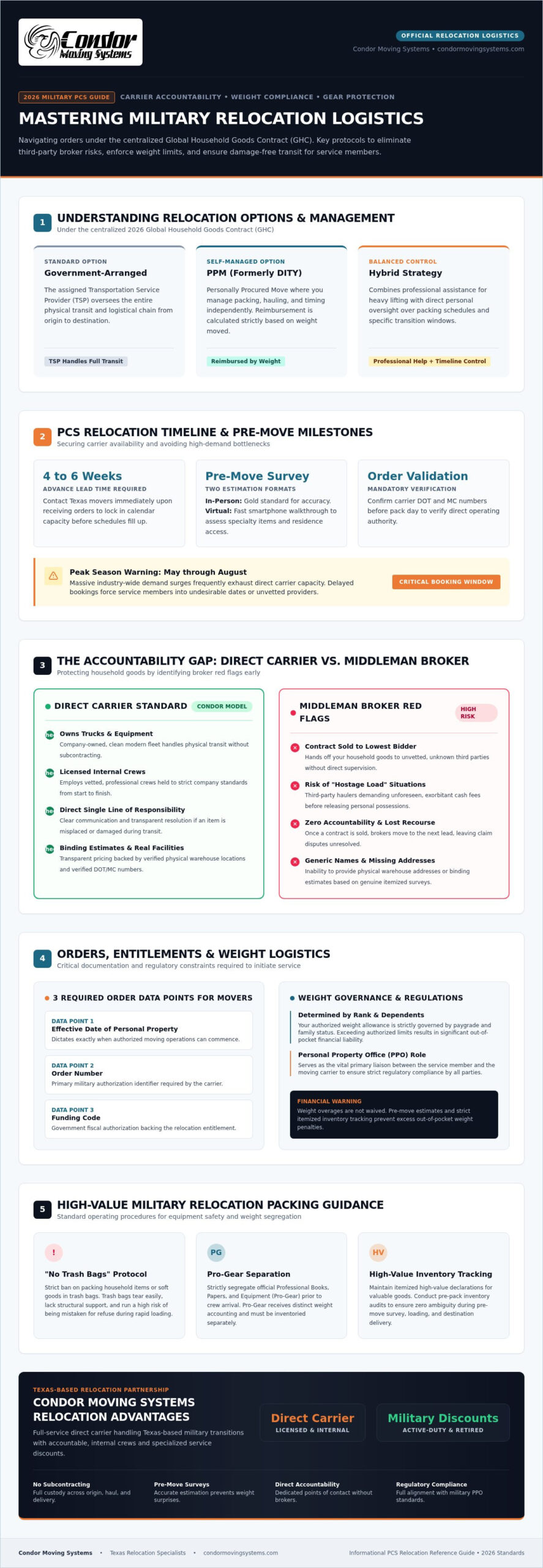
A permanent change of station (PCS) isn’t just a relocation; it’s a regulated logistical operation. When you receive your orders, the government typically assigns a Transportation Service Provider (TSP) to manage the physical transit of your household goods. The shift toward the 2026 Global Household Goods Contract (GHC) means the military is centralizing management to improve carrier accountability and provide more consistent service. While this update streamlines the process, it also requires you to be more proactive in understanding your specific entitlements before military movers arrive at your doorstep.
Service members generally choose between a government-arranged move or a Personally Procured Move (PPM), formerly known as a DITY move. In a government move, the TSP handles the entire process. In a PPM, you manage the logistics yourself and receive a reimbursement based on the weight of the goods moved. Many families find a hybrid approach works best, using professional assistance for the heavy lifting while maintaining control over their specific timeline.
Understanding Your PCS Orders and Entitlements
Your orders contain the “Effective Date of Personal Property,” which dictates exactly when you can start moving your goods. Movers need this date, along with your Order Number and Funding Code, to initiate the process. Your authorized weight allowance is determined strictly by your rank and whether you have dependents. Exceeding this limit results in significant out-of-pocket costs, so consulting with your Personal Property Office (PPO) early is vital. They serve as the primary liaison between you and the moving company, ensuring all regulations are followed by both parties.
Setting a Realistic Relocation Timeline
Timing is the most critical variable in a successful relocation. You should ideally contact local movers in Texas at least 4 to 6 weeks before your desired pack date. This lead time is essential because the “Peak Season,” which runs from May through August, sees a massive surge in demand that can exhaust carrier capacity. If you wait too long, you might be forced to accept less desirable dates or use a carrier that doesn’t meet your standards.
Once you’ve established contact, schedule your pre-move survey. Many carriers now offer virtual surveys via smartphone for speed, though in-person walkthroughs remain the gold standard for accuracy. This survey allows military movers to identify specialty items or potential access issues at your residence, preventing delays on moving day. Use this time to confirm the carrier’s DOT and MC numbers to verify they are a direct carrier rather than a broker, which ensures the people loading the truck are accountable to the company you hired.
How to Vet Military Movers: Why Carrier Accountability Matters
Vetting military movers is the single most effective way to protect your household goods from the common pitfalls of relocation. Many families assume every company they find online is a direct provider, but the industry is crowded with brokers. A broker acts as a middleman, selling your contract to the lowest bidder. This lack of oversight often leads to “hostage load” situations, where an unknown third party demands additional fees before releasing your items. To avoid this, you must prioritize carrier accountability by hiring companies that own their trucks and employ their own crews.
Direct handling ensures that the standards promised during your initial estimate are the same standards maintained during transit. When you work with a carrier, there is a clear line of responsibility. If an item is misplaced or damaged, you deal directly with the company that handled it, rather than a broker who has already moved on to the next lead. This transparency is the foundation of a stress-free PCS.
The Accountability Gap: Carrier vs. Broker
Identifying a broker early prevents significant logistical stress. Red flags include generic company names, the absence of a physical warehouse address, or an inability to provide a binding estimate based on an actual inventory. Direct communication with the people who physically load and transport your belongings reduces the risk of claim disputes. Condor Moving Systems operates as a full-service carrier, using licensed, internal crews rather than subcontracting the work to strangers. This direct ownership of the process ensures total reliability from the moment the truck arrives until the final box is unloaded.
Verifying Credentials and Certifications
Before signing any contract for long-distance moves, you must verify the company’s legal authority. Every legitimate carrier must possess a USDOT number and an MC (Motor Carrier) license. You can use the FMCSA’s “Protect Your Move” website to cross-reference these numbers against the company’s safety record and insurance status. For additional peace of mind, check for professional designations like Pinnacle Mover certification or membership in the Southwest Movers Association. These organizations require members to adhere to strict ethical and operational guidelines that many brokers simply cannot meet.
Utilizing official Defense Personal Property Program resources provides a strong foundation for your search, but local expertise remains invaluable. A carrier with deep roots in Texas understands the specific logistical challenges of the region, from navigating major hubs like Dallas and San Antonio to meeting base access requirements. Checking these credentials ensures you are hiring a professional team dedicated to operational integrity. If you are ready to secure a partner for your relocation, you can request a binding estimate from a verified carrier to lock in your 2026 moving dates.
Strategizing Weight Allowances and Inventory Tracking
Managing your weight allowance is often the most stressful aspect of a military move because the financial consequences of an overage are immediate and significant. While your orders specify a maximum poundage based on rank, the actual weight of your household goods isn’t confirmed until the truck crosses a certified scale. Professional military movers typically estimate weight using a standard industry ratio of seven pounds per cubic foot. This calculation provides a baseline, but the density of your specific items, such as heavy solid wood furniture versus lighter particle board pieces, can create discrepancies between the estimate and the final scale ticket.
If you suspect your load exceeds your authorized limit, you have the right to request a re-weigh before delivery. It’s vital to follow FMCSA carrier accountability guidelines to ensure the process is handled transparently. You should also utilize the “High-Value Inventory” form for specialized military gear, high-end electronics, or collectibles. Choosing experienced military movers ensures that these estimations are as accurate as possible. Utilizing this form ensures your items receive specific attention and valuation, protecting you from the loss of mission-essential equipment that might otherwise be categorized as standard household goods.
Calculating Your Household Goods Weight
A carrier calculates your shipment’s weight by subtracting the truck’s empty weight from its weight after loading at a certified scale. To avoid surprises at the weigh station, you should aggressively purge your belongings before the crew arrives. Focus on heavy, low-value items like old exercise equipment, outdated books, or broken appliances. Reducing your total inventory not only keeps you under your weight ceiling but also speeds up the packing and unloading phases of your relocation.
The Role of Inventory Tagging and Tracking
A professional tagging system is the backbone of an organized move. Each box and piece of furniture receives a unique, numbered sticker that corresponds to a master inventory sheet. This level of detail prevents items from being left on the truck or delivered to the wrong residence. Before the driver departs your origin, you must review the Bill of Lading and the inventory sheet to confirm that every item’s condition is accurately recorded. If you find your current inventory exceeds the space available in your new housing, you may need to consider an integrated moving and storage service to safely house your surplus belongings until you can properly sort them.
Packing Guidance for High-Value Military Relocations
Professional packing is the first line of defense against damage during a PCS. Experienced military movers enforce a strict “no trash bags” policy for all household goods because plastic bags are prone to tearing and offer zero protection against the weight of a stacked load. Instead, carriers require uniform, heavy-duty boxes that provide the structural integrity needed for secure stacking within the trailer. You should also separate your professional gear, known as Pro-Gear, from standard household items. This equipment, which includes uniforms and mission-essential tools, can often be excluded from your total weight allowance if it’s clearly labeled and inventoried separately during the packing phase.
Handling specialty items requires specific logistical planning and clear communication. For instance, pianos are moved ground-floor to ground-floor only, and pool tables are disassembled for transit but not re-assembled at the destination. For items requiring extra care, such as glassware, fine art, or sensitive electronics, consulting a professional fragile item packing guide ensures you use the correct materials and techniques. Taking these precautions at the start of your relocation prevents delays and minimizes the risk of transit-related damage.
Non-Allowables: Items Your Mover Cannot Carry
Certain items are strictly prohibited from transit due to safety regulations and carrier policies. You must personally transport firearms, ammunition, hazardous chemicals, and live plants, as these cannot be loaded onto the truck. Additionally, high-value personal assets like cash, jewelry, and legal deeds should never be packed in a moving trailer; these must remain in your possession throughout the move. Perishable foods are also excluded because they cannot be safely stored or transported over long distances without risking spoilage or attracting pests to the rest of your shipment.
Valuation vs. Insurance: Protecting Your Belongings
Understanding the difference between valuation and insurance is essential for your financial protection. The standard coverage provided is Released Value Protection, which compensates $0.60 per pound per item in the event of a claim. While this is the industry baseline, it often falls short of the replacement cost for high-value electronics or furniture. For more comprehensive coverage, you should look into moving insurance options that provide full replacement value through third-party providers. It’s also important to note that “Packed by Owner” (PBO) boxes typically have limited coverage compared to items packed by the carrier, as the mover cannot verify the quality of the internal packing.
Choosing Condor Moving Systems for Your Texas-Based Military Relocation
Condor Moving Systems has specialized in relocation logistics since 2003, establishing a reputation for reliability across the state’s major military installations. As professional military movers, we understand the specific needs of service members stationed at Fort Cavazos, Joint Base San Antonio (JBSA), and other Texas hubs. Our status as a direct carrier ensures that our own licensed crews manage every phase of your move. This provides a level of accountability that brokers cannot match. To further support the military community, we offer dedicated discounts for both active-duty personnel and veterans.
Financial transparency is a core part of our operational philosophy. We utilize a structured payment schedule to provide clarity throughout the process: a 20% non-refundable deposit secures your moving dates, followed by 30% due at pickup, and the final 50% balance collected at delivery. You must use specific payment methods for the final delivery. We accept only cashier’s checks, money orders, or Zelle. We do not accept credit cards, personal checks, or cash at the destination.
Expertise in Texas Military Hubs
Our extensive service area covers the major metropolitan centers of Dallas, Fort Worth, Austin, and San Antonio. We are equipped to handle the unique logistical challenges often found in Texas relocations. This includes shuttle services for restricted access areas and long-carries for complexes with extended distances between the truck and your front door. For those requiring specific regulatory adherence, our Government Employee Relocation Services guide offers detailed insights into compliance and logistics.
The Condor Difference: Direct Carrier Service
Choosing a family-owned, independent carrier means you receive personalized attention rather than being treated as a number in a global network. We take full ownership of the work from start to finish. This direct responsibility allows us to maintain high service standards and provide 24-hour emergency customer service to address any urgent concerns during transit. Our disciplined approach ensures your household goods are protected by military movers who value precision and operational integrity.
Secure Your 2026 PCS with Proven Texas Carriers
Success in your next relocation depends on early preparation and the selection of accountable partners. By distinguishing direct carriers from brokers and maintaining strict control over your weight allowances, you eliminate the most common sources of PCS stress. Protecting your high-value professional gear requires more than just standard packing; it demands a disciplined approach to inventory management and valuation. Choosing a provider with deep roots in the Texas military community ensures that your move is handled with the precision your career deserves.
Condor Moving Systems brings over 20 years of Texas moving expertise to every shipment. As an A+ BBB rated full-service carrier with Pinnacle Mover and AMSA ProMover certifications, we take full responsibility for your belongings from pickup to delivery. Our team is dedicated to providing the transparency and security that military movers must deliver for a damage-free transition. You can rely on our experienced crews to manage the heavy lifting while you focus on your new assignment.
Your next duty station is waiting, and we’re ready to help you get there with total peace of mind.
Frequently Asked Questions
Does Condor Moving Systems offer military discounts?
Condor Moving Systems provides dedicated military and veteran discounts for active-duty members and retired personnel. These savings help alleviate the financial burden of a PCS relocation across Texas hubs like Fort Cavazos or JBSA. You should mention your military status during the initial estimate process to ensure the discount is applied to your binding quote. Our team is committed to supporting those who serve by offering reliable, direct carrier services at competitive rates.
Can military movers transport firearms or ammunition?
No, movers cannot transport firearms or ammunition due to strict safety regulations and carrier policies. These items are classified as non-allowables and must be transported personally by the service member. Other prohibited items include hazardous materials, explosives, flammable gases, and perishable food. Ensuring these items are removed from your inventory before the packing crew arrives prevents delays and maintains compliance with federal transportation safety standards.
What is the difference between valuation and insurance for a military move?
The primary difference is that “valuation” refers to tariff liability, while insurance is a separate product. Standard Released Value Protection is provided at no extra cost, covering $0.60 per pound per item. For comprehensive coverage, you can purchase moving insurance through a third-party provider for full replacement value. It’s important to note that valuation cannot be modified once the transit begins, and owner-packed boxes typically have limited coverage unless external damage is evident.
How is my military weight allowance calculated during the move?
Your weight allowance is initially estimated by military movers using an industry standard of seven pounds per cubic foot. However, the final official weight is determined by weighing the truck on a certified scale both before and after loading your household goods. This net weight is what the government uses to calculate your PCS entitlements. To stay within your rank-based limits, consider purging heavy, low-value items before your scheduled pack date.
What payment methods are accepted at the time of delivery?
At the time of delivery, we accept only cashier’s checks, money orders, or Zelle for the final 50% balance. We don’t accept cash, personal checks, or credit cards at the destination. This policy ensures a secure and transparent transaction for both the carrier and the client. For the initial deposit and pickup payments, you may use a card with a 3% fee, but the delivery phase remains strictly limited to the verified methods mentioned.
Can I use trash bags to pack my belongings for a PCS move?
No, you cannot use trash bags for packing because they are strictly prohibited by our operational standards. Trash bags lack the structural integrity required for safe stacking and are highly susceptible to tearing during transit. To protect your belongings and ensure efficient loading, all items must be packed in uniform, heavy-duty boxes. Using proper materials also ensures your shipment remains eligible for standard valuation coverage in the event of transit-related damage.
What happens if my shipment exceeds my authorized weight allowance?
If your shipment exceeds your authorized weight allowance, you will be responsible for paying the additional transportation costs out-of-pocket. This can become a significant expense, so it’s vital to monitor your inventory closely. If you suspect the recorded weight is inaccurate, you have the right to request a re-weigh of the truck at a certified scale before delivery. Professional carriers work with you to provide the most accurate estimations possible.
Does Condor Moving Systems provide real-time GPS tracking for my move?
Condor Moving Systems does not provide real-time GPS tracking or continuous status updates for shipments. Instead, we offer two specific notifications to keep you informed without the ambiguity of constant data streams. You will receive a notification once your household goods are in transit and a second update 24 to 48 hours before the truck arrives. This structured communication ensures you have the necessary information to prepare for delivery by military movers.