


The most expensive mistake you can make during a relocation isn’t hiring the wrong crew; it’s unknowingly hiring a middleman who never intends to touch your boxes. While the internet is flooded with flashy advertisements, understanding how to choose a local moving company requires looking past the surface to find true operational accountability. It’s natural to feel anxious about hidden fees or the safety of your sentimental belongings when so many stories of moving scams circulate online. You deserve to know exactly who is entering your home and who is responsible if something goes wrong.
This guide provides a transparent vetting process to help you identify reputable carriers that own their equipment and employ their own staff. We’ll explain how to verify legal licenses like USDOT and TXDMV numbers, why you should avoid the common pitfalls of moving brokers, and how to secure a binding estimate that protects your budget. By the end of this article, you’ll have the professional framework needed to ensure your items are handled by seasoned experts, giving you total peace of mind throughout your transition.
Key Takeaways
- Understand why hiring a direct carrier instead of a broker is essential for maintaining accountability and control over your belongings throughout the relocation.
- Learn how to verify mandatory federal USDOT and state TXDMV registrations to ensure your mover is fully compliant with legal safety standards.
- Discover the specific vetting steps for how to choose a local moving company that utilizes its own trained crews and equipment rather than outsourcing to third parties.
- Identify critical operational red flags, such as phone-only estimates or the use of trash bags, that distinguish professional movers from high-risk operations.
- Review the essential final checklist for secure bookings, including standard valuation coverage options and strict protocols for accepted payment methods.
The Carrier vs. Broker Distinction: Why Accountability Matters
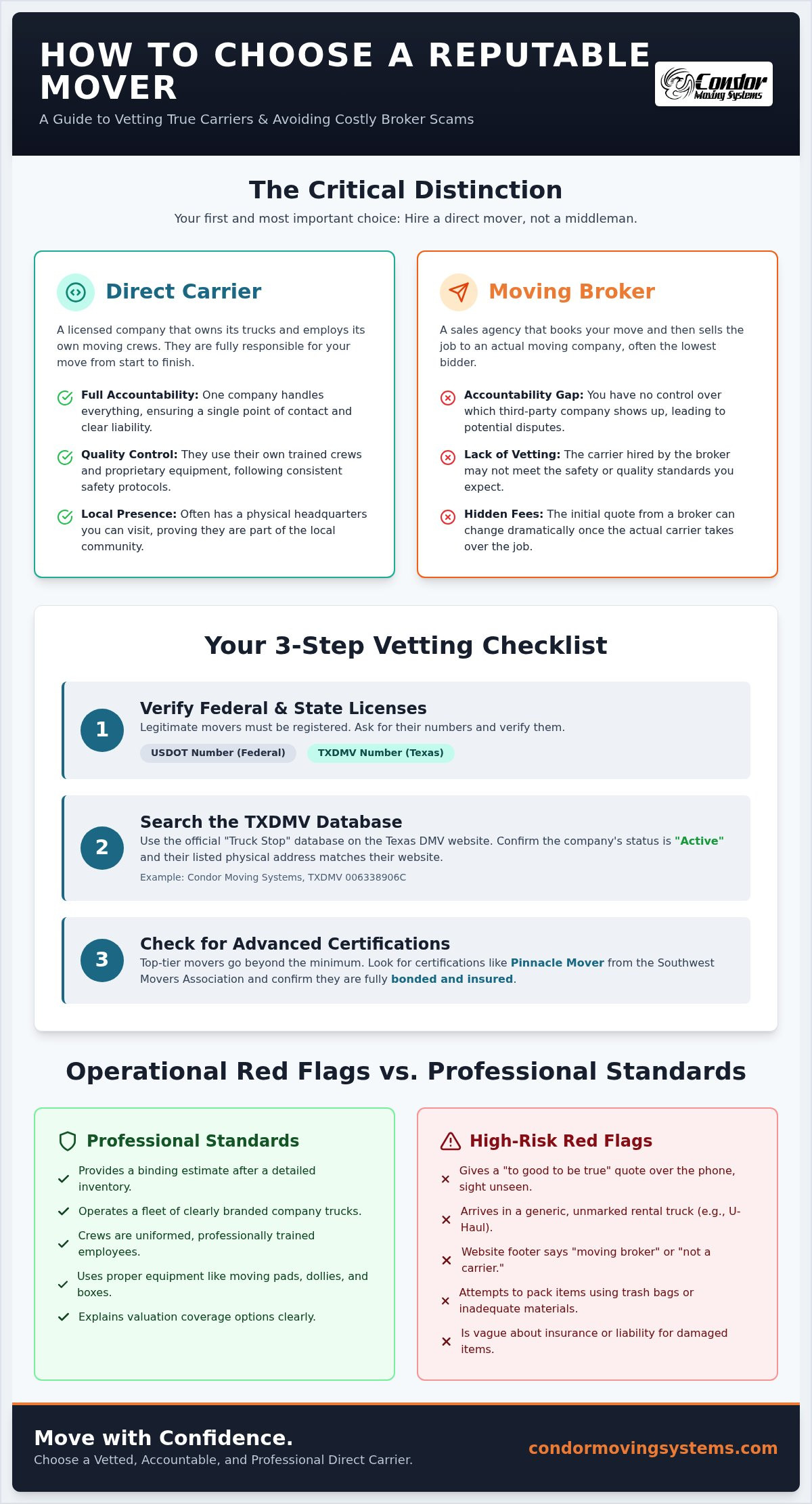
The moving industry is split into two distinct entities: carriers and brokers. Understanding this difference is the first step in learning how to choose a local moving company that actually delivers on its promises. A moving carrier is a licensed company that owns its fleet of trucks and employs the actual crew that performs your relocation. They take full ownership of the process from the initial quote to the final box unloaded. In contrast, a moving broker is essentially a sales agency. They don’t own trucks or employ movers. Instead, they sell your moving contract to a third party carrier, often the one that offers the lowest bid to maximize their own commission.
This creates a significant accountability gap. When you hire a broker, you have no control over which company eventually arrives at your door. This lack of transparency often leads to disputes over pricing, timing, and liability for damaged items. A direct carrier provides a single point of contact, ensuring that the standards promised during your consultation are the same standards maintained on moving day. Reliability isn’t just about showing up; it’s about who is legally and operationally responsible for your property.
How to Identify a Moving Broker
Brokers are legally required to disclose their status, but this information is often buried in fine print. Look at the website footer for phrases like “broker of household goods” or “not a carrier.” If a company provides an estimate without requesting a detailed inventory or performing a virtual walk-through, they’re likely a middleman. Always ask directly if they own their trucks and if the movers are their direct employees. If the answer is vague or non-committal, you’re likely dealing with a broker who will outsource your move to an unknown entity.
The Importance of a Direct Service Provider
Choosing a company that provides direct local moving services ensures that the crew handling your fragile items is trained to the company’s specific safety protocols. A carrier with a local physical headquarters in Texas offers a level of accessibility that a remote broker cannot match. You can verify their equipment, speak with management in person, and trust that their local reputation is at stake with every move. This carrier-based model allows for rigorous internal quality control and clear, direct liability. When you work with a carrier, there’s no finger-pointing between different companies; the responsibility starts and ends with one professional team.
Verifying Credentials: Texas and Federal Licensing Requirements
A legitimate mover’s credentials are the only thing standing between you and a potential “hostage load” situation. When researching how to choose a local moving company, you must verify their legal standing at both the federal and state levels. The USDOT number acts as a universal identifier for the Federal Motor Carrier Safety Administration to track safety audits and compliance. For moves staying entirely within state lines, the TXDMV registration is the primary legal requirement. This registration confirms the company has the mandatory insurance and a “Certificate of Operating Authority” to transport household goods in Texas.
Beyond legal minimums, look for the Pinnacle Mover certification. This is a high-level designation from the Southwest Movers Association that requires companies to meet strict ethical and operational standards. It’s a clear signal that the mover is committed to professional excellence rather than just doing the bare minimum. You should also confirm the company is fully bonded and insured to protect yourself from liability if an injury occurs on your property during the relocation process.
Searching the TXDMV Database
Verification takes only a few minutes but provides lasting security. You can visit the Texas Department of Motor Vehicles website and use their “Truck Stop” database to look up any mover. Follow these steps to ensure accuracy, using a known carrier like Condor Moving Systems (TXDMV 006338906C) as your benchmark:
- Search by the company’s legal name or their TXDMV number.
- Confirm the status is listed as “Active.”
- Ensure the physical address on their website matches the address on the state filing.
If the information doesn’t align, it’s a major red flag. Before finalizing your decision, request a detailed estimate from a verified carrier to see their credentials documented on official paperwork.
Industry Affiliations as Trust Signals
Active membership in the Southwest Movers Association (SMA) shows a commitment to the local Texas moving community and its specific regulations. Another strong indicator of quality is the ProMover certification, which helps consumers distinguish reputable carriers from “rogue” operators. Stability is also a factor. A company that’s been in continuous operation since 2003 demonstrates a proven track record of handling logistical challenges. Twenty years of local experience suggests a business that has survived through accountability and consistent service delivery. These affiliations aren’t just logos; they’re evidence of a long-term commitment to consumer protection.
Operational Red Flags to Watch for During the Selection Process
Identifying a quality mover requires looking at operational details that amateurs often ignore. When researching how to choose a local moving company, the first red flag is an “over the phone” estimate that lacks a detailed inventory. A company that doesn’t ask about the specific number of boxes or the size of your furniture cannot provide a reliable quote. This often leads to price gouging on moving day when the crew claims the load is larger than expected. Professionalism should extend to every touchpoint, including the equipment used. If a company arrives in an unmarked rental truck or the crew lacks branded uniforms, they may be an unregistered subcontractor rather than a dedicated carrier.
The Inventory and Binding Estimate
Understanding the difference between a non-binding and a binding flat-rate quote is a critical part of the vetting process. A non-binding estimate is merely a guess, while a binding estimate commits the company to a specific price based on the inventory provided. To avoid unexpected charges, you must provide a comprehensive list of all items. An Inventory Tagging System is a methodical process where every item is assigned a unique, numbered sticker and logged on a master manifest to ensure total accountability during transit. This system provides a clear paper trail, making it nearly impossible for items to go missing without notice.
Professionalism in Materials and Logistics
Standardized materials are a direct reflection of a company’s safety standards. A strict “No Trash Bags” rule is a hallmark of a professional carrier; trash bags offer zero protection against crushing and make stable stacking in the truck impossible. Professional apartment moving services also require specific logistical planning to navigate tight hallways and elevator time slots. While some fees are red flags, others are standard industry practice. Legitimate additional charges, such as long-carry or stair fees starting at $75, should be disclosed upfront in your contract. Finally, be wary of payment demands that deviate from professional norms. Reputable carriers typically require a structured payment schedule and a formal deposit rather than “cash only” transactions or full payment before the work begins.
Understanding Valuation: Protecting Your Belongings
When you’re researching how to choose a local moving company, the legal jargon surrounding “insurance” can be confusing. It’s vital to understand that movers don’t provide insurance in the traditional sense; they provide valuation. By federal and state law, every licensed mover must include Released Value Protection at no additional cost. This coverage is set at $0.60 per pound per article. While this meets the legal minimum, it rarely covers the actual replacement cost of a high-value item. For example, a 100-pound television damaged in transit would only yield a $60 claim under this standard.
For more comprehensive protection, you should consider Full Value Replacement. This often involves third-party coverage that ensures items are repaired or replaced at current market value. If an incident occurs, you have a 9-month window to file a formal claim. However, professional carriers typically request that you report any service issues or obvious damage within 72 hours of delivery to ensure a swift investigation. This short window allows the company to interview the crew and inspect the truck while the move details are still fresh.
What Valuation Is Not
Valuation is a tariff-based liability level, not a policy you buy from an insurance agent. It’s a contractual agreement between you and the carrier. One critical detail to remember is that coverage levels cannot be modified once the move begins. Additionally, items listed as “Packed by Owner” (PBO) have significantly limited coverage. Because the mover didn’t pack the box, they can’t verify the condition of the contents or the quality of the packing, which often leads to denied claims for internal damage.
Protecting Specialty and High-Value Items
True accountability involves specialized handling for items that a standard box cannot protect. Custom crating is essential for fine art, marble tops, or fragile electronic equipment. For those with industrial-grade requirements, specialists like Caldo Freddo provide advanced polymer barrier protection to ensure sensitive components are shielded from environmental damage. When moving specialty items like pianos, professional standards usually dictate ground-floor to ground-floor service to minimize risk. You should also be aware of “non-allowables.” Legitimate movers will exclude high-risk items like jewelry, cash, and firearms from their liability. You should transport these personal valuables yourself to ensure their safety.
Once you’ve verified credentials and identified operational red flags, the final step in how to choose a local moving company involves understanding the contractual obligations. A reputable carrier uses a structured payment schedule to maintain operational flow and ensure accountability. This typically includes a 20% deposit to secure your date, followed by 30% at pickup and the final 50% upon delivery. This tiered approach protects both the consumer and the mover, ensuring resources are allocated correctly for your specific dates. You should also inquire about military or senior discounts, as established carriers often provide these as a token of professional courtesy to the community.
Clear communication regarding transit times is equally vital for a stress-free relocation. While local moves are often completed quickly, industry standards for regional transitions usually fall within a 1-10 business day window. Understanding these timelines upfront prevents the anxiety of waiting for a truck without a confirmed arrival window. By reviewing these logistical details before signing a contract, you ensure that the company’s operational standards align with your personal expectations.
Securing Your Dates and Deposit
For homeowners who are also managing the logistics of moving a vehicle, coordinating with a dedicated transport provider is a smart move; you can learn more about My Auto Transport Services to see how professional shipping ensures your car arrives safely at its new destination.
Booking your move requires a financial commitment that reflects the company’s dedication to your schedule. It’s standard practice for the initial 20% deposit to be non-refundable, as this secures a dedicated crew and truck for your specific window. Because professional carriers do not outsource their labor, crew availability is limited and managed with precision. If your relocation plans change or if you find yourself preparing for long-distance moves that cross state lines, you must communicate these shifts early to ensure the carrier can adjust the logistical planning and equipment requirements accordingly.
Preparing for Delivery Day
The final phase of your move requires strict adherence to payment and safety protocols to ensure a smooth transition into your new home. On delivery day, professional carriers have specific rules regarding accepted payment methods to prevent fraud and ensure immediate settlement. You should be prepared to pay the remaining 50% balance via cashier’s check, money order, or Zelle; cash, personal checks, and credit cards are typically not accepted at the time of delivery. This protocol is a security measure used by established companies to maintain financial transparency.
Safety and liability constraints also dictate where a crew can deliver your items. For instance, professional movers do not deliver items into attics or basements due to the high risk of injury or property damage in these unconditioned spaces. When the truck arrives, your primary responsibility is to inspect the exterior of your boxes and furniture. If you notice any external damage, you must note it on the Bill of Lading immediately before the crew leaves. This document is the official record of the move and serves as the foundation for any future valuation claims.
Secure Your Relocation with a Verified Carrier
Mastering how to choose a local moving company comes down to verifying direct accountability. By choosing a carrier that owns its fleet and employs its own crews, you eliminate the risks associated with third-party brokers. Always verify mandatory licensing through the TXDMV and USDOT databases to ensure you’re working with a legitimate, insured professional. A binding inventory and clear payment protocols are your best defenses against hidden fees and logistical ambiguity.
Condor Moving Systems is a fully licensed and insured carrier (USDOT 1126171 | TXDMV 006338906C) that has provided full-service relocation since 2003. As a Pinnacle Mover certified specialist and active SMA member, we provide the direct oversight that brokers cannot match. We take full ownership of your move from the first quote to the final delivery, ensuring your property is handled by seasoned experts who value precision and transparency.
Your transition to a new home should be defined by professional execution and peace of mind. We’re ready to handle the heavy lifting while you focus on your next chapter.
Frequently Asked Questions
How do I know if a mover is a broker or a carrier?
Check the website footer for mandatory broker disclosures. A carrier owns trucks and employs the crew directly, while a broker sells the contract. Ask for their USDOT and TXDMV numbers; carriers must have their own operating authority. If they provide a quote without a detailed inventory or walk-through, they’re likely a broker. This distinction is critical when learning how to choose a local moving company that maintains direct accountability.
What is the difference between a binding and non-binding estimate?
A binding estimate is a guaranteed price based on a specific inventory of items. It protects you from price spikes on moving day. A non-binding estimate is merely a projection of the final cost based on weight or time. If you add more items, a binding estimate can be adjusted, but it generally offers more budget security. Always demand a binding, flat-rate quote in writing to ensure total transparency and avoid hidden fees.
Are local movers in Texas required to be licensed?
Yes, every mover operating within the state must be registered with the Texas Department of Motor Vehicles. This registration requires the company to maintain specific insurance levels and follow state safety regulations. You can verify a company’s “Certificate of Operating Authority” through the TXDMV database. Licensed carriers will also have a USDOT number for federal oversight, providing another layer of consumer protection and operational accountability for every local relocation within Texas.
What should I do if my items are damaged during a local move?
You must note any external damage on the Bill of Lading before the crew leaves your property. This document serves as the primary evidence for any future claim. After the move, contact the company’s claims department immediately. Most professional carriers require service issues to be reported within 72 hours, though you have up to nine months to file a formal valuation claim under state and federal guidelines to protect your financial interests.
Why do moving companies refuse to move items in trash bags?
Trash bags offer no structural protection for your belongings and cannot be stacked safely in a moving truck. They’re prone to tearing, which leads to lost or damaged items during transit. Professional carriers require boxes or custom crates to ensure a stable load and to maximize the safety of your property. This standard is a key indicator of a company’s commitment to professional logistics and safe handling practices throughout the entire moving process.
Can I pay for my move with a credit card at the time of delivery?
Most reputable carriers don’t accept credit cards, cash, or personal checks at the time of delivery to ensure secure financial processing. Standard accepted methods usually include cashier’s checks, money orders, or Zelle. This protocol helps prevent fraud and ensures that the final payment is settled immediately upon the completion of service. Always confirm the accepted payment methods with your coordinator well before the truck arrives at your new home to avoid delivery delays.
Do local moving companies provide storage solutions if my new home isn’t ready?
Professional full-service carriers often provide both short-term and long-term storage solutions in climate-controlled facilities. This is a common need when closing dates shift or renovations take longer than expected. Your items remain in the carrier’s custody, which maintains a single point of accountability. When researching how to choose a local moving company, ask if their storage is vaulted or racked to understand exactly how your belongings will be protected while in their care.
What items are considered “non-allowable” for local movers?
Non-allowables include hazardous materials like propane tanks and paint, as well as high-value personal items like jewelry, cash, and firearms. Professional movers are prohibited by safety regulations or insurance policies from transporting these goods. You should plan to transport these items yourself in your personal vehicle. A legitimate carrier will provide a complete list of non-allowables during your initial consultation to help you prepare for a safe relocation and avoid last-minute packing issues.