


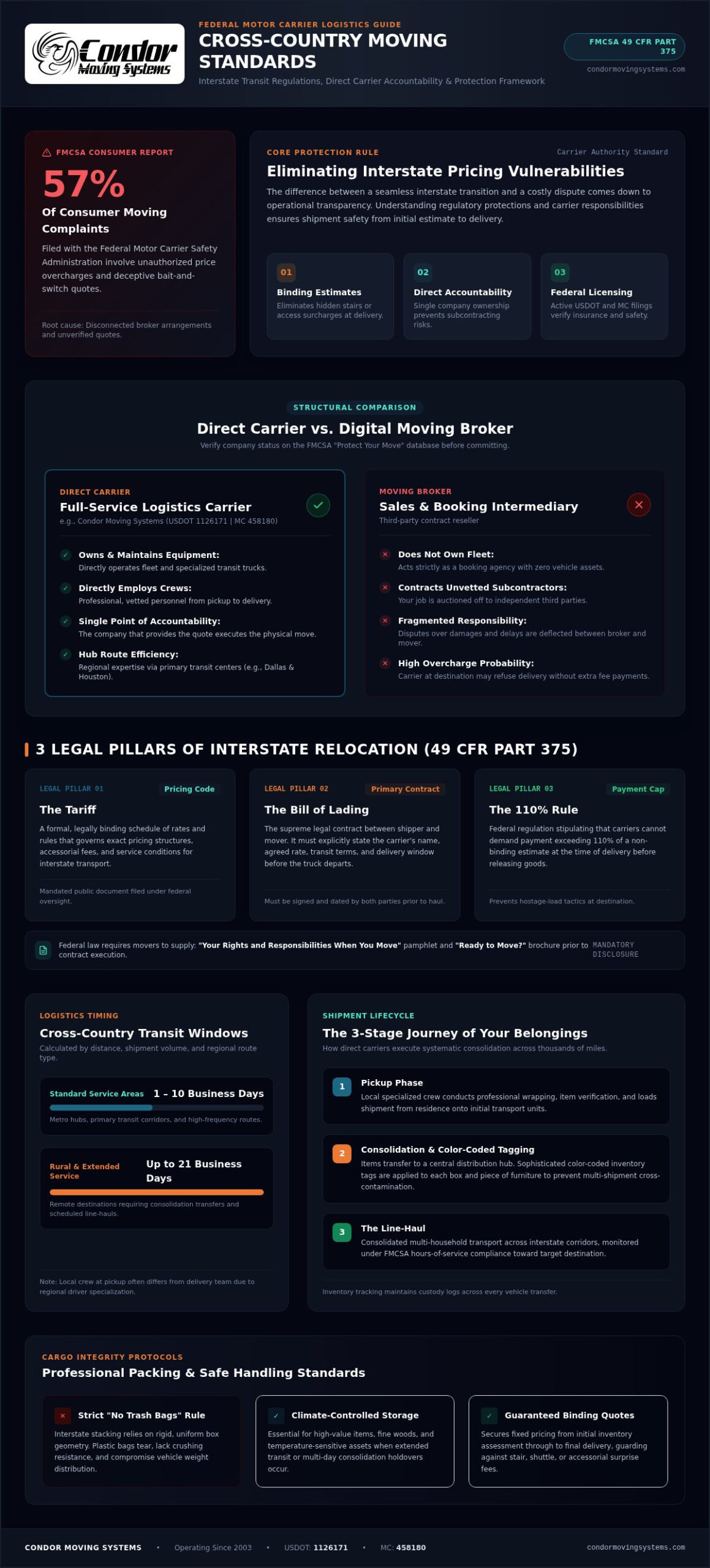
Did you know that 57% of consumer moving complaints filed with the FMCSA involve unauthorized price overcharges and bait-and-switch quotes? When you’re planning a relocation across state lines, the difference between a seamless transition and a logistical nightmare often comes down to the company you hire. Finding reputable cross country movers shouldn’t feel like a gamble with your life’s possessions. You’ve likely felt the anxiety of hearing about hidden surcharges for stairs or shipments that sit in a warehouse for weeks without an update.
We understand that you want total accountability and a price that stays fixed from the initial quote to the final box. This 2026 buyer’s guide provides the professional framework you need to identify reliable direct carriers, avoid the common traps set by digital brokers, and ensure your items arrive safely. You’ll learn how to secure a binding estimate you can trust, what to look for in a professional crew, and how to maintain clear communication throughout the transit period. By the end of this guide, you’ll have a clear roadmap for a successful, damage-free interstate relocation.
Key Takeaways
- Identify the critical differences between direct carriers and brokers to ensure the company you hire maintains full accountability for your shipment.
- Learn how reputable cross country movers calculate transit times and why some routes require up to 21 days for delivery.
- Master the art of securing a binding estimate to eliminate surprise surcharges and ensure your final bill matches your initial quote.
- Discover why professional packing standards, including the strict “no trash bags” rule, are essential for a damage-free arrival.
- Gain insights into the specialized handling and climate-controlled storage options available for protecting high-value items during long-distance transit.
What Are Cross Country Movers and Why Choosing a Carrier Matters
Cross country movers are specialized entities legally authorized to transport household goods across state lines. These companies operate under the strict oversight of the Federal Motor Carrier Safety Administration (FMCSA). To function legally, a carrier must maintain active USDOT and MC numbers, which prove they meet federal safety and insurance standards. Understanding professional moving company operations is your first defense against the logistical errors that often plague long-distance relocations.
The most common trap for consumers is failing to distinguish between a carrier and a broker. A moving broker is essentially a sales agency that books your relocation and then sells the contract to a third party. This often leads to a lack of accountability and unexpected surcharges. When you hire a direct carrier, you’re working with the same team from pickup to delivery. This model is especially beneficial when moving through major hubs like Dallas or Houston. Localized expertise in these regions allows for more efficient route planning and reliable scheduling across the country.
Identifying a Direct Carrier vs. a Moving Broker
You can easily verify a company’s status by checking the FMCSA’s “Protect Your Move” database. Look for “Carrier” status to ensure you aren’t dealing with a middleman. Brokers usually don’t own trucks or employ their own crews, which increases the risk of your possessions being handled by unvetted subcontractors. Condor Moving Systems has operated as a full-service carrier since 2003 (USDOT 1126171, MC 458180), maintaining total control over the moving process. Choosing long-distance moves managed by a direct carrier ensures that the people who quote your move are the same people who execute it.
The Legal Requirements for Interstate Relocation
Federal law requires all interstate movers to provide you with the “Your Rights and Responsibilities When You Move” pamphlet and the “Ready to Move?” brochure. These documents explain your protections under 49 CFR Part 375. Pricing for these moves is based on a tariff, which is a formal schedule of rates and rules. There are three key legal pillars to every move:
- The Tariff: A formal schedule of rates and rules that governs pricing and service conditions.
- The Bill of Lading: Your primary legal contract that must contain the carrier’s name, the agreed price, and delivery dates.
- The 110% Rule: A federal regulation stating that carriers cannot demand more than 110% of a non-binding estimate at the time of delivery.
It’s vital that your cross country movers provide a Bill of Lading that matches your original estimate to prevent the price inflations that account for 57% of industry complaints. Always ensure the document is signed and dated by both parties before the truck pulls away. This contract is your ultimate protection if disputes arise regarding transit times or property damage.
Understanding Cross-Country Logistics and Transit Times
Logistics for a move spanning thousands of miles require a methodical approach that differs significantly from local relocations. For standard service areas, professional cross country movers typically estimate a transit window of 1 to 10 business days. However, if your destination is in a rural or “extended service” region, the timeline can expand to 21 business days. These durations are calculated based on the distance, the volume of the shipment, and the specific route requirements. To maintain order during these complex hauls, carriers utilize sophisticated tagging systems where every item is inventoried and color-coded. This prevents loss when shipments from multiple households are consolidated on a single trailer. Following FMCSA interstate moving regulations ensures that these tracking and inventory processes remain transparent and legally compliant.
The Journey of Your Belongings
Your relocation unfolds in three distinct stages: pickup, consolidation, and the line-haul. During the pickup phase, a local crew loads your possessions. These items are then brought to a central hub for consolidation, where they are organized for the long-haul journey. Our expertise in long-distance moves allows us to navigate these stages with precision. It is common for the pickup crew to differ from the delivery crew in national logistics, as different teams specialize in specific regions. You should expect regular updates throughout this period, with a final arrival notification provided 24 to 48 hours before the truck reaches your home.
Transit Time Guarantees and Delay Reimbursements
Most industry providers offer a delivery window rather than a specific date. If you require your belongings on a precise day, a “dedicated truck” service is the only way to guarantee that timeline. For standard shipments, it’s essential to review the carrier’s delay policy. Condor Moving Systems provides a $15.00 per day reimbursement if the delivery exceeds the estimated transit schedule. This provision reflects our commitment to accountability and helps manage expectations for moves to more remote regions. If you’re preparing for a complex relocation, you can request a detailed estimate to see how these timelines apply to your specific route.
Comparing Moving Costs: Binding Estimates and Surcharges
Securing a binding estimate is the most effective way to insulate yourself from the pricing volatility that often defines long-distance logistics. While a non-binding estimate provides a general idea of cost, it allows for upward adjustments based on final weight or volume. In contrast, a binding estimate locks in a guaranteed flat-rate price, provided the inventory remains unchanged. Professional cross country movers rely on a comprehensive inventory to generate these quotes. If you add items on moving day, the original agreement becomes void. Beyond the base rate, you must account for fuel surcharges, which typically range between 10% and 20% of the line-haul charges. The FTC long-distance moving guidance recommends scrutinizing these details early to identify red flags and ensure total pricing transparency.
Condor Moving Systems requires a 20% non-refundable deposit to secure your move date. It’s also vital to understand the industry payment standards, as rogue operators often demand large cash sums upfront. At the time of delivery, payment is strictly limited to cashier’s checks, money orders, or Zelle. Credit cards and personal checks aren’t accepted at the destination to ensure immediate and secure settlement of the balance. This structure protects both the carrier and the client by establishing clear financial expectations before the first box is loaded.
Technical Surcharges Explained
Many “surprise” costs on moving day result from site-specific challenges that weren’t disclosed during the quoting process. A long-carry fee is triggered if the distance between the truck and your front door exceeds 150 feet. Similarly, stair fees apply if the crew must navigate more than 14 steps. If your street cannot accommodate a standard 18-wheeler, a shuttle service is required. This involves transferring your goods to a smaller box truck for final delivery, which starts at a minimum rate of $450.00. Providing photos or video of your entryways helps your long-distance moves stay within the quoted budget.
Valuation vs. Insurance: Protecting Your Shipment
Standard coverage is known as Released Value Protection. This is a federally mandated tariff liability that covers items at $0.60 per pound per item. It’s important to realize this isn’t insurance, but a baseline level of carrier responsibility. For high-value items like fine art or electronics, we recommend purchasing Full Value Replacement through a third-party provider. Keep in mind that “Owner Packed” (PBO) boxes carry zero liability unless there is visible exterior damage to the carton. Using proper materials is essential for safety. Trash bags are strictly prohibited and will be refused by the crew, as they offer no protection against transit vibrations.
Preparing for the Move: Packing Standards and Non-Allowables
Professional packing serves as the primary defense against the constant vibrations of a 2,000 mile journey. Unlike local moves, where items spend minimal time on a truck, cross country movers must secure shipments for days of high speed transit across varying terrain. This environmental stress is why we enforce a strict “No Trash Bags” policy. Plastic bags offer zero structural integrity and often tear, leading to property damage or loss. All items must be contained in sturdy, corrugated cardboard boxes to ensure they can be stacked safely within the trailer without collapsing.
Handling specialty items requires a disciplined approach. Professional cross country movers provide specialized techniques for items like pianos and custom bikes. While we offer disassembly for complex furniture like pool tables, please note that reassembly is not included in the standard service scope. For high value glass or fine art, utilizing Professional Fragile Item Packing is the most reliable way to ensure these pieces survive the rigors of interstate travel. Our crews are trained to handle these items with the resources of a large scale enterprise and the focus of a dedicated specialist.
The Non-Allowables List
Federal regulations and safety protocols prohibit the transport of certain materials. Attempting to ship these items can void your valuation and create significant safety hazards during the line-haul phase. The following items must be handled personally or disposed of before the crew arrives:
- Hazardous Materials: Paint, propane tanks, ammunition, explosives, and household chemicals.
- Personal Valuables: Jewelry, cash, deeds, securities, and coin or stamp collections.
- Perishables and Living Things: Live plants, perishable foods, and pets or animals.
- Restricted Items: Firearms and legal documents that require immediate access.
Packing for Success
Choosing between full-service and partial packing depends on your budget and the complexity of your inventory. Full-service packing ensures that every item is professionally wrapped and boxed by our licensed crews, who take full ownership of the process. If you choose to pack your own boxes, remember that owner-packed cartons carry zero liability unless there is visible exterior damage. For fine art or high-value glass, custom crating provides a rigid shell that prevents shifting. Every box should be clearly labeled with its contents and the destination room to ensure a structured and efficient unpacking process at your new home.
The Condor Advantage: Direct Cross-Country Solutions
Condor Moving Systems operates as a full-service carrier, which means we maintain total control over your relocation from start to finish. Unlike brokers who outsource contracts to unvetted third parties, our licensed, professional crews handle every aspect of the transition. This direct-service model is the foundation of our reliability. We offer comprehensive solutions including climate-controlled storage for clients who need a temporary bridge between homes. If you’re searching for cross country movers who take full responsibility for your shipment, choosing a carrier with over 20 years of experience provides the stability your move requires.
We prioritize clear communication through 24-hour emergency customer service and dedicated support lines. You shouldn’t have to wait for answers while your life is in transit. Our binding estimates provide financial peace of mind by locking in a guaranteed flat-rate quote. This eliminates the risk of “weight bumping” or other common industry scams, provided your inventory remains consistent with the original agreement. We take ownership of the work, ensuring that the team that loads your truck is the same organization accountable for the delivery.
Our Service Footprint
While we maintain a national reach, our expertise is deeply rooted in Texas hubs like Dallas, Houston, and Austin. This regional specialization allows us to navigate the complexities of Southern logistics with an efficiency that larger, detached networks often lack. We combine the resources of a large-scale enterprise with the personalized care of a specialized independent mover. You can explore our full range of Long Distance Moving Services to see how we tailor our operations to your specific route.
Booking Your Move
The process begins with a thorough inventory to ensure your quote is as accurate as possible. We require a 20% non-refundable deposit to secure your date, allowing us to commit the necessary equipment and personnel to your move. At the destination, we accept only cashier’s checks, money orders, or Zelle for the remaining balance. This policy ensures a secure and immediate settlement without the complications of credit card processing fees or personal check delays. If you’re ready to secure your relocation with established cross country movers, we’re prepared to deliver a seamless, professional experience.
Get your free, no-obligation binding estimate today
Securing Your Future with Reliable Interstate Relocation
Relocating across state lines is a significant milestone that requires a disciplined, professional approach to ensure your possessions arrive safely. By prioritizing a direct carrier over a third-party broker, you establish a clear chain of accountability that protects your interests from pickup to delivery. The most successful moves are built on binding estimates and strict packing standards that eliminate the risk of hidden surcharges or transit damage.
As a Pinnacle Mover Certified carrier with over 20 years of relocation expertise, Condor Moving Systems provides the stability and operational integrity needed for a seamless transition. You don’t have to navigate the complexities of long-distance logistics alone. Choosing experienced cross country movers who manage the entire process with their own licensed crews ensures that every detail is handled with precision. We take full ownership of the work, providing climate-controlled storage and specialized handling for your most valuable items. Our team is committed to delivering your shipment on time and within the guaranteed flat-rate budget we’ve established.
We look forward to helping you start this new chapter with total peace of mind and professional care. Your journey to a new home deserves the steady hand of a dedicated specialist.
Frequently Asked Questions
What is the difference between a moving carrier and a broker?
A moving carrier is a direct service provider that owns its fleet and employs its own crews to execute your relocation. In contrast, a broker is a sales entity that books your move and then sells the contract to a third-party company. As a direct carrier serving hubs like Dallas and Houston, Condor Moving Systems manages the entire process from pickup to delivery. This model ensures total accountability and eliminates the communication gaps often found with brokers.
How much does a cross-country move typically cost in 2026?
Cross-country moving costs are calculated based on the total weight or volume of your shipment, the distance traveled, and any additional services like custom crating. In 2026, reputable cross country movers provide binding estimates to ensure your final bill remains predictable. These quotes typically include a fuel surcharge ranging from 10% to 20%. To get an accurate price for your relocation from Austin or Plano, you must provide a detailed inventory to your carrier.
How long will it take for my belongings to arrive at my new home?
Standard transit times for long-distance relocations typically range between 1 and 10 business days. However, if you’re moving to a rural or extended service area, delivery may take up to 21 business days. These timelines depend on the specific route and current logistical conditions. We provide two primary notifications during the journey: one when your items are in transit and another 24 to 48 hours before the truck arrives at your destination in Southlake or McKinney.
Is my move insured for full replacement value?
Standard interstate moves include Released Value Protection at no additional cost. This is a tariff liability that covers your items at a rate of $0.60 per pound per item. It’s important to realize this isn’t insurance. If you require comprehensive coverage for high-value items like electronics or fine art, you should purchase Full Value Replacement through a third-party provider. This ensures your belongings are protected at their current market value during transit across state lines.
Can I pack my own boxes to save money on a long-distance move?
You can choose to pack your own boxes to reduce costs. However, please be aware that cross country movers don’t accept liability for the contents of “Owner Packed” (PBO) cartons unless the exterior of the box shows visible damage. For safety reasons, we don’t allow trash bags as packing material. All items must be secured in sturdy cardboard boxes. If you have fragile items in Frisco or Irving, professional packing remains the most reliable defense against transit vibrations.
What payment methods are accepted on the day of delivery?
On the day of delivery, accepted payment methods are strictly limited to cashier’s checks, money orders, or Zelle. We don’t accept cash, personal checks, or credit cards at the destination. This policy ensures a secure and immediate settlement of the remaining 50% balance. It’s helpful to have your payment ready before the driver arrives to avoid any delays in the unloading process at your new home in San Antonio or Arlington.
Are there items that cross-country movers are not allowed to transport?
Federal regulations and safety protocols prohibit the transport of hazardous materials like paint, propane, and ammunition. Additionally, professional movers can’t transport perishables, live plants, or animals. You should personally carry high-value items such as jewelry, cash, deeds, and coin collections. For a complete list of restricted items, we recommend reviewing our resource center before your move date in Fort Worth or Grapevine to ensure a smooth loading day without any last-minute complications.
What happens if my delivery is delayed beyond the estimated window?
If your delivery exceeds the estimated transit schedule, Condor Moving Systems provides a reimbursement of $15.00 per day. While we strive to meet every delivery window, unexpected delays can occur due to weather or mechanical issues. This provision offers a level of financial accountability for our clients. We maintain clear communication through our 24-hour answering service to keep you updated on any changes to your shipment’s arrival time at your new residence.