



The most expensive moving quote you’ll ever receive isn’t the one with the highest number; it’s the one that changes on moving day. Most homeowners feel a genuine sense of dread when they start researching how much do movers cost, fearing that a low initial estimate is simply a lure for hidden fees and last-minute surcharges. It’s a valid concern in an industry where many providers act as intermediaries rather than the people actually lifting the boxes. You deserve a relocation process that is defined by professional accountability and price certainty from the very first phone call.
This 2026 guide provides a transparent breakdown of residential moving costs, from base line-haul rates to specific Texas logistical fees, so you can plan your budget without any unwelcome surprises. We’ll explain the critical distinction between hiring a licensed carrier and a broker, ensuring you know exactly who is responsible for your belongings. You’ll also learn how specific factors like fuel surcharges, stair fees, and long-carry requirements impact your bottom line. By the end of this article, you’ll understand how to secure a binding, flat-rate quote that protects your interests and guarantees a professional, background-checked crew.
Key Takeaways
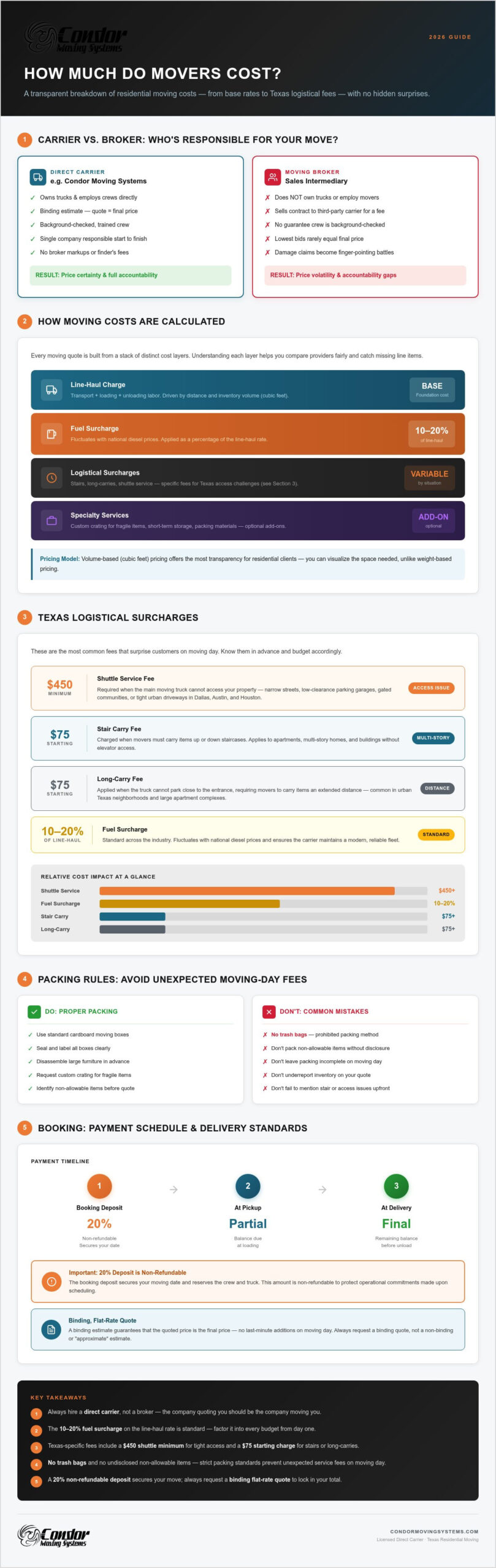
- Learn why hiring a direct carrier instead of a broker is the most effective way to ensure price accountability and avoid hidden markups.
- Understand how much do movers cost by analyzing line-haul rates and the standard 10% to 20% fuel surcharge applied to residential moves.
- Identify specific logistical fees for Texas relocations, including the $450 shuttle minimum for tight access or the $75 starting charge for stairs and long-carries.
- Avoid unexpected service fees on moving day by following strict packing standards, such as the prohibition of trash bags and specific non-allowable items.
- Gain total budget certainty by reviewing the 20% non-refundable deposit and the required payment schedule for pickup and delivery.
Choosing Residential Movers: Why Carrier vs. Broker Models Affect Your Cost
The question of how much do movers cost is often answered with a number that feels solid but is actually a placeholder. This price volatility usually stems from the business model of the company you hire. In the moving industry, providers generally fall into two categories: direct carriers and brokers. A direct carrier, such as Condor Moving Systems, owns its fleet of trucks, employs its own crews, and maintains direct authority over the entire logistical process. We take full ownership of the move from the initial estimate to the final delivery. This model is built on accountability; the company that gives you the quote is the same company that carries your furniture.
In contrast, a moving broker is a sales entity that does not own trucks or employ movers. Instead, they act as an intermediary, selling your contract to a third-party carrier for a fee. This model often leads to unexpected price increases on moving day because the broker and the carrier may have different standards for inventory and labor costs. At Condor, we operate as a direct carrier to ensure pricing integrity. By eliminating the middleman, we provide a binding estimate that reflects the actual work required, protecting you from the “finder’s fees” and communication gaps inherent in the broker system.
Accountability and Price Certainty
Direct communication with your moving team is the most effective way to eliminate “lost in translation” fees. When you work with a carrier, the inventory specialist and the moving crew operate under the same management and pricing guidelines. This internal alignment ensures that every item is accounted for and that logistical challenges are identified before the truck arrives. Our internal inventory tracking systems allow us to provide more accurate initial estimates because we aren’t guessing what a third-party sub-contractor might charge. This level of control provides the price certainty necessary for a stress-free transition, whether you are coordinating local movers in Texas or a complex interstate relocation.
The Hidden Risks of Moving Brokers
The primary risk of the broker model is the lack of control over who actually shows up at your door. Since brokers outsource the labor, you have no guarantee that the crew has been background-checked or trained to professional standards. Brokers often present the lowest initial bids to secure your deposit, but these quotes are rarely the final word on how much do movers cost. Once a sub-contractor takes the job, they may demand additional fees for services the broker failed to mention, such as stair carries or shuttle requirements. Furthermore, resolving damage claims becomes a bureaucratic nightmare as the broker and the carrier deflect responsibility onto one another. Hiring a direct carrier eliminates this ambiguity, ensuring that one company remains responsible for your belongings from start to finish.
How Residential Moving Costs Are Calculated
Calculating the final bill for a relocation involves several distinct variables. When homeowners ask how much do movers cost, they are often referring to the line-haul charge. This is the foundational cost of transporting goods from your current residence to your new destination. It covers the basic use of the truck and the professional labor required for loading and unloading. However, this is only the starting point. A standard estimate also includes a fuel surcharge, which typically ranges between 10% and 20% of the line-haul rate. This fee fluctuates according to national diesel prices and ensures the carrier can maintain a reliable, modern fleet.
The pricing model itself usually depends on either weight or inventory volume measured in cubic feet. We find that volume-based pricing offers the most transparency for residential clients, as it allows for a clear visualization of the space required. Beyond transport, specialized services like custom crating for fragile items or short-term storage will influence the total. These additions provide the necessary protection for your investment and allow for a more flexible moving timeline. Understanding these components helps you evaluate how much do movers cost when comparing different service levels.
The Components of a Moving Estimate
A professional estimate details the specific labor hours and equipment needed for your move. Distance is the primary driver for long-distance quotes, as it dictates fuel consumption and driver logging requirements. Inventory accuracy is the most vital factor in maintaining your budget. When your list is precise, you avoid unexpected volume charges that occur when a truck is overloaded. Our team prioritizes thorough walkthroughs to ensure the initial quote remains the final price.
Binding vs. Non-Binding Estimates
Understanding the difference between estimate types is essential for price protection. A binding estimate provides a guaranteed flat-rate quote. This means your price is locked in as long as the inventory does not change. Non-binding estimates are less certain, as they are essentially educated guesses that can increase if the move takes longer than expected. For a deeper look at your options, read our resource on Relocation Companies: How to Get a Free Moving Quote. If you value total financial clarity, you can request a binding estimate to secure your moving date and price.
Texas Logistical Surcharges: Shuttles, Long-Carries, and Stairs
While the line-haul rate covers the primary transport, logistical surcharges often determine the final reality of how much do movers cost. Texas presents unique geographic and architectural hurdles that require additional labor or specialized equipment. For instance, if a full-sized 18-wheeler cannot safely enter your narrow street or gated community, a shuttle service becomes necessary. This process involves transferring your belongings from the tractor-trailer into a smaller box truck for final delivery. Due to the extra equipment and double-handling required, shuttle services carry a $450 minimum charge.
Beyond vehicle access, the physical layout of your residence can trigger specific labor fees. A long-carry fee applies when the distance from the moving truck to your front door exceeds 150 feet. This fee starts at $75 and compensates the crew for the significant increase in physical effort and time. Similarly, stair fees start at $75 and are applied when the crew must navigate more than 14 steps. These charges are not arbitrary; they reflect the increased risk and labor intensity associated with complex architectural layouts. Specialized items like pianos, pool tables, or custom motorcycles also require dedicated handling fees to ensure they are crated and transported with the necessary precision.
Access Challenges in Major Texas Hubs
Urban density in cities like Dallas and Austin frequently creates access constraints that impact your moving budget. High-rise apartment complexes often have restrictive loading zones or small service elevators that necessitate longer carry times. Gated communities in suburban areas may also have weight limits on roads that prevent large rigs from entering. You can identify these needs early by measuring the distance from your curb to your door. If the path is obstructed or excessively long, communicating this during the estimate phase prevents “surprise” fees on moving day. For residents in these areas, choosing reliable local moving services for a stress-free home transition ensures these Texas-specific logistics are handled by experts who know the local infrastructure.
Valuation Coverage vs. Insurance
It is vital to distinguish between valuation and actual insurance. By federal law, all licensed carriers provide Released Value Protection at no extra cost, covering your belongings at $0.60 per pound. This is a minimal level of protection and rarely covers the full cost of high-value electronics or furniture. If you require comprehensive protection, you should consider third-party Full Value Replacement insurance. This coverage ensures that in the unlikely event of damage, you receive the current market value for repairs or replacement. Understanding these options is a key part of evaluating how much do movers cost and ensuring your peace of mind throughout the relocation process.
Preparation and Packing: How to Avoid Unexpected Fees
When you calculate how much do movers cost, the physical preparation of your home is a variable often overlooked. Proper packing is non-negotiable. Unexpected fees on moving day are frequently the result of non-compliance with industry safety standards rather than the transport itself. We enforce a strict ban on the use of trash bags for any items. Trash bags are impossible to stack securely, offer no protection against weight-bearing loads, and are prone to tearing during transit. Every item in your inventory must be secured within a box or crate to prevent damage and ensure the crew can load the truck efficiently.
Operational boundaries also exist to protect both the client and the crew. Our professional movers don’t provide debris or trash removal services; the residence must be clear of waste before the team arrives. For liability and safety reasons, crews also don’t enter unfloored attics or crawl-space basements. These areas often lack the structural reinforcement necessary for heavy lifting and professional maneuvering. Ensuring your items are moved to a main floor or a garage before the truck arrives is the best way to avoid labor delays that can increase your final bill.
Professional Packing Standards
The method you choose for packing directly impacts your liability coverage. If you opt for owner-packed (PBO) boxes, please be aware that valuation coverage is limited because the carrier cannot verify the condition of the items before they were sealed. For high-value or exceptionally fragile pieces, custom crating is the industry standard for protection. This specialized service ensures your most valuable assets are secured in tailor-made wooden enclosures. For a detailed breakdown of these techniques, see our Professional Fragile Item Packing: 2026 Protection Guide.
Items You Must Transport Personally
Certain items are legally prohibited from being loaded onto a commercial moving truck. You must personally transport essential documents such as deeds, securities, and stamp collections, along with cash and jewelry. Hazardous materials, including propane tanks, paint, and household chemicals, pose a severe safety risk and are strictly forbidden by federal regulation. Plants and perishable food items are also excluded from transport because they cannot withstand the environmental conditions of a long-haul trailer. Identifying these items early is a critical step in understanding how much do movers cost and avoiding last-minute logistical conflicts.
Booking Your Move: Payment Schedules and Delivery Standards
Securing your moving date requires a 20% non-refundable deposit. This initial payment isn’t just a formality; it’s a commitment that reserves a specific truck and a background-checked crew for your relocation. When homeowners evaluate how much do movers cost, they must consider the structure of the payment schedule as a benchmark for professional accountability. We utilize a transparent 20/30/50 split. Following the initial deposit, 30% of the total is due at the time of pickup, with the remaining 50% balance settled at delivery. This methodical approach ensures that your financial interests are protected throughout every phase of the transport process.
To maintain operational security and provide a clear paper trail, we accept payments via cashier’s check, money order, or Zelle. These methods provide a level of verification that protects both the client and the carrier. Staying informed during transit is equally important for your peace of mind. We utilize a dedicated two-notification system. You’ll receive direct updates as your shipment progresses, allowing you to coordinate your arrival at the new residence with total certainty. This clear communication flow is designed to eliminate the anxiety often associated with long-haul logistics.
Delivery Day Protocols
Final payment is required before the unloading process begins at your new destination. It’s vital to remember that we don’t accept cash, personal checks, or credit cards at the time of delivery. Having your cashier’s check or money order prepared in advance prevents delays and ensures a professional conclusion to your move. Once the crew completes the job, you have a 72-hour window to report any service issues or concerns. This timeframe allows you to inspect your belongings thoroughly while the details of the move are still fresh. In the rare instance of a logistical delay, we provide a $15 per day reimbursement provision. This policy reflects our commitment to punctuality and our willingness to take full responsibility for the agreed-upon timeline.
The Condor Moving Systems Advantage
Partnering with a provider that has over 20 years of Texas moving expertise offers a level of stability that brokers simply cannot match. We’re Pinnacle Mover Certified, which means our operations meet the highest rigorous standards for safety and professional conduct in the state. Because we handle every move with our own crews and equipment, we have total control over the quality of the work. This direct carrier model is the primary reason our binding estimates are so reliable. When you ask how much do movers cost, the answer should always include the value of direct accountability. For more insights on choosing a high-standard provider, see our Best Long Distance Moving Companies of 2026: A Complete Buying Guide.
Securing Your Relocation with Total Price Certainty
Planning a residential move requires more than just a list of boxes; it demands a partner who provides operational integrity and absolute transparency. By understanding the critical differences between direct carriers and brokers, you’ve already taken the first step toward avoiding the hidden fees that typically inflate final bills. Whether you are navigating the narrow streets of a major Texas hub or calculating the impact of fuel surcharges, the key to a successful relocation is a binding estimate that accounts for every logistical detail. You now have the professional tools to evaluate how much do movers cost with total precision.
Condor Moving Systems brings over 20 years of Texas expertise to every transition. As a USDOT Licensed Carrier (1126171) and Pinnacle Mover Certified specialist, we take full responsibility for your belongings from pickup to final delivery. We are here to ensure your move is handled with the disciplined execution and accountability you deserve.
We look forward to providing the security and peace of mind your family needs for a seamless home transition.
Frequently Asked Questions
What is the difference between a moving carrier and a broker?
Condor Moving Systems is a direct carrier, meaning we own our fleet and employ our own crews. A broker is a sales entity that sells your contract to a third-party company. Hiring a carrier ensures direct accountability and prevents the price hikes often associated with intermediaries. This distinction is vital when calculating how much do movers cost for families in Dallas or Houston who require a reliable, binding estimate.
How much does a shuttle service cost if the truck can’t reach my home?
In many Austin neighborhoods or gated communities in Frisco, a shuttle service is required if an 18-wheeler cannot safely enter. Our shuttle service is priced at $0.75 per cubic foot with a minimum charge of $450. This fee covers the labor and equipment needed to transfer your belongings from the tractor-trailer to a smaller box truck for final delivery to your doorstep. The contract figure governs the final cost.
Can I pay for my move with a personal check or cash at delivery?
No, we don’t accept cash, personal checks, or credit cards at the time of delivery. For the final 50% balance, accepted payment methods are limited to cashier’s checks, money orders, or Zelle. This policy ensures a secure and verifiable transaction for our clients in Fort Worth and San Antonio. You may use a credit card for the initial deposit or pickup payment, though a 3% convenience fee applies to those transactions.
Why are trash bags prohibited for packing residential moves?
Trash bags are strictly prohibited because they don’t protect your items and are impossible to stack safely in a moving truck. Using bags increases the risk of damage and slows down the loading process for our crews in Plano and McKinney. To maintain professional standards, all items must be placed in sturdy boxes or crates. We offer professional packing and custom crating services for those who need assistance meeting these safety requirements.
Does standard moving valuation cover items I packed myself?
Standard Released Value Protection covers items at $0.60 per pound, but it generally doesn’t apply to owner-packed (PBO) boxes unless there’s visible damage to the exterior of the box at delivery. This is a common factor in determining how much do movers cost when choosing between self-packing and professional packing services. For comprehensive coverage of high-value items in Irving or Grapevine, we recommend purchasing Full Value Replacement through a third-party provider.
What happens if my delivery is delayed beyond the estimated window?
While we strive for punctuality across all Texas relocations, we provide a $15 per day reimbursement for every day a delivery is delayed beyond the estimated transit window. This provision offers financial protection and reflects our commitment to reliability. Our two-notification system keeps you informed during transit, so you always know the status of your shipment as it moves toward your new home in Arlington or Southlake.
Are there discounts for military families or senior citizens?
Yes, Condor Moving Systems proudly offers specialized discounts for active-duty military members, veterans, and senior citizens aged 65 and older. These discounts help alleviate the financial burden of relocation for those who’ve served or are transitioning into a new phase of life. If you’re moving to or from any of our service areas like Dallas or San Antonio, please mention your eligibility during the initial estimate process to receive these benefits.
Will the movers hoist my furniture or move items into my attic?
No, our crews don’t perform hoisting services, and we don’t pick up or deliver items into attics or basements. These areas often present safety risks and lack the structural flooring required for heavy lifting. To ensure a smooth process at your residence in Plano or Frisco, please move any items stored in these locations to a main floor or garage before our team arrives to begin the loading process.