


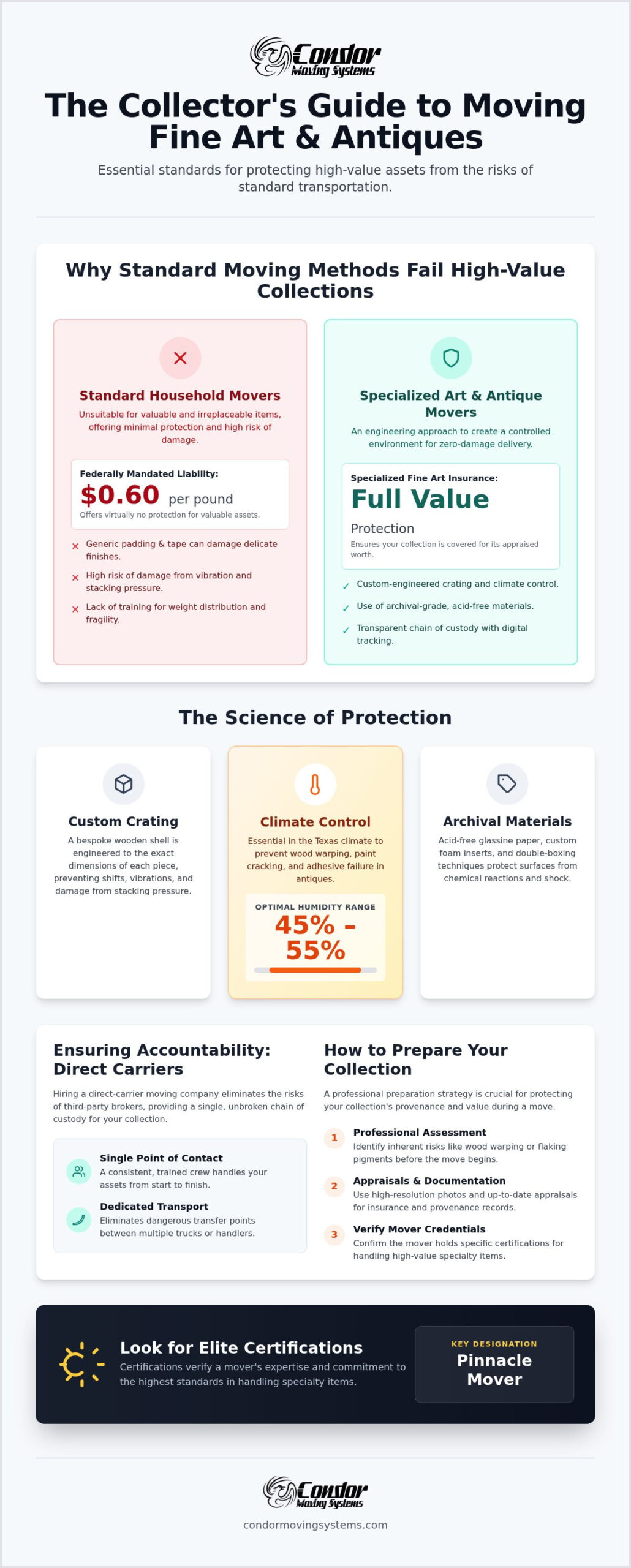
The assumption that a standard moving crew can safely transport a $50,000 oil painting or a century-old heirloom is a gamble most collectors eventually regret. Relying on federally mandated liability, which covers a mere $0.60 per pound, offers virtually no protection for high-value assets. When you hire specialized art and antique movers, you’re investing in the engineering of a controlled environment rather than just a truck and a crew. We recognize that the stress of potential rough handling or the extreme Texas heat is a significant burden for any collector.
You deserve the peace of mind that comes with a transparent chain of custody and a zero-damage delivery. This article defines the essential standards for transporting fine art and antiques in 2026, from the precision of custom crating to the necessity of direct-carrier accountability. We will explain how to maintain the 45% to 55% humidity levels required for delicate wood and lacquer, ensuring your collection remains stable during transit. You’ll also learn how to navigate the complexities of 2026 tariff regulations and the critical differences between standard valuation and specialized fine art insurance.
Key Takeaways
- Understand why standard moving methods often fail high-value collections and how specialized engineering prevents damage from vibration and stacking pressure.
- Discover the technical requirements for custom crating and how maintaining 45% to 55% humidity protects delicate materials from the Texas climate.
- Learn why hiring direct-carrier art and antique movers eliminates the risks associated with third-party brokers and ensures a single point of accountability.
- Implement a professional preparation strategy using appraisals and high-resolution documentation to protect your collection’s provenance and value.
- Identify the specific certifications that verify a mover’s expertise in handling specialty items, including the elite Pinnacle Mover designation.
Why Art and Antique Moving Requires Specialized Expertise
Moving a collection of fine art or historical artifacts isn’t just a logistical task; it’s an engineering challenge. Professional art and antique movers view each piece as a unique set of vulnerabilities requiring a controlled environment. Specialized moving combines custom structural engineering with precise climate management to ensure that external forces don’t compromise the integrity of the item. Risks like vibration from road travel can cause microscopic fractures in aged lacquer, while stacking pressure from standard household goods can lead to structural collapse. High-value inventory tagging provides a clear chain of custody, allowing for digital tracking of every asset from the moment it leaves your gallery or home. Specialty Item Moving is a risk-mitigation strategy designed specifically for items with high sentimental or financial value.
The Limitations of Standard Household Moving
Standard household movers typically rely on generic padding and tape, which can damage delicate finishes. In contrast, Specialized Expertise involves the use of archival-grade materials, such as acid-free glassine paper, to prevent chemical reactions with oil paints or varnishes. General crews often lack the specific training required to handle the weight distribution of marble sculptures or the tension sensitivity of an oil on canvas. For those requiring long-distance moves, the danger often lies in transfer points where goods are moved between trucks. A dedicated team of art and antique movers ensures your collection stays on a single vehicle with a consistent crew.
Identifying High-Value and Fragile Items
Categorizing your collection is the first step toward a successful relocation. Sculptures, oil paintings, and delicate 18th-century furniture each require different handling protocols. Professionals must account for inherent vice, which refers to the natural tendency of certain materials to deteriorate over time, such as wood warping or pigments flaking. A professional assessment identifies these risks before the first crate is built. Whether you’re coordinating local movers in Texas or a cross-country relocation, this initial audit is mandatory for ensuring the preservation of your assets.
The Science of Protection: Custom Crating and Climate-Control
Securing high-value assets during transit requires more than standard household packing techniques. Expert art and antique movers utilize custom crating as the primary line of defense against physical impact and structural stress. This process involves building a bespoke wooden shell engineered to the exact dimensions of an individual piece. By focusing on weight distribution and pressure points, these crates prevent the item from shifting or sustaining damage from external stacking pressure. Inside the crate, we apply layers of archival-grade protection. This includes acid-free glassine paper to shield sensitive surfaces from chemical reactions, followed by custom foam inserts and bracing that absorb road vibrations during transport.
Archival-Grade Packing Materials
The choice of materials is what separates a professional operation from a standard moving service. We strictly prohibit the use of non-breathable plastics or trash bags, as these can trap moisture and cause mold or finish degradation. Condor Moving Systems maintains a rigorous “no trash bags” policy to ensure that every antique is handled with materials that respect its chemical composition. For high-fragility items like porcelain or glassware, we employ a double-boxing technique. This involves placing the item in an initial cushioned container, which is then suspended within a larger, shock-absorbing box to provide a secondary layer of impact resistance.
Climate-Controlled Storage in Texas
The Texas environment presents unique challenges for collectors. When temperatures exceed 100 degrees, the adhesives in antique furniture can fail, and the tension of an oil canvas can fluctuate dangerously. To prevent wood warping or paint cracking, it’s essential to maintain a stable environment. Research suggests that fine art and antiques should be kept within a humidity range of 45% to 55% to prevent the expansion and contraction of organic materials like wood, bone, and leather. The Smithsonian specifically recommends a 40% to 55% range for optimal preservation.
Condor provides both short-term and long-term climate-controlled storage options to bridge the gap during complex relocations. Whether you are coordinating long-distance moves or simply need a secure holding area between residences, our facilities are designed to mitigate the risks of the Texas climate. If you are preparing to move a significant collection, you can request a detailed moving estimate to see how our specialized climate-control protocols can safeguard your investment.
Direct Carriers vs. Moving Brokers: Ensuring Accountability
Choosing art and antique movers involves more than comparing quotes; it requires a clear understanding of who will actually handle your collection. A direct carrier like Condor Moving Systems owns its fleet and employs its own specialized crews. In contrast, a broker is a sales entity that books your move and sells the contract to a third-party carrier. This model often results in the contract going to the lowest bidder, which is a high-risk scenario for irreplaceable collections. We maintain full operational control as a direct carrier, verified by our USDOT license 1126171 and TXDMV registration. Because we don’t outsource to brokers, we guarantee a single point of accountability from pickup to delivery.
Whether you are hiring local movers in Texas or planning an interstate relocation, knowing who is touching your art is the first step in risk management. Our direct crews take full ownership of the work from start to finish, providing a level of operational integrity that brokers cannot match.
Why Accountability Matters for Fine Art
For high-value items, accountability is synonymous with security. Standard logistics often involve “shuttling,” where items are moved between different trucks or warehouses to maximize trailer space. Every time a piece is handled, the risk of damage increases significantly. We eliminate this hazard by maintaining a strict chain of custody. This ensures your items aren’t swapped between vehicles or handled by untrained subcontractors at transfer points. Our personalized inventory tracking starts the moment a piece is crated, ensuring that the same team that packs your collection is the one that delivers it.
Understanding Valuation vs. Insurance
It’s vital to understand the difference between carrier valuation and true insurance. Federally mandated Released Value Protection covers only $0.60 per pound per item. For a 100-pound antique worth $10,000, this standard liability would only provide $60 in coverage. For serious collectors, this is rarely sufficient. Professional art and antique movers recommend securing Full Value Protection through a third-party provider for high-end assets. As of May 2026, specialized fine art insurance typically costs between 1% and 3% of the item’s appraised value annually. You must finalize these decisions before the move begins, as valuation levels cannot be modified once transit is underway.
How to Prepare Your Collection for a Professional Move
Preparation is the most critical phase of a successful relocation. When you work with professional art and antique movers, the process begins long before the crew arrives at your door. A disciplined approach to documentation ensures that the financial and historical value of your collection remains protected throughout the transit process. To qualify for the Chapter 97 tariff exemptions in 2026, an item must be verifiable as at least 100 years old. Therefore, your first step should always be a professional appraisal. This establishes a baseline market value and provides the necessary proof of age for high-value antiques.
Once you’ve established value, you must create a visual record. Take high-resolution photos of every piece from multiple angles. Don’t forget to capture close-ups of artist signatures, serial numbers, and any identifying marks on the underside of furniture. Document the existing condition of every item on your inventory list. Note any hairline cracks in porcelain, slight fading on oil canvases, or previous restoration work. This level of detail eliminates ambiguity and provides a clear record of the item’s state before it enters our custody.
Items Movers Cannot Transport
Every licensed carrier has a list of “Non-Allowable” items that cannot be placed on a moving truck due to safety or liability regulations. Condor Moving Systems does not transport jewelry, cash, deeds, or coin collections. We also don’t move plants or hazardous materials, such as flammable cleaners and pressurized canisters. These items often have high personal or financial value but require a different level of security than a standard moving van provides. We recommend that you keep these assets in your personal vehicle to ensure you maintain direct control over them at all times.
Preparation for Specialty Items
Specialty items require specific logistical considerations that differ from standard furniture. For piano moving, we provide ground-floor to ground-floor transport to ensure the structural integrity of the instrument. Please keep in mind that re-tuning is not included, as the internal tension of a piano naturally shifts during any relocation. For pool tables, our service includes professional disassembly, but we do not provide re-assembly at the destination. If you’re moving between major hubs like Dallas, Houston, or Austin, our local movers in Texas can coordinate these specialized requirements for city-to-city transport.
Condor Moving Systems: Certified Specialty Movers for Texas
Condor Moving Systems has established a reputation for excellence as specialized art and antique movers since our founding in 2003. With over two decades of experience, we’ve developed the logistical infrastructure necessary to handle the most delicate relocations across the state. Our credentials reflect this commitment to operational integrity. We hold the elite Pinnacle Mover certification, a designation reserved for carriers that meet the highest standards of safety and service. We’re also active members of the Southwest Movers Association and hold ProMover status, ensuring that our processes align with industry best practices.
To provide total financial transparency, we utilize a Binding Estimate process for all specialty moves. This means you receive a no-obligation, guaranteed flat-rate quote before the work begins. By eliminating the ambiguity of hourly rates, we allow collectors to budget with confidence. Our central hub in the Dallas/Fort Worth area serves as the logistical heart of our operation, providing streamlined access to every major metropolitan region in Texas. This centralized location allows us to maintain the single point of accountability required for high-value collections.
The Condor Moving Process
Our engagement begins with a structured intake process designed to account for every detail of your collection. Securing a moving date requires a 20% non-refundable deposit, which allows us to reserve the necessary specialized equipment and crew for your relocation. On the day of the move, our team conducts a final walkthrough to verify the inventory and condition reports established during the planning phase. We maintain strict payment protocols to ensure security and transparency for both parties. It’s vital to remember that we don’t accept cash, personal checks, or credit cards at the time of delivery. All final payments must be made via:
- Cashier’s Check
- Money Order
- Zelle
To support you throughout the transit period, we provide 24-hour emergency customer service. This ensures you have a direct line of communication with our team if any logistical questions arise outside of standard business hours, providing the peace of mind you expect when moving irreplaceable assets.
Service Areas and Logistics
While our focus is on the Texas corridors, we recognize that many high-value relocations involve major urban centers like New York City. For these moves, EDEK MOVING, STORAGE & SERVICES LLC offers specialized residential and apartment moving solutions to help navigate the complex logistics of the Bronx, Brooklyn, Queens, and Manhattan.
We provide comprehensive coverage across the Dallas, Austin, Houston, and San Antonio corridors. Our familiarity with these urban environments allows us to navigate complex logistical hurdles, such as restricted access streets or high-rise requirements. If your pickup or delivery location can’t accommodate a standard 18-wheeler, we provide specialized shuttle services. This involves transferring your crated items to a smaller vehicle for the final leg of the journey, ensuring your collection reaches its destination safely regardless of local infrastructure limitations.
Request a free moving quote from Condor Moving Systems today
Securing the Legacy of Your Collection
Protecting a high-value collection in 2026 requires a shift from standard logistics to a disciplined, engineering-focused approach. You’ve learned that custom crating and strict climate management are non-negotiable for preserving delicate antiques in the Texas environment. By prioritizing a direct carrier over a broker model, you ensure a single point of accountability and a transparent chain of custody from the moment a piece is crated until its final installation.
Condor Moving Systems operates with total transparency as a Pinnacle Mover certified company. We utilize direct crews to eliminate the risks of subcontracting, maintaining full control of your assets under USDOT 1126171 and TXDMV 006338906C licenses. Our experienced team of art and antique movers remains focused on delivering your collection with zero damage and absolute precision. We take full ownership of the work, providing the stability and thoroughness your investments deserve.
You don’t have to face the stress of a complex relocation alone. With the right preparation and a steady, professional hand guiding the process, your most precious heirlooms will arrive at their new home ready to be enjoyed for generations to come. We’re here to provide the security and peace of mind you need for a successful transition.
Frequently Asked Questions
How much does it cost to move fine art or antiques?
The cost of moving fine art depends on the volume of items, the distance of the relocation, and the complexity of the required crating. Because every collection is unique, it’s necessary to conduct a professional assessment to determine the specific engineering and climate-control needs. This approach allows art and antique movers to provide a guaranteed flat-rate quote that covers the entire scope of the project, ensuring you don’t face hidden fees at delivery.
Is my art insured during the move?
Standard carrier liability is limited to Released Value Protection, which provides coverage at $0.60 per pound per item. This federally mandated minimum is rarely sufficient for high-value assets. For comprehensive protection, we recommend securing Full Value Protection through a third-party insurer. This coverage typically costs between 1% and 3% of the item’s appraised value. You must select your desired valuation level before the moving process begins, as it cannot be adjusted during transit.
What is custom crating and do I need it?
Custom crating is a structural protection method where a bespoke wooden shell is engineered to the exact dimensions of a specific item. You need this service for high-fragility pieces, such as marble sculptures or large oil paintings, that cannot withstand standard stacking pressure. The process includes internal bracing and archival cushioning to absorb road vibrations. While standard padding is sufficient for some furniture, custom crating remains the gold standard for high-value preservation during a move.
Can movers transport my jewelry and cash collections?
Professional art and antique movers do not transport jewelry, cash, deeds, or coin collections. These items are classified as non-allowables due to security regulations and liability restrictions. We recommend that you transport these high-value personal assets in your own vehicle to maintain direct custody at all times. Additionally, we cannot transport hazardous materials, flammable liquids, or live plants. Keeping these items separate ensures that the specialized crew can focus entirely on your larger assets.
How do I know if a mover is a broker or a direct carrier?
You can identify a direct carrier by verifying their USDOT license and confirming they own their trucks. Brokers act as intermediaries that sell your contract to the lowest bidder, which often compromises accountability. Condor Moving Systems is a direct carrier, holding USDOT 1126171, meaning our crew handles your collection from pickup to delivery. This model eliminates the risks of shuttling goods between different companies and maintains a strict, secure chain of custody.
Do you move pianos and pool tables?
We provide specialized transport for pianos and pool tables, focusing on ground-floor to ground-floor logistics. For pianos, we ensure structural stability during transit, though we don’t provide re-tuning services as the instrument’s internal tension naturally shifts. For pool tables, our service includes professional disassembly to protect the slate and frame. However, we do not provide re-assembly at the destination. These specialty services are designed to mitigate the risks associated with moving heavy, complex mechanical items.
What happens if my antique is damaged during transit?
If damage occurs, you must document the condition change on the inventory list immediately upon delivery and file a formal claim. Our crews conduct a final walkthrough to verify the state of each piece before you sign the delivery receipt. It’s important to remember that without third-party insurance, the carrier’s legal liability is limited to $0.60 per pound. Having high-resolution before photos and professional appraisals is vital for supporting your claim and establishing the item’s provenance.
Can I use my own boxes and trash bags for packing?
We strictly prohibit the use of trash bags or non-archival boxes for packing high-value collections. Trash bags trap moisture and can cause mold or finish degradation, especially in the humid Texas climate. Our specialized crews use archival-grade materials, such as acid-free glassine paper and custom foam, to ensure chemical stability. If you are looking to source professional-grade containers for other household items, you can learn more about Phoenix Supplies UK and their range of specialty moving supplies. Using your own materials may void valuation coverage, as the carrier can’t guarantee the structural integrity or chemical safety of non-professional packing supplies.