


Imagine waking up on moving day only to discover that your “guaranteed” quote didn’t account for the specific handling required for your pool table or piano. It’s a common frustration for Texas residents who realize too late that their mover lacks the proper equipment or a comprehensive local moving checklist. You likely already feel the weight of this transition, balancing utility transfers with the fear that your high-value items might be mishandled during the short trip to your new home.
A successful relocation requires more than just cardboard boxes; it demands a structured plan built on professional standards. This tactical guide helps you master your move with a timeline that prioritizes inventory accuracy and total transparency. We’ll walk you through every critical milestone, from verifying TxDMV licensing to managing the 90-day claim window for standard liability coverage. By following this methodical approach, you’ll ensure your belongings are protected and your moving day remains entirely stress-free.
Key Takeaways
- Understand the critical difference between direct carriers and brokers to ensure total accountability for your relocation. Hiring a licensed mover with in-house crews prevents third-party miscommunications and hidden costs.
- Utilize a professional-grade local moving checklist to organize your timeline starting eight weeks before your move. This structured approach helps you manage inventory accuracy and select a carrier with verified TXDMV credentials.
- Learn how to execute a master packing strategy that prioritizes the protection of high-value items. Using professional materials instead of household alternatives like trash bags is essential for safety and carrier compliance.
- Prepare for the final countdown by coordinating utility transfers and identifying logistical needs like shuttle services for restricted access areas. Taking these steps early eliminates moving-day surprises and ensures a smooth transition.
- Master the execution of moving day by conducting a thorough final walkthrough and reviewing the Bill of Lading. These final actions safeguard your interests and confirm that all contractual obligations are met.
Why a Tactical Local Moving Checklist is Essential for Texas Relocations
A tactical local moving checklist isn’t just a list of boxes to check; it’s a framework designed for mover accountability and precise logistical timing. In a state as large as Texas, moving between major hubs like Dallas, Houston, or Austin requires more than a casual plan. Relocating involves complex logistics; studies have found that moving house is often particularly stressful, largely due to the loss of control over one’s environment and belongings. A tactical guide restores that control by setting clear benchmarks for every phase of the journey.
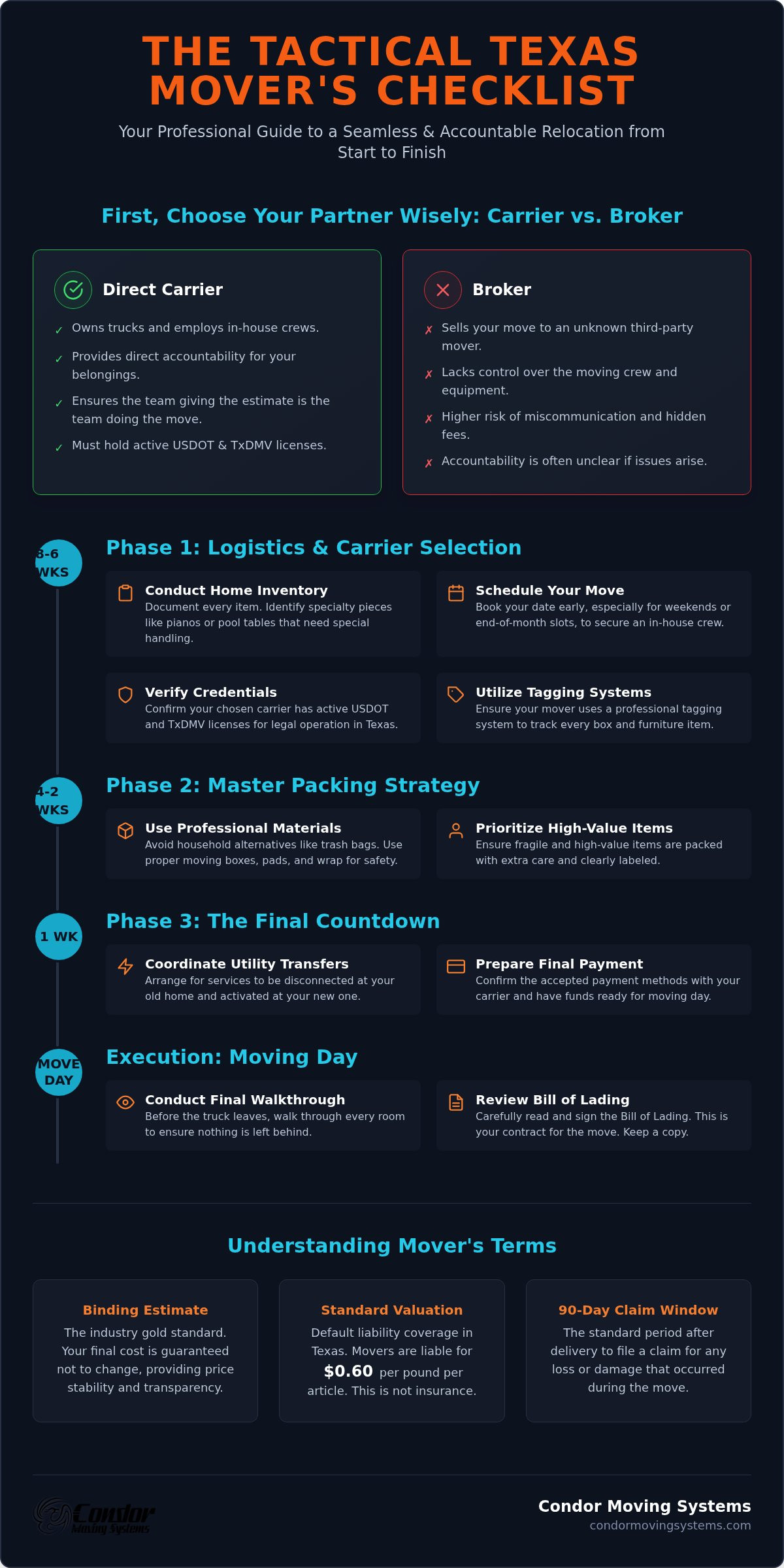
Many residents fall into the “Broker Trap,” where a third party sells a move to an unknown subcontractor. This often leads to miscommunications, damaged items, and unexpected price hikes. By choosing a direct carrier for local moving services, you ensure that the team providing your estimate is the same team handling your furniture. This direct line of responsibility is essential for protecting high-value items and maintaining inventory accuracy throughout the process.
You should also familiarize yourself with the concept of “Valuation.” Unlike traditional insurance, valuation represents the level of liability a mover assumes for your property. While the Texas standard is $0.60 per pound per article, a tactical approach helps you determine if you need additional coverage for specialty items such as pianos or pool tables before the truck arrives.
The Legal Difference: Carrier vs. Broker
A carrier owns the physical trucks and directly employs the crews, whereas a broker merely facilitates the transaction. Brokers often lack control over the actual moving crew, which can lead to a lack of accountability during the move. Condor Moving Systems has operated as a licensed, full-service mover since 2003, maintaining total ownership of the relocation process from the initial quote to the final delivery at your new home.
Setting Realistic Expectations for Local Moves
Even for local or regional shifts, transit times can range from 1 to 10 business days depending on the volume of the move and the specific distance. Transparency starts with a binding estimate, which is the industry gold standard for price stability. Unlike non-binding quotes, a binding estimate ensures your final cost won’t fluctuate unexpectedly based on weight or time. It’s also standard practice to provide a 20% non-refundable deposit; this commitment secures your specific moving date on the carrier’s calendar and ensures the necessary resources are allocated to your relocation.
Phase One: Logistics, Inventory, and Selecting a Carrier (8–6 Weeks Out)
The first phase of a professional local moving checklist focuses on establishing a baseline of truth. Accurate quotes depend entirely on a comprehensive home inventory conducted at least eight weeks before your move. This is the time to identify specialty items like pianos, pool tables, or custom bikes that require custom crating or specific equipment. Scheduling your date early is vital; weekend and month-end slots fill up quickly in high-growth areas across Texas, and securing your window early ensures the carrier can allocate a dedicated in-house crew for your specific date.
The Inventory and Tagging Process
Professional tagging systems prevent lost items by assigning a unique identifier to every piece of furniture and box. This level of detail ensures that what goes onto the truck is exactly what comes off it at your destination. An accurate inventory also prevents “extra charge” surprises on moving day because the carrier has a clear, documented record of the total volume. You can find more details on how these logistical processes apply to your specific region on our Local Movers Texas service page.
Vetting Your Moving Company
Licensing is the most critical factor in carrier selection. Verify that your mover holds active USDOT and TXDMV credentials; for example, Condor Moving Systems operates under USDOT 1126171 and TXDMV 006338906C. Beyond basic licensing, look for Pinnacle Mover certification and membership in the Southwest Movers Association. These designations signal a commitment to higher operational standards and ethical pricing that goes beyond the industry minimums.
Ask specific questions about potential surcharges to avoid surprises during delivery. “Long-Carry” fees are a standard industry cost, often starting at $75 for distances exceeding 150 feet from the truck to your front door. Confirm that the company uses its own licensed, in-house crews rather than outsourced day laborers who may lack the training required for high-value items. Before committing, consult the federal resource on Your Rights and Responsibilities When You Move to ensure you’re fully informed of consumer protections. If you’re ready to begin the inventory process, you can request a professional moving quote to lock in your preferred date.
Phase Two: Master Packing Strategy and Managing Non-Allowables (4–2 Weeks Out)
Between four and two weeks before your move, the focus shifts from logistical planning to physical execution. This is the period where a tactical local moving checklist becomes indispensable for managing the sheer volume of household goods. You should begin by decluttering ruthlessly; moving items you no longer need is a common logistical error that increases both your quote and your unpacking time. Once you’ve narrowed your inventory, transition to room-by-room packing, ensuring that every container is labeled by its destination and its priority level. An “Essentials Box” containing first-night necessities like toiletries, basic tools, and chargers should be packed last and kept easily accessible.
The “No Trash Bags” Rule and Professional Packing
While it’s tempting to use trash bags for soft items like linens or clothing, professional carriers strictly prohibit them. Trash bags cannot be stacked, they tear easily under the weight of other items, and they offer zero protection against the shifting forces inside a moving truck. Using sturdy, professional-grade boxes is a requirement for maintaining an organized and safe load. If you choose a self-pack option, remember that owner-packed boxes (PBO) typically have limited valuation coverage because the carrier cannot verify the condition of the items inside before they were sealed. For high-value or fragile collections, opting for full-service local moving services ensures that professional crews handle the crating, which provides the highest level of protection and accountability.
The Non-Allowables Trap
A major gap in many moving plans is the failure to account for “Non-Allowable” items that carriers are legally or operationally unable to transport. To ensure a smooth transition, you should consult an official moving checklist to identify hazardous materials that must be disposed of before the truck arrives. Condor Moving Systems cannot move or store firearms, ammunition, hazardous chemicals, or flammable liquids such as propane or gasoline. Additionally, perishable foods and live plants are prohibited to prevent pest infestations and property damage within the trailer.
High-value personal items also fall into a specific category of responsibility. Items such as cash, jewelry, stock certificates, and important legal deeds must remain in your personal possession throughout the relocation. Professional crews focus on the safe transport of your household furniture and packed boxes, but they’re not equipped to provide the specialized security required for small, high-value valuables. Keeping these items with you eliminates the risk of loss and provides immediate access to critical documents when you arrive at your new address.
Phase Three: The Final Countdown—Utilities and Payment Preparation
As your moving date nears, the focus of your local moving checklist shifts toward the final administrative and logistical hurdles. You must coordinate the transfer of water, electricity, and gas for both your current and future addresses to ensure a seamless transition. It’s best to schedule these transfers at least two weeks in advance to avoid service gaps. Don’t forget to notify secondary service providers like landscaping, pest control, and pool maintenance teams. Providing them with your new address or a final service date prevents billing errors and ensures your new property is maintained from day one.
Navigating Access Issues
Logistical transparency requires a clear understanding of how your belongings will reach your front door. If an 18-wheeler cannot safely navigate your new neighborhood due to narrow streets, low-hanging branches, or local weight restrictions, a “Shuttle Service” becomes necessary. This involves transferring your inventory into smaller trucks to complete the final delivery. You should also prepare for “Stair” charges if your new unit is located above the 14th step, as well as “Long-Carry” fees for extended distances between the truck and the entrance. Professional crews prioritize safety and efficiency; therefore, they won’t deliver items into attics or basements due to the high risk of property damage and personal injury.
Strict Payment Protocols
Relocation costs are structured to ensure security and accountability for both the carrier and the client. Following the initial 20% deposit used to secure your date, the standard payment schedule involves a 30% payment at the time of pickup and the remaining 50% balance at delivery. There’s a hard rule regarding the methods of payment accepted during the final stage: no cash, personal checks, or credit cards are accepted at the time of delivery. To ensure your move stays on schedule, you must prepare your final balance using a Cashier’s Check, Money Order, or Zelle. This protocol eliminates the ambiguity of “word-of-mouth” agreements and ensures a documented, secure financial transaction.
Moving Day Execution: What to Expect from Professional Crews
Moving day is the culmination of weeks of meticulous preparation. At this stage, your local moving checklist transitions from a planning tool into a real-time management guide. When the crew arrives, your primary responsibility is to supervise the process and ensure that high-value items receive the specific handling discussed during your estimate. Before the truck departs, perform a final walkthrough of your residence. Open every closet, cabinet, and storage nook to confirm that no items have been overlooked. This final sweep is a simple but vital step in maintaining total inventory accuracy.
The Bill of Lading and Inventory Check
The Bill of Lading serves as your primary legal contract with the carrier. It outlines the terms of service, the pickup and delivery locations, and the declared value of your shipment. You must verify the inventory numbers on the driver’s list against your own records before signing this document. This ensures that every piece of furniture and every box is accounted for before transport begins.
Understanding your coverage is essential for peace of mind. Licensed movers in Texas provide Released Value Protection, which is a standard liability coverage of $0.60 per pound per article at no additional charge. If you require more comprehensive coverage for your belongings, you must purchase Full Value Protection from a third-party insurance provider before moving day. If you notice any external damage to boxes or furniture during the unloading process at your new home, you must note these discrepancies immediately on the inventory sheet. This documentation is critical if you need to file a claim within the 90-day window allowed by Texas regulations.
Settling Into Your New Home
Efficiency at your destination depends on clear communication with the moving crew. You should direct the team to specific rooms as they unload, which prevents the need for heavy lifting later. Professional crews are trained to work methodically, placing items exactly where they belong to streamline your unpacking process. For those moving into multi-story units, you can find specialized advice in our guide to Professional Apartment Moving Services.
Assembly services are another key component of a full-service move. The crew will re-assemble any furniture they disassembled at the origin, such as bed frames or dining tables. It’s important to remember that professional movers will not assemble new furniture that is still in its original retail packaging. By focusing on these execution details, you ensure that the transition into your new space is as organized and disciplined as the planning that preceded it.
Securing Your Texas Relocation with Professional Precision
Success in a local move depends on moving beyond generic tips and adopting a structured, tactical approach. By utilizing a comprehensive local moving checklist, you’ve established a foundation of accountability that protects your high-value items and eliminates the risk of hidden costs. You now understand the critical importance of selecting a direct carrier rather than a broker, ensuring that the team handling your inventory is the same one that provided your initial estimate. This transparency is the only way to guarantee a move without surprises.
Condor Moving Systems provides the operational integrity required for a stress-free transition. As a fully licensed and insured mover (USDOT 1126171), we offer no-obligation guaranteed flat-rate quotes and 24-hour emergency customer service to maintain total reliability throughout your journey. We’re ready to execute your plan with the precision and care your belongings deserve.
We look forward to helping you settle into your new home with complete peace of mind and professional support every step of the way.
Frequently Asked Questions
Can I pay the final balance with a credit card at delivery?
No, credit cards are not accepted for the final balance at the time of delivery. To ensure a secure and documented transaction, we only accept cashier’s checks, money orders, or Zelle for the remaining 50% of your move cost. This policy helps maintain transparent pricing and prevents the complications associated with card processing on-site. You can use a credit card for your initial deposit and pickup payment, though a 3% fee applies to those specific transactions.
What happens if my local move is delayed?
If your relocation exceeds the estimated transit time provided in your contract, we provide a reimbursement of $15.00 per day. While we strive for absolute precision in our logistical timing across Texas, external factors can occasionally impact schedules. This provision is part of our commitment to accountability and ensures you’re compensated for any deviation from the agreed-upon timeline. We maintain 24-hour emergency customer service to keep you informed of any status changes during the process.
Will the movers take my trash or old furniture for disposal?
No, we don’t provide debris or trash removal services as part of our relocation offerings. Managing the disposal of old furniture, empty boxes, or packing paper is the customer’s responsibility. We recommend coordinating with local Texas waste management providers or donation centers before your scheduled move date. Focusing exclusively on the safe transport of your inventory allows our crews to maintain the high standards required for professional-grade relocations without the complications of waste management.
Does the standard moving quote include insurance?
Your standard quote includes Released Value Protection, which is a form of tariff liability rather than traditional insurance. This coverage provides $0.60 per pound per article at no additional cost to you. For those moving high-value items, we recommend purchasing Full Value Protection through a third-party provider. Including these details in your local moving checklist ensures you have the appropriate level of security for your specific household inventory before our crews begin the loading process.
Are there discounts for military families or seniors?
Yes, we offer dedicated discounts for active-duty military members, veterans, and seniors aged 65 and older. We value the service of our military families and the unique needs of our senior community in cities like Dallas and San Antonio. To apply these savings to your local move, please mention your eligibility during the initial estimate process. This is one way we provide personalized service while maintaining competitive, transparent pricing for our valued Texas clients.
Can movers transport my houseplants or wine collection?
No, we cannot transport live plants or perishable food items due to safety and regulatory restrictions. These items are part of our “Non-Allowables” list because they are susceptible to damage and can attract pests within the moving trailer. While we specialize in specialty item handling for pianos and pool tables, living items must be moved in your personal vehicle. This policy protects your other belongings and ensures the integrity of our climate-controlled storage and transit environments.
What is a “Long-Carry” fee and when does it apply?
A “Long-Carry” fee applies when the distance between our moving truck and your front door exceeds 150 feet. These charges typically start at $75 and also apply if our crew must navigate more than 14 steps. Identifying these logistical challenges early is a vital part of your local moving checklist. Accurate address details allow us to provide a binding estimate that accounts for these physical demands, ensuring there are no financial surprises on your moving day.
Do I need to be present for the entire moving process?
Yes, it’s essential that you or an authorized representative are present during both the loading and unloading phases. You’ll need to verify the inventory tagging, sign the Bill of Lading, and perform a final walkthrough of your home. Being on-site allows you to direct the crew to specific rooms and confirm that all high-value items are handled according to your expectations. This active participation is a cornerstone of a successful, professional-grade relocation experience.