



The lowest quote on an online search directory often proves to be the most expensive mistake a homeowner can make. When you type residential movers near me into a search bar, you aren’t just shopping for transportation; you’re looking for absolute certainty that your furniture, fragile heirlooms, and family memories will arrive intact without surprise surcharges or hostage-fee tactics. It’s completely natural to feel anxious when detached booking brokers present polished websites, only to outsource your life’s possessions to unvetted third-party labor.
You deserve complete operational transparency before letting any crew walk through your front door. This guide gives you the exact steps to evaluate, compare, and select dependable residential movers near you without hidden fees or broker headaches. Ahead, we detail how to verify carrier credentials on state and federal registries, clarify the vital distinction between valuation coverage and insurance, and build a framework to guarantee a smooth, predictable relocation handled by dedicated professionals.
Key Takeaways
- Learn how to verify state and federal operating credentials to distinguish dedicated motor carriers from unvetted booking brokers.
- Uncover the essential operational standards to review when searching for residential movers near me so you can avoid lowball estimates and surprise delivery fees.
- Understand the vital legal distinction between baseline Released Value valuation coverage and supplemental protection policies for your household goods.
- Compare local relocation service models to determine whether a full-service direct carrier or a specialized provider matches your specific inventory needs.
- Master moving day preparation strategies that streamline crew workflow, protect delicate home interiors, and prevent transit delays.
Key Criteria for Evaluating Residential Movers Near You
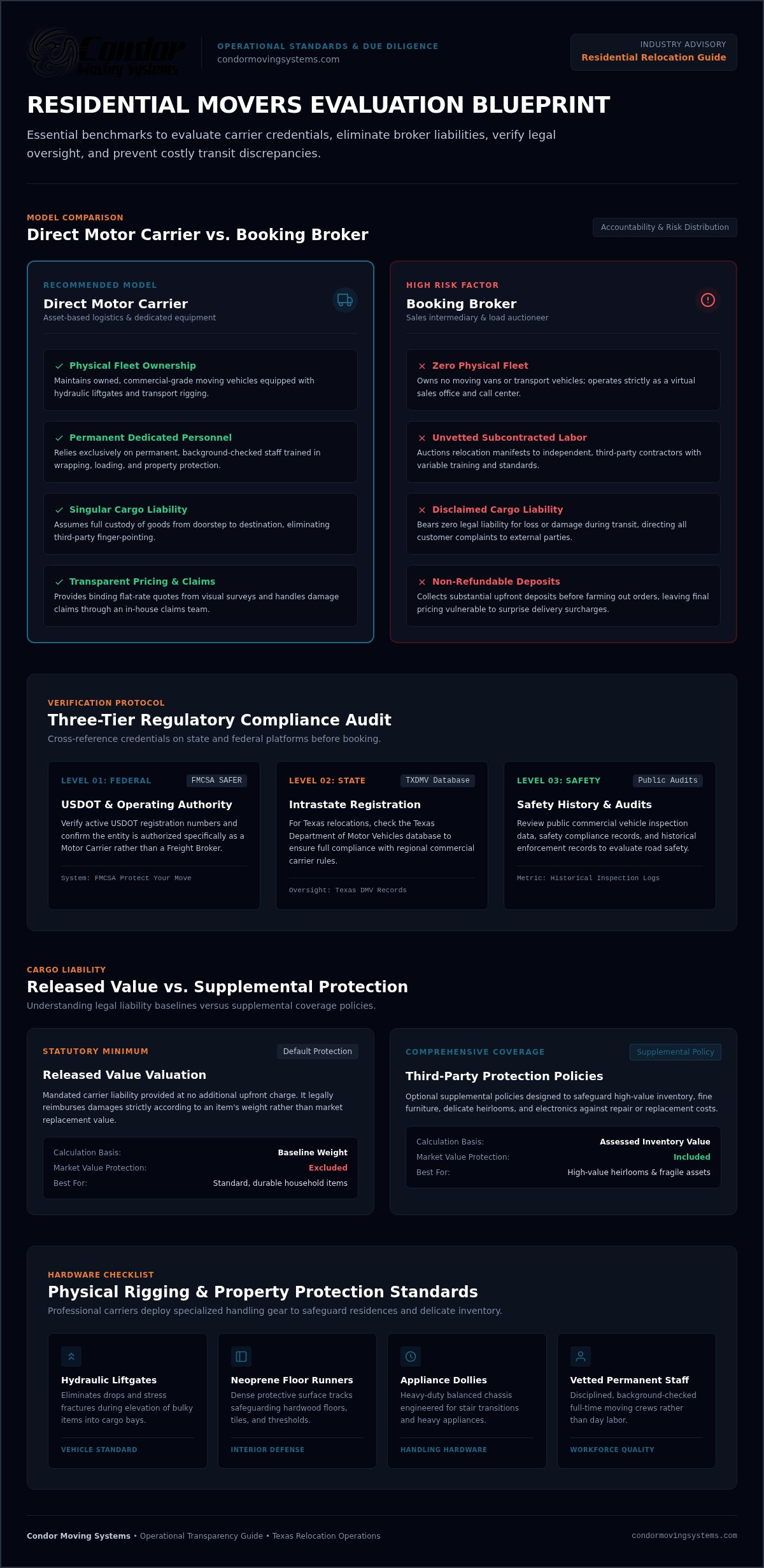
Searching for residential movers near me often produces hundreds of sponsored links, but filtering for operational excellence requires looking past introductory promotional discounts. Direct accountability separates seasoned carriers from unregulated contractors. Understanding what is a moving company in terms of legal obligations helps protect your household goods, ensuring you hire a legitimate service provider equipped to manage complex neighborhood access and delicate cargo safely.
Regulatory Licensing and Operational Compliance
Legitimate operations maintain complete legal transparency across federal and state transport databases. Before booking, verify active credentials directly through official oversight platforms:
- Federal Registration: Ensure an active USDOT number and operating authority through the Federal Motor Carrier Safety Administration (FMCSA) SAFER system.
- State Authority: For relocations within Texas, confirm state-level compliance via the Texas Department of Motor Vehicles (TXDMV) database.
- Safety Records: Check public safety audits to examine inspection results and historical compliance records.
Comprehensive Estimates and Transparent Contracts
Reputable operators establish cost clarity through binding flat-rate quotes generated from comprehensive visual inventory surveys. Avoid verbal agreements that leave access fees, flight-of-stairs handling, or heavy appliance surcharges open to interpretation. Clarify coverage terms immediately. Standard carrier liability provides Released Value valuation, which covers items based on baseline weight rather than market value, so determine early if your high-value inventory requires supplemental third-party protection policies.
Dedicated Equipment and Trained Personnel
Operational integrity depends on the physical resources deployed on move day. Professional carriers maintain branded commercial vehicles outfitted with hydraulic liftgates, heavy-duty appliance dollies, and dense neoprene floor runners to safeguard door jambs and hardwood flooring. Dependable local movers in Texas rely exclusively on permanent, background-checked personnel rather than temporary day labor, guaranteeing disciplined cargo handling from initial loading to final room placement.
Carrier vs. Broker: Navigating Local Moving Company Models
Most homeowners researching residential movers near me assume every polished website belongs to an enterprise that owns moving vans and employs drivers. That assumption can lead to painful logistical surprises. Understanding whether you hire an asset-based motor carrier or an independent sales broker dictates who holds legal liability for your belongings from the moment they leave your residence.
How the Moving Broker Model Operates
Moving brokers are sales intermediaries rather than logistics providers. They collect an upfront, often non-refundable deposit to secure your booking, then auction your relocation manifest to independent motor carriers. Because brokers own no transportation equipment and employ no field staff, they bear zero direct cargo liability. If the contracted crew fails to arrive on schedule or damages your furniture during transit, the broker typically disclaims responsibility, leaving you to resolve disputes with an unfamiliar third party.
The Advantages of Contracting Direct Carriers
Direct carriers assume full custody of your move. They maintain their own fleet, enforce uniform packing protocols, and assign dedicated personnel who handle your items across every mile. This model provides substantial operational protections:
- Singular Accountability: One management team oversees your shipment, eliminating finger-pointing between booking agents and drivers.
- Direct Communication: You coordinate directly with internal dispatchers rather than detached call centers.
- Streamlined Claims: In-house claims teams evaluate damage issues promptly under clear regulatory standards.
Identifying Misleading Broker Listings Online
Untangling direct carriers from lead-generation brokerages requires simple verification. Always check federal records; the FMCSA platform at Protect Your Move allows consumers to view whether a business is registered as an authorized motor carrier or strictly as a freight broker. In addition, beware of websites displaying vague regional coverage areas without physical warehouse addresses. Securing a binding, transparent rate from a reputable direct carrier begins by requesting a comprehensive moving quote directly from the team that operates the trucks.
Top Residential Moving Company Options in 2026
Condor Moving Systems: Dedicated Full-Service Carrier
Condor Moving Systems has operated continuously as an asset-based carrier since 2003, serving major Texas hubs including Dallas, Fort Worth, Austin, Houston, and San Antonio. The company maintains full operational control over its fleet, using permanent, uniform crews rather than independent contractors. Certified as a Pinnacle Mover by the Southwest Movers Association, Condor provides guaranteed flat-rate binding estimates supported by detailed item tagging. Beyond standard residential loading, the operation manages secure short- and long-term storage alongside specialized packing and custom crating for sensitive items. Homeowners can review specialized relocation packages through Condor local moving solutions.
National Franchise Moving Systems
Large franchise networks provide high brand recognition and expansive vehicle networks across primary metropolitan regions. While corporate headquarters establish systemwide protocols, day-to-day operations depend heavily on individual franchisees. Service standards, staff retention, and vehicle maintenance quality can vary significantly between locations. These systems work well for straightforward single-family home moves with standard furnishings, but they often lack the customized packing capabilities or uniform accountability required for valuable heirlooms and difficult building layouts.
Online Labor Aggregators and Marketplaces
Digital marketplaces let consumers hire hourly manual labor to load and unload personal rental trucks. While appealing for small studio apartments or budget-conscious moves, this arrangement shifts immense logistical risk onto the homeowner. Gig-economy workers rarely possess specialized rigging expertise for heavy appliances, and online labor platforms disclaim direct cargo liability for structural or property damage. If a worker drops a marble credenza down a flight of stairs, resolving the claim becomes an uphill battle. Consumers should consult the federal Protect Your Move database to verify whether a local company operates as an insured entity before entrusting them with residential cargo.
How to Vet Residential Movers and Avoid Common Estimate Traps
Online reviews rarely tell the whole story. Five-star aggregator scores frequently obscure licensing lapses, hidden auxiliary fees, and untrained labor pools. When vetting residential movers near me, applying a disciplined screening process protects your household budget and eliminates moving-day surprises. A suspiciously low estimate usually signals missing access fees or an unbinding quote designed to increase on delivery day.
Step 1: Verify Federal and State Credentials
Start by auditing regulatory compliance directly through official government portals rather than trusting commercial marketing claims:
- Federal Validation: Check the carrier’s USDOT and Motor Carrier numbers on the FMCSA database to verify active operating status and safety history.
- State Authority: For relocations across Texas, verify active licensing through the Texas Department of Motor Vehicles (TXDMV).
- Trade Accreditation: Confirm professional affiliations, such as membership in the Southwest Movers Association and voluntary adherence to Pinnacle Mover standards.
Step 2: Require a Detailed In-Home or Virtual Survey
Never accept a binding quote based solely on a brief telephone conversation. Dependable carriers demand a thorough visual inspection, conducted either on-site or through a guided virtual walk-through. Show the estimator every room, storage closet, patio, and garage. Point out heavy specialty items such as gun safes, large workout stations, or musical instruments so dispatch can assign appropriate hoisting dollies, protective padding, and truck space.
Step 3: Review Contract Terms, Access Fees, and Exclusions
Read the entire estimate to identify secondary charges before executing a service agreement. Inquire specifically about charges for long walking carries, multi-flight staircases, or narrow driveway shuttle transfers. Note mandatory cargo restrictions; carriers strictly prohibit non-allowable items including cash, family heirlooms, deeds, live plants, and combustible household chemicals. Finally, clarify valuation terms. Federal baseline protection is Released Value valuation, and carriers do not cover contents packed by the owner unless physical carton puncture or crush damage is apparent upon arrival.
Preparing for Moving Day: Coordinating with Your Chosen Movers
Thorough preparation turns moving day into a precise, orderly operation. Once you select reputable residential movers near me, establishing direct coordination with dispatch ensures the crew loads, transports, and delivers your household goods without friction. Completing basic logistical groundwork before the commercial vehicle arrives protects your schedule, your property, and your peace of mind.
Managing Packing Standards and Prohibited Items
Proper box construction preserves transit safety. Pack all household goods exclusively into heavy-duty corrugated cartons rather than weak supermarket boxes. Professional carriers strictly prohibit plastic trash bags because they puncture easily, cannot be sealed securely, and cannot be stacked inside cargo bays. In addition, set aside all non-allowable items before loading starts. You must transport family pets, living plants, vital legal documents, cash, and fine jewelry personally, as motor carriers cannot accept custody of these items.
Coordinating Property Access and Parking Logistics
Physical site accessibility directly impacts loading efficiency. Secure necessary street parking permits or reserve freight elevator access through municipal offices or HOA management before the crew arrives. Alert dispatch if your property features low-hanging tree branches, steep driveways, or tight access roads. When an over-the-road transport unit cannot safely navigate narrow suburban streets, dispatch schedules an auxiliary shuttle vehicle to transfer household goods safely to the main freight van.
Finalizing Paperwork and Delivery Protocols
Complete a final walk-through alongside the crew leader to review every tagged carton against the detailed manifest before departure. Families managing multi-city transitions often depend on dedicated Condor long-distance moving services to ensure structured handling across regional routes. Remember to arrange delivery payment in advance. Professional carriers do not accept cash, personal checks, or credit cards at the time of delivery, so prepare certified cashier’s checks, money orders, or verified electronic payment options to ensure seamless unloading at your new residence.
Take Control of Your Next Relocation with Confidence
Finding dependable residential movers near me doesn’t have to mean dealing with detached booking brokers or surprise delivery fees. A successful relocation always comes down to three non-negotiable operational standards: verifying active motor carrier authority on official registries, insisting on binding flat-rate estimates, and trusting dedicated company crews rather than outsourced day labor.
Operating continuously as an asset-based carrier since 2003, Condor Moving Systems delivers the accountability and peace of mind your household deserves. Backed by USDOT 1126171 and TXDMV 006338906C licensing, along with Pinnacle Mover certification from the Southwest Movers Association, our permanent teams manage every phase of your transition with steady, disciplined precision. You can look forward to settling into your new residence without the stress of logistical uncertainty.
Frequently Asked Questions
How do I tell the difference between a direct moving carrier and a moving broker?
A direct moving carrier owns its vehicle fleet, manages dedicated crews, and assumes direct legal custody of your goods from start to finish. A moving broker functions as a sales middleman that sells your move to third-party truckers. Check the FMCSA SAFER registry or state platforms like the TXDMV. If an entity is registered strictly as a broker, they don’t operate trucks or employ movers, leaving claims handling fragmented between separate parties.
What questions should I ask when interviewing residential movers near me?
When evaluating residential movers near me, ask whether they operate as an asset-based carrier or a sales broker. Confirm their active USDOT and TXDMV numbers, and verify that crew members are permanent company employees. Inquire whether their estimate is a binding flat-rate quote calculated from a visual inventory survey. Finally, ask about their accepted delivery payment methods, access fees for stairs or long carries, and in-house claims procedures.
What is the difference between released value protection and full value coverage?
Released Value protection is baseline tariff valuation provided by law at no extra charge, compensating lost or damaged items at sixty cents per pound rather than fair market value. In contrast, Full Value Protection is comprehensive coverage purchased through a third party based on your declared inventory value. If an item is damaged under full coverage, the provider repairs it, replaces it, or offers an equivalent cash settlement.
Can moving companies transport plants, perishable food, or cleaning chemicals?
No, licensed moving carriers cannot transport living plants, perishable groceries, or hazardous household items. State and federal transportation regulations strictly prohibit moving hazardous materials such as propane canisters, aerosol paints, motor oil, and chemical cleaners due to combustion risks. Perishable foods spoil during transit and attract pests, while live plants rarely survive cargo bay temperatures. Homeowners must transport these items personally or safely dispose of them beforehand.
Why do residential movers require visual surveys before providing binding estimates?
Professional residential movers require visual surveys, conducted in person or via video walk-through, to calculate precise cubic volume and shipment weight. Eyeballing room contents, furniture dimensions, and garage storage allows estimators to allocate the right truck capacity and crew size. A visual survey identifies difficult access points, fragile antiques requiring custom crating, and heavy appliances, preventing surprise fees or unexpected contract modifications on move day.
What happens if a large moving van cannot fit down my neighborhood street?
If an over-the-road transport unit cannot safely navigate narrow suburban streets, low power lines, or gated entrances across communities like Southlake or Plano, dispatch arranges a shuttle service. Movers park the large carrier at an accessible staging location and transfer your belongings using a smaller commercial truck. This auxiliary vehicle shuttles items directly to your residence, protecting neighborhood property and ensuring safe, efficient unloading.
How far in advance should I book professional residential moving services?
You should secure your moving date four to six weeks in advance for local moves across Texas hubs like Dallas, Fort Worth, Austin, Houston, and San Antonio. If you plan to relocate during peak season between May and September, contact carriers six to eight weeks ahead. Booking early secures your preferred calendar window and gives estimators ample time to conduct a comprehensive inventory survey.