

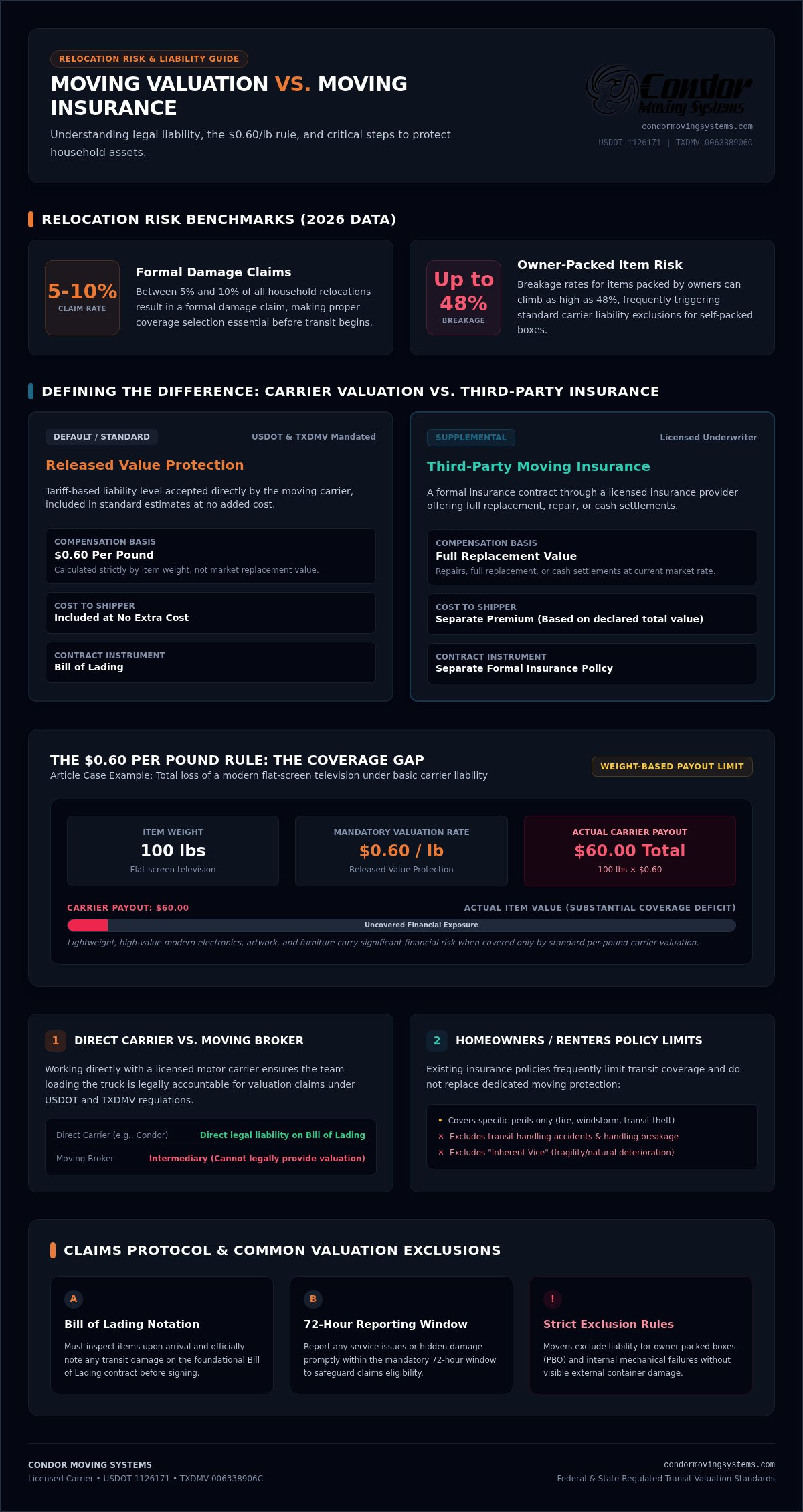
Recent industry data from 2026 indicates that between 5% and 10% of all household relocations result in a formal damage claim, while breakage rates for items packed by owners can climb as high as 48%. If you’re planning a move, you’ve likely heard the term moving insurance used as a catch-all for protection. However, relying on a misunderstanding of how liability works can lead to devastating financial losses if an expensive item is damaged during transit. You want to feel secure that your property is in expert hands, yet the legal jargon surrounding “Released Value” often creates more confusion than clarity.
It’s natural to feel protective of your investments and frustrated by the lack of direct answers regarding coverage. We’ll help you navigate these complexities by explaining the mandatory $0.60 per pound valuation rule and identifying exactly when it’s necessary to purchase a third-party policy for full replacement value. You’ll gain a clear understanding of the claims process and the specific timelines required to protect your rights. By the end of this guide, you’ll have the professional knowledge needed to secure your move with total confidence and accountability.
Key Takeaways
- Understand the fundamental legal distinction between carrier valuation and third-party moving insurance to ensure your assets are protected by the correct financial instrument.
- Recognize that basic Released Value Protection is limited to $0.60 per pound, which often creates a significant coverage gap for lightweight, high-value items.
- Determine when it’s necessary to secure Full Value Protection through an external provider to guarantee repair, replacement, or cash settlements at current market rates.
- Avoid common claim denials by learning why movers typically exclude liability for owner-packed boxes and internal mechanical failures without visible external damage.
- Master the essential documentation process, including noting transit damage on the Bill of Lading and reporting service concerns within the required 72-hour window.
Moving Insurance vs. Valuation: Defining the Difference
Many people use the term moving insurance as a catch-all phrase for protecting their belongings, but there’s a significant legal distinction you need to understand. Moving insurance is a formal contract between you and a licensed insurance company that provides coverage based on the policy’s specific terms. In contrast, valuation represents the degree of liability a moving company is willing to accept for your property during transit. Valuation is a tariff-based liability level mandated by the USDOT. While standard valuation is included in your initial quote at no extra cost, third-party insurance typically requires you to pay a separate premium based on the total value of your shipment.
Condor Moving Systems operates with total transparency regarding these options. We are regulated by both federal law via the Federal Motor Carrier Safety Administration (FMCSA) and state law through the Texas Department of Motor Vehicles (TXDMV). These regulations ensure that every client receives a baseline level of protection, though the financial recovery for a claim depends entirely on the level of liability you select on your paperwork before the move begins.
The Legal Framework of Carrier Liability
Accountability starts with proper licensing and direct responsibility. As a direct carrier holding USDOT 1126171 and TXDMV 006338906C, we take full ownership of the moving process from the moment we arrive at your door. This is a critical distinction from moving brokers, who act as intermediaries and cannot legally provide valuation themselves. Your Bill of Lading serves as the foundational contract for your move, officially documenting the liability level you have chosen. Most interstate moving companies must adhere to these strict documentation standards to protect consumers during long-distance moves. By working directly with a carrier, you ensure that the crew loading your truck is the same entity responsible for your valuation claim.
When Homeowners Insurance Steps In
Don’t assume your current home or renters policy provides comprehensive protection for your relocation. While some policies cover specific “perils” like fire, windstorms, or theft while your goods are in transit, they rarely account for accidental breakage or damage caused by improper handling. Insurance providers also frequently exclude “inherent vice,” which refers to the natural tendency of an item to deteriorate or break due to its own fragile nature. It’s vital to call your agent well before your 2026 moving date to verify the specific limits of your coverage. If your existing policy doesn’t cover transit accidents, securing third-party moving insurance is the most reliable way to achieve total peace of mind for high-value items.
Released Value Protection: The $0.60 Per Pound Rule
Every estimate provided by Condor Moving Systems includes Released Value Protection as the default level of liability at no additional cost. This is the most basic form of protection mandated by federal law for interstate moves. While it provides a baseline of accountability, it’s essential to recognize that this is not a full-coverage moving insurance policy. Instead, it sets a strict limit on the carrier’s financial responsibility based solely on the weight of the item rather than its actual replacement value. Under this basic liability level, a 100-pound flat-screen television that is completely destroyed would result in a total payout of only $60.
This $0.60 per pound rule applies to every article in your shipment, from heavy appliances to lightweight antiques. For many households, this coverage is insufficient for protecting modern electronics, fine art, or high-end furniture where the cost to repair or replace far exceeds the weight-based payout. The FMCSA valuation and insurance guidelines require carriers to offer this option, but they also warn consumers that it provides minimal protection for high-value shipments. To see how these liability levels factor into your specific relocation costs, you can request a comprehensive moving estimate today.
Pros and Cons of Basic Valuation
Choosing Released Value Protection is a decision that involves balancing cost against risk. It’s often the logical choice for shipments consisting primarily of low-value household goods or for clients who have already secured a separate, comprehensive moving insurance policy from a third-party provider.
- Pros: There’s no additional fee or premium required. It’s automatically included in your binding estimate, and the claims process is straightforward because it relies on verified weight rather than fluctuating market values.
- Cons: It leaves a significant financial gap for lightweight, expensive items. If a designer chair weighing 20 pounds is lost, the payout would only be $12, regardless of whether the chair cost $500.
Texas State Specifics for Local Moves
For those utilizing our local movers Texas services in cities like Dallas, Austin, or Houston, the Texas Department of Motor Vehicles (TXDMV) sets specific standards for intrastate liability. Just like federal interstate rules, Texas carriers must provide the $0.60 per pound valuation as a standard offering. State regulations also mandate that we provide every client with the “Your Rights and Responsibilities” brochure before the move begins. This document ensures you’re fully informed of your legal protections and the carrier’s obligations under TXDMV 006338906C. We believe in providing this information upfront to maintain the professional transparency our clients expect.
Full Value Protection and Third-Party Moving Insurance
While basic valuation provides a legal minimum of coverage, Full Value Protection (FVP) is the industry standard for clients who require comprehensive financial security. Under an FVP plan, the carrier is liable for the replacement value of lost or damaged goods. This means if an item is damaged while in our care, we must either repair it to its original condition, replace it with a similar item, or provide a cash settlement for the current market value. At Condor Moving Systems, we facilitate this enhanced level of security through specialized third-party moving insurance for an additional fee. Unlike basic valuation, FVP is calculated based on the total declared value of your entire shipment rather than individual weights. Once your relocation is underway and the transit process has officially started, your Full Value Protection plan cannot be canceled or modified.
How Full Value Replacement Works
The settlement process under FVP is designed to be equitable and thorough. Understand that carriers typically retain the right to repair an item before offering a full cash replacement. If a technician can restore a piece of furniture to its pre-move state, that is the primary course of action. Most FVP plans also involve a deductible, which you select when choosing your coverage level; a higher deductible usually results in a lower upfront cost. To ensure a smooth claims process, our teams use rigorous inventory tagging and tracking. This detailed documentation allows us to verify the condition of every item at both the origin and destination, providing the clear evidence needed for successful settlements.
Third-Party Insurance Providers in 2026
In some complex relocation scenarios, you might find that a stand-alone policy from an external provider offers the most flexibility. Companies like MovingInsurance.com specialize in third-party trip transit insurance, which can provide higher coverage limits than standard carrier plans. This is particularly relevant if your move involves Storage-In-Transit (SIT). When items enter our climate-controlled storage facilities, the valuation requirements may shift, and having a dedicated moving insurance policy ensures continuous protection. As one of the best long distance moving companies in the industry, we prioritize helping you understand these nuances so your high-value assets remain protected across state lines.
Common Exclusions: What Moving Valuation Won’t Cover
Even with a robust third-party moving insurance policy or a high level of carrier valuation, certain scenarios and items fall outside the scope of professional liability. Understanding these exclusions is a critical part of your relocation planning. Most carriers, including Condor Moving Systems, operate under industry-standard tariffs that limit responsibility for factors beyond their direct operational control. For instance, losses resulting from “Acts of God,” such as tornadoes or floods, are typically excluded from standard carrier valuation. Additionally, internal mechanical or electrical derangement is not covered if the item shows no signs of external mishandling. Movers cannot be held responsible for the internal components of electronics they didn’t manufacture or pack themselves.
The PBO (Packed by Owner) Trap
The “Packed by Owner” (PBO) designation is one of the most common reasons for denied claims. Under federal and state regulations, movers are generally not liable for the contents of boxes they didn’t pack unless there is clear, visible damage to the exterior of the carton at the time of delivery. If you choose to pack your own belongings, you must document any “concealed damage” immediately, but even then, proving carrier negligence is difficult without external evidence. Utilizing Professional Fragile Item Packing and custom crating is the most effective way to ensure your high-value items are covered by valuation, as the carrier then takes full responsibility for the integrity of the packing job.
Non-Allowable Items and Liability
There are specific items that professional carriers are prohibited from transporting due to safety regulations or high liability risks. Condor Moving Systems will not move or cover jewelry, cash, deeds, securities, coin or stamp collections, plants, or perishable food. Hazardous materials, including firearms, ammunition, propane tanks, and certain household cleaners, are also strictly prohibited. It’s also vital to declare any items of “extraordinary value,” defined as those valued at more than $100 per pound, on a separate inventory list before the move. Failure to disclose these items can void your protection. Finally, be aware of “inherent vice” in items like particle board furniture; these materials are often too unstable to survive the stresses of transit, and many carriers exclude them from damage claims.
How to File a Claim and Ensure Accountability
The final stage of your relocation is the delivery, which is the most critical moment for ensuring accountability. While we strive for a seamless experience, you must be prepared to document the condition of your property as it enters your new home. Whether you’ve chosen standard valuation or opted for third-party moving insurance, the validity of any future claim depends on your actions during the offloading process. You should carefully inspect every piece of furniture and every carton as it comes off the truck. If you see visible damage, you must note it explicitly on the Bill of Lading or the inventory sheet before the crew departs. This creates an immediate, signed record of the issue. For any service-related concerns that don’t involve physical damage, report them directly to Condor Moving Systems within 72 hours of delivery.
For formal loss or damage claims, we partner with Anthem Claim Management. You can reach them at 877-476-5983 to begin the formal process. Federal law provides a 9-month window from the date of delivery to file a written claim, but waiting too long can make the investigation more difficult. It’s essential to keep all damaged items and their original packing materials for inspection by a claims adjuster. Discarding these materials before the claim is settled often results in a denial, as the adjuster cannot verify how the damage occurred.
Step-by-Step Claims Process
Evidence is the foundation of any successful settlement. We recommend taking high-resolution photos of your high-value items at the origin and again at the destination if you suspect damage. When you fill out the Anthem Claim Management forms, ensure every detail is accurate and matches your inventory records. Be aware that all moving fees must be paid in full before a claim can be processed. If there’s an outstanding balance on your account, a 1.5% late fee may apply. The claims adjuster will pause the evaluation until all financial obligations are met, so settling your bill promptly is in your best interest.
The Direct Carrier Advantage
Working with a full-service carrier like Condor Moving Systems provides a level of security that brokers simply cannot match. Because we’re the direct entity that loaded and transported your goods, we maintain a clear chain of custody. Our personalized inventory tagging system allows us to track every item throughout the journey, making it significantly easier to locate missing pieces. To close out your move and ensure your eligibility for claims, remember that we only accept cashier’s checks, money orders, or Zelle for payments at the time of delivery. We don’t accept cash or personal checks. These strict standards protect the financial integrity of the transaction and ensure your move is officially closed for the claims process.
Securing Your Assets for a Confident Relocation
Choosing the right level of protection is the most important step in planning a successful move. You now understand that standard valuation is a baseline of liability, not a comprehensive moving insurance policy, and that lightweight, high-value items often require third-party coverage for full replacement security. By following strict documentation protocols at delivery and respecting the “Packed by Owner” exclusions, you maintain full control over your claim eligibility. These steps are essential for alleviating the stress of transit and ensuring your property is handled with the respect it deserves.
Condor Moving Systems brings more than 20 years of direct carrier experience to every project, ensuring that your belongings are handled by a Pinnacle Mover certified team. We take full ownership of the logistical process, providing the stability and precision required for complex relocations. Our partnership with Anthem Claim Management provides a structured, transparent path for accountability that protects your interests from start to finish. We are committed to delivering results without hidden complications, allowing you to focus on your new beginning while we manage the logistical details with professional care.
We look forward to providing the reliable, professional service you deserve for your next move.
Frequently Asked Questions
Is moving insurance mandatory for a local move in Texas?
Texas law requires all licensed carriers in cities like Dallas and Austin to provide basic Released Value Protection at no extra cost. This isn’t a comprehensive policy but a mandatory level of carrier liability. While you aren’t required to purchase additional third-party coverage, we strongly recommend it for high-value relocations. Every intrastate move must include the “Your Rights and Responsibilities” brochure to ensure you understand these state-mandated protections.
What is the difference between Released Value and Full Value Protection?
Released Value Protection is the standard, no-cost option that limits liability to $0.60 per pound per item. Full Value Protection, which Condor offers through third-party providers, requires the carrier to repair, replace, or provide a cash settlement based on current market value. While basic valuation is part of every quote, Full Value Protection ensures that a damaged lightweight item, like a high-end laptop, is covered for its actual worth rather than just its weight.
Does my homeowners insurance cover my belongings while they are on a moving truck?
Most homeowners or renters policies provide limited coverage for specific perils like fire, windstorms, or theft during transit. However, they rarely cover accidental breakage or damage caused by handling during the moving process. You should contact your insurance agent in Houston or Plano before your move date to verify your policy’s limits. If your current plan is insufficient, purchasing specialized moving insurance from a third-party underwriter is the most reliable way to fill those coverage gaps.
How long do I have to file a claim for damaged items after my move?
You have a legal window of nine months from the date of delivery to file a formal written claim for lost or damaged items. At Condor, these claims are processed through Anthem Claim Management to ensure a transparent and professional resolution. If you encounter service-related issues or operational concerns that don’t involve physical damage, you must report them to our office within 72 hours of delivery to ensure a timely investigation and response.
Are items I pack myself covered if they break during the move?
Items designated as “Packed by Owner” (PBO) are generally excluded from valuation coverage unless there is clear, visible damage to the exterior of the box at the time of delivery. Carriers cannot be held liable for internal breakage if the packing quality was not performed by their professional crews. To ensure your belongings are fully protected, we recommend utilizing our professional packing and custom crating services, which transfer the liability for the packing integrity to the carrier.
What happens if the moving company loses one box from my inventory?
If an item or box is missing, the settlement depends entirely on the level of protection you selected before the move began. Under Released Value Protection, the payout is calculated at $0.60 per pound based on the weight of the missing carton. If you secured Full Value Protection through a third-party moving insurance provider, you may be eligible for a replacement or a cash settlement based on the declared value of the contents documented on your inventory list.
Can I buy moving insurance for just my most expensive items?
Full Value Protection is typically applied to the entire shipment rather than individual pieces. However, items of extraordinary value, defined as those worth more than $100 per pound, must be specifically declared on a high-value inventory list to receive coverage. This ensures that items like fine art or high-end electronics in your Fort Worth or Frisco home are properly documented and protected. We recommend discussing specific high-value items with your relocation consultant during the estimate process.
Why wont my mover cover my jewelry or cash?
Jewelry, cash, deeds, and securities are classified as “non-allowable” items because they are highly susceptible to loss and difficult to value for transit purposes. Professional movers in Texas are prohibited from transporting these items, along with hazardous materials and firearms, for safety and security reasons. You should transport these high-risk valuables yourself to ensure they remain in your direct possession throughout the relocation. This policy protects both the client and the carrier from the risks associated with irreplaceable assets.