



Most corporate relocations fail not because of poor packing, but because of a lack of direct accountability at the project management level. You likely recognize that moving an entire organization is one of the most stressful operational hurdles a leader can face. The fear of extended downtime or seeing high-value IT infrastructure arrive damaged is enough to keep any operations manager awake at night. It’s a valid concern; even a minor delay in a mid-sized office relocation can result in thousands of dollars in lost productivity and missed deadlines.
This guide provides a professional framework for office move project management designed to replace logistical uncertainty with a structured, carrier-owned process that ensures your business remains functional from day one. We’ve built this strategic guide to help you master the complexities of relocation while maintaining operational continuity. You’ll learn how to navigate the 2026 landscape of stricter FMCSA electronic logging device enforcement and medical certification standards. We also detail how to protect high-value equipment through custom crating and why a direct-service model is the only way to ensure predictable costs and total equipment safety during a transition.
Key Takeaways
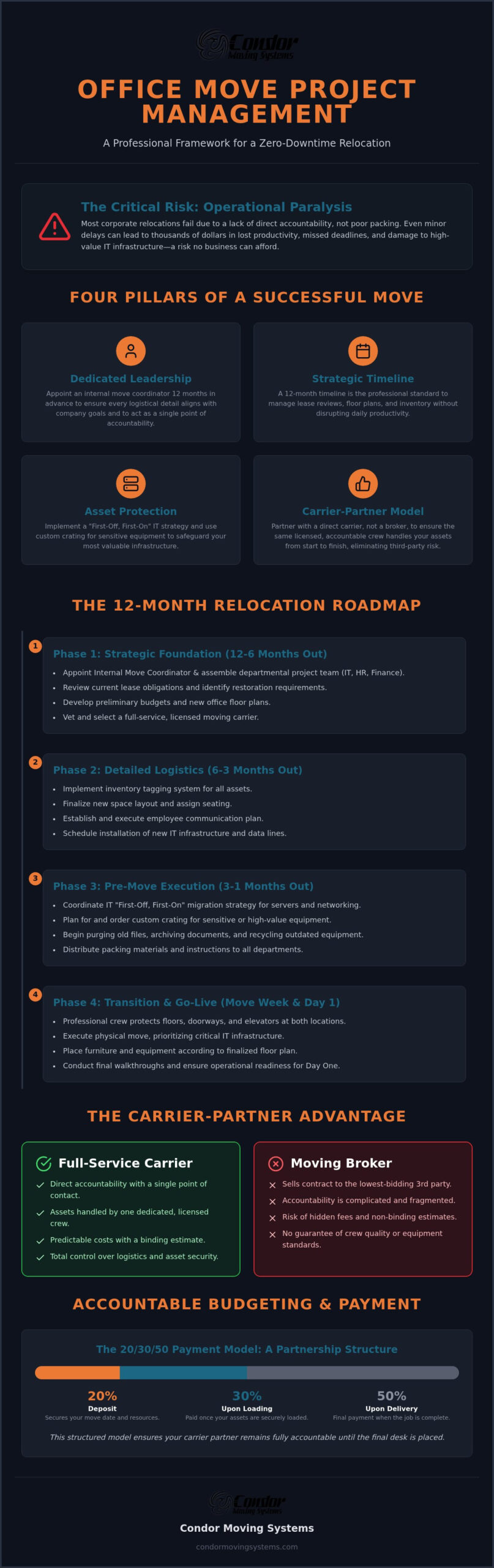
- Establishing a dedicated internal move coordinator 12 months in advance is the first step toward a successful relocation. This leadership ensures every logistical detail aligns with your company’s operational goals.
- Effective office move project management requires a strategic 12-month timeline to manage lease reviews, floor plans, and inventory tagging without disrupting daily productivity.
- Protect high-value IT infrastructure by implementing a “First-Off, First-On” strategy and utilizing custom crating for sensitive networking equipment.
- Shifting from a vendor mindset to a carrier-partner model ensures that the same licensed crew handles your assets from start to finish, eliminating the risks associated with third-party brokers.
Defining Roles and Building Your Office Relocation Project Team
Project management serves as the bedrock of any successful corporate transition. Without a structured framework, the physical act of moving desks becomes a secondary concern to the looming threat of operational paralysis. Office Move Project Management is the integration of physical logistics with business continuity planning. A robust office move project management plan creates a culture of accountability that extends from the C-suite to the loading dock, ensuring every decision supports the goal of zero downtime.
The success of your office move project management strategy depends heavily on the Internal Move Coordinator. This leader shouldn’t just be an administrator; they need the authority to make real-time decisions and the organizational discipline to manage multiple moving parts. They act as the primary liaison between your executive board and external Relocation services, keeping the project timeline on track while filtering out logistical noise from your core business operations.
Selecting Internal Stakeholders
A functional project team requires representation from every department impacted by the transition. Your IT Director leads the infrastructure migration, focusing on the “First-Off, First-On” rule for networking equipment to maintain digital operations. HR plays a vital role in managing employee expectations and mitigating “change fatigue” through transparent communication and phased updates. Simultaneously, the Finance Director must approve logistical contingencies early to handle specialized equipment needs or site-specific requirements. Establishing a weekly meeting cadence prevents communication silos and keeps all departments aligned on the 12-month roadmap.
Defining External Partner Requirements
Choosing the right vendor is a matter of security and asset protection. Many businesses fall into the trap of hiring a moving broker, which is an intermediary that sells the contract to a third party. This adds layers of risk and complicates accountability. Instead, prioritize a full-service carrier that maintains its own crews and equipment. Specialized business relocation services require licensed professionals who understand the nuances of corporate assets and high-value IT infrastructure. When vetting partners, look for credentials like Pinnacle Mover certification and membership in the Southwest Movers Association. These designations, combined with over 20 years of industry experience, signal a commitment to operational integrity. For organizations in Dallas, Houston, or Austin, selecting a partner with direct Texas-based expertise ensures compliance with regional logistics and building-specific requirements.
Developing a 12-Month Strategic Timeline and Budget
Successful office move project management relies on a timeline that begins long before the first box is packed. While some sources suggest a six-month window, a 12-month horizon is the professional standard for ensuring business continuity. This extended lead time allows your team to navigate lease obligations, technical migrations, and the logistical nuances that often derail smaller projects. Aligning your schedule with a comprehensive corporate relocation guide ensures you account for high-level milestones like permit acquisitions and infrastructure build-outs.
Budgeting for a corporate relocation requires more than just a line item for labor. It involves understanding a structured 20/30/50 payment model, which is common among established carriers. This typically requires a 20% deposit to secure your move date, 30% upon loading your assets, and the final 50% at delivery. This breakdown protects your organization by ensuring the service provider remains accountable until the final desk is placed. If you’re ready to establish your baseline costs, requesting a free moving quote can provide the binding estimate needed for executive approval.
Phase 1: The 6-to-12 Month Planning Window
The initial phase focuses on contractual and physical discovery. You must review current lease obligations to identify restoration requirements, such as “broom clean” clauses or the removal of custom cabling. During this window, your project team should conduct a full inventory of all furniture and specialty equipment. Every item needs a digital tag that corresponds to the new floor plan. Securing binding estimates at this stage is critical; these guaranteed flat-rate quotes prevent “scope creep” and ensure your finance department can allocate funds with total precision.
Phase 2: Managing Logistics and Site Access
As the move date approaches, the focus shifts to site-specific challenges that often lead to “hidden” costs. One of the most overlooked factors in office move project management is the “Long-Carry.” This fee applies if the distance between the loading dock and the office suite exceeds 150 feet or involves more than 14 steps. Additionally, if your new location has restricted access that prevents an 18-wheeler from docking, you must budget for shuttle services. This involves transferring assets into smaller trucks to complete the delivery. For phased transitions, booking climate-controlled storage is essential to protect sensitive documents and electronics from the fluctuating Texas humidity while the new space is finalized.
Managing Technical Logistics: IT Infrastructure and Specialty Equipment
Effective office move project management prioritizes the technical heartbeat of your organization above all other physical assets. To minimize downtime, professional carriers utilize the “First-Off, First-On” rule for server and networking equipment. This strategy ensures that your IT infrastructure is the last thing loaded onto the truck and the first thing installed at the new destination, allowing your technical team to begin the reconnection process while furniture is still in transit. Technical logistics require a synchronized schedule between your internal IT department and the moving crew to avoid bottlenecks during the disconnect phase.
Coordination is the only way to prevent the loss of critical connectivity. Your project team should utilize a comprehensive office move IT checklist to track every cable, rack, and peripheral before the physical move begins. It’s also vital to understand the category of “non-allowables” in corporate relocation. For security and safety reasons, licensed carriers will not transport server data backups, proprietary software drives, or hazardous cleaning chemicals. These items must be handled through your internal chain of custody to ensure data integrity and compliance with safety regulations.
Custom Crating for High-Value Assets
Standard corrugated boxes lack the structural integrity required to protect precision electronics or fragile corporate assets. For high-value electronics, fine art, and sensitive lab equipment, professional packing and custom crating is a logistical necessity rather than an optional upgrade. Custom-built wooden crates provide a rigid exterior that absorbs vibration and prevents shifting during transit. Relying on “Packed by Owner” (PBO) boxes for expensive IT assets introduces significant commercial liability risks, as most valuation coverage excludes items not professionally packed by the carrier. Using office move project management to identify these high-value items early allows for the preparation of specialized containers that meet the exact dimensions of your hardware.
Specialty Item Handling
Moving heavy or oversized items like industrial safes, pianos, or specialized medical equipment requires more than just standard labor. These assets often have “ground-floor to ground-floor” requirements, meaning the transport is limited to locations with direct street-level access or heavy-duty freight elevators. If your relocation involves these specialty items, verify that your carrier has the specific rigging and equipment needed for safe transport. Additionally, remember that re-assembly services are typically limited to items disassembled by the moving crew. If your internal team disassembles complex workstations or lab benches to save time, the carrier cannot assume the liability of rebuilding them at the new site, making clear role definition essential for a seamless transition.
Communication and Risk Mitigation: Ensuring Business Continuity
A successful transition relies on a tiered communication strategy that reaches both internal staff and external stakeholders. You should inform clients of service interruptions at least 30 days in advance, while employees require a more granular schedule to manage their specific departments. Integrating these communications into your office move project management framework prevents the confusion that leads to downtime. To further protect operations, many organizations schedule physical transport during after-hours or weekend windows. This ensures that the heavy lifting occurs when your team is offline, allowing for a seamless return to work on Monday morning.
Risk mitigation also involves a clear understanding of financial protection. It’s vital to distinguish between “insurance” and “valuation.” Under standard contracts, the carrier provides Released Value protection at $0.60 per pound. While this is the industry standard, it often fails to cover the actual cost of high-value IT assets. For total peace of mind, you should evaluate Full Value Protection or third-party coverage options. Any service issues or missing items must be reported within a 72-hour window post-delivery to ensure the carrier can address the discrepancy immediately.
Employee Coordination and Packing Rules
Clear packing protocols are essential for maintaining order at the new site. You must set strict deadlines for personal desk packing to ensure the crew can begin moving furniture without obstruction. We enforce a “No Trash Bags” policy; all items must be placed in professional-grade moving boxes or crates to prevent damage and allow for secure stacking. Your labeling system should be color-coded or numbered to match the new floor plan. This allows the crew to place every box in the correct suite or workstation on the first attempt, significantly reducing the time spent on post-move organization.
Liability and Claims Management
Managing potential claims starts the moment the truck arrives at the destination. You must document any visible damage to crates or equipment directly on the Bill of Lading before the crew departs. While we maintain a high standard of care, professional office move project management requires a formal process for unexpected issues. If you’ve opted for Full Value Replacement Coverage, the carrier is responsible for repairing or replacing damaged assets at their current market value. Federal regulations allow for a 9-month window to file formal claims, but prompt documentation at the time of delivery is the best way to ensure a swift resolution.
Selecting a Corporate Moving Service for Total Project Accountability
Choosing the right partner is the final, most critical decision in your office move project management strategy. While many companies market themselves as relocation experts, there’s a significant operational difference between a broker and a full-service carrier. A carrier-led move ensures that the same licensed crew that inventories your assets in Dallas, Houston, or Austin is the one that offloads them at the destination. This continuity eliminates the “middleman” risk where accountability is lost between different subcontractors. For organizations requiring a dedicated-truck service, this model provides guaranteed delivery dates and a direct chain of custody for time-sensitive shifts.
Texas-based expertise is invaluable when navigating the logistical hurdles of major metropolitan centers. Professional carriers use personalized inventory tagging and tracking systems to ensure every workstation and server rack is accounted for in real-time. This level of precision is the only way to maintain the transparency needed for complex corporate relocations. By working with a specialist that owns its equipment and employs its own crews, you gain a level of reliability that third-party brokers simply can’t match. Organizations managing staff transitions alongside physical logistics can find a comprehensive framework in our employee relocation services resource guide for 2026, which covers policy development, tax implications, and logistical execution. Smaller organizations can find additional guidance on avoiding broker pitfalls in our dedicated resource on small business moving services for 2026.
The Full-Service Mover Advantage
Eliminating the broker model is essential for corporate security and liability management. Brokers are intermediaries that sell your contract to the lowest bidder, which often leads to fragmented communication and disputed claims. In contrast, a full-service carrier provides a single point of contact from the initial estimate to the final delivery. This is particularly vital for long distance moves where assets cross several state lines. Direct handling by experienced crews ensures that the specialized packing and crating standards established at the start of the project are maintained until the final item is placed.
Finalizing the Move: Delivery and Setup
The relocation process doesn’t end when the truck pulls into the new loading dock. You must verify the delivery inventory against the original manifest before the driver departs. This final audit is the closing stage of effective office move project management. Regarding financial protocols, it’s important to prepare for specific payment requirements. For the final 50% of the move cost, professional carriers typically require a cashier’s check or Zelle. They don’t accept cash, personal checks, or credit cards at the time of delivery, so coordinating with your finance department in advance is necessary. Once the assets are inside, the focus shifts to post-move support. This includes re-assembling modular furniture and ensuring workstation setups match the approved floor plan, allowing your employees to return to a fully functional environment on day one.
Securing Your Operational Continuity for 2026 and Beyond
Executing a seamless corporate transition requires more than just logistics; it demands a dedicated commitment to direct accountability. By establishing a 12-month strategic roadmap and prioritizing a carrier-led model, your organization eliminates the risks of downtime and fragmented communication. Mastering office move project management means protecting your high-value IT infrastructure with custom crating and ensuring that the same licensed crew handles your assets from start to finish. It’s the only way to guarantee that your business remains functional from day one.
Choosing a partner with over 20 years of Texas moving expertise provides the stability your business needs during a period of change. As a licensed and insured direct carrier (USDOT 1126171), we ensure that no brokers ever touch your sensitive equipment. This direct-service approach allows you to focus on your core business while we manage the complexities of your relocation with total operational integrity. You don’t have to face the stress of relocation alone when you have a disciplined professional managing every detail.
We’re ready to help you move forward with confidence and precision.
Frequently Asked Questions
What is the first step in managing an office relocation?
The first step is establishing a dedicated internal project team and move coordinator at least 12 months before your relocation date. This leadership group should include representatives from IT, HR, and Finance to ensure every operational requirement is documented early. Setting this foundation allows for a clear office move project management timeline and prevents the logistical bottlenecks that often occur when planning is rushed or decentralized for large-scale Texas enterprises.
How much does a professional corporate moving service cost?
Commercial relocation costs vary based on the square footage of the office, the volume of IT infrastructure, and specific site access requirements. Factors such as “Long-Carry” fees for distances over 150 feet or the need for shuttle services if 18-wheelers cannot access the loading dock will influence the final estimate. We recommend securing a free, no-obligation binding estimate to receive a guaranteed flat-rate quote tailored to your specific logistical needs in Dallas or Houston.
Can I use my own boxes and trash bags for packing office supplies?
While you can use your own professional-grade moving boxes, trash bags are strictly prohibited for packing any office supplies or equipment. Items packed in trash bags won’t be accepted by our crews because they lack structural integrity and can’t be safely stacked in the truck. For the best protection, we recommend using uniform moving boxes or our specialized packing kits, which are available online with free shipping to ensure your assets remain secure.
What items are considered ‘non-allowable’ for office movers?
Non-allowable items include jewelry, cash, deeds, securities, plants, and perishable food. Additionally, we don’t transport or store hazardous materials such as explosives, flammable gases, propane, paint, ammunition, or industrial cleaners. These items pose a safety risk to the crew and the shipment. Your office move project management plan should account for the internal handling of sensitive documents and proprietary data backups, as these are not transported by professional carriers for security reasons.
Do you provide real-time GPS tracking for our office equipment?
We don’t provide real-time GPS tracking or live location updates for shipments. Instead, we maintain a methodical communication process that includes two specific notifications for our clients. You’ll receive an update once your office equipment is officially in transit and a second notification approximately 24 to 48 hours before the scheduled delivery. This structured approach ensures you have the necessary information to prepare your team in Austin or San Antonio for the arrival of your assets.
How do I handle claims for damaged IT equipment after the move?
If you discover damage to IT equipment, you must note the discrepancies on the Bill of Lading at the time of delivery before the driver leaves. Any service issues should be reported within 72 hours. To file a formal claim, you must submit it in writing to Anthem Claim Management within 9 months of delivery. Remember that owner-packed items are not covered for internal damage unless there is visible external damage to the box noted at delivery.
Is there a discount for military-owned businesses or senior-led organizations?
We offer specific discounts for active-duty military, veterans, and seniors aged 65 and older. These discounts are part of our commitment to providing accessible, high-quality relocation services to those who have served or are leading established organizations across the Fort Worth and Plano areas. When you contact us for your initial estimate, please mention your eligibility to ensure these savings are applied to your final quote. We take pride in supporting the Texas business community.
What is the difference between standard valuation and full value protection?
Standard valuation, known as Released Value Protection, is provided at no extra cost and covers items at $0.60 per pound. This is a tariff liability rather than insurance. Full Value Protection is a comprehensive option purchased through a third party that covers the replacement or repair of items at their current market value. While standard valuation provides basic protection, many corporate clients opt for Full Value Protection to secure their high-value technical infrastructure and specialty equipment during transit.