



In 2026, a corporate relocation policy is only as reliable as the hands that actually lift the crates. You already know that choosing the right employee relocation services involves much more than just booking a truck. It’s a high-stakes transition where hidden broker fees, damaged high-value assets, and employee burnout can quickly derail your operational goals. Balancing the human element with strict logistical requirements is often the most stressful part of your year.
This guide will help you master the complexities of corporate moves by providing a transparent framework for policy development and logistical execution. We will break down the latest 2026 tax implications for moving benefits, provide a comprehensive logistics checklist, and show you how to identify an accountable moving partner who takes direct responsibility for every item. By the end of this resource, you’ll have the tools to ensure every transition is predictable, secure, and professional. You will learn to move beyond the uncertainty of intermediaries and focus on a direct carrier model that prioritizes your company’s assets and your people’s peace of mind.
Key Takeaways
- Compare Lump Sum, Managed Cap, and Full-Service relocation models to determine which policy structure best aligns with your corporate goals and budget.
- Recognize the accountability gap between brokers and direct carriers to protect your company from hidden costs and damaged equipment.
- Master the logistics of professional packing and custom crating to ensure sensitive office technology arrives safely and ready for immediate use.
- Navigate the 2026 tax landscape for employee relocation services to provide clear, compliant benefits that support your workforce.
- Streamline transitions within the Texas triangle by partnering with a provider that understands the specific logistical demands of the state’s major business hubs.
What are Corporate Relocation Services?
Corporate relocation is the structured management of moving employees, their families, and their household goods to a new location to meet specific business goals. While global mobility often highlights international assignments, the domestic U.S. market remains the backbone of corporate growth. Relocation services provide a framework that allows organizations to transfer human capital without the typical friction of a DIY move. It’s a strategic tool. When your business expands, you need your most experienced leaders on the ground immediately. Professional relocation ensures they arrive ready to work.
Local expertise matters, especially in high-growth regions. For businesses operating in Texas, the logistical challenges of Dallas, Houston, Austin, and San Antonio require a partner who knows the territory. Whether you are coordinating local movers in Texas or managing a cross-country transfer, the goal is the same: minimize downtime. A provider with local hubs can navigate the specific building requirements and transit windows unique to these major cities, which prevents costly delays.
The Scope of Modern Relocation Support
Modern support is multifaceted. It isn’t just about a truck and a crew. It’s a three-tiered approach to business continuity. First, physical logistics include specialized packing and custom crating for fragile office assets. Second, administrative support handles the complexities of policy development and expense tracking. Finally, employee-focused care addresses the human side of the move. This includes area orientation and storage solutions that alleviate the immediate pressure on the relocating family. Comprehensive employee relocation services bridge the gap between a company’s needs and an employee’s comfort.
Who Needs a Corporate Relocation Partner?
Strategic partnerships are essential for any organization that values talent and time. Growing enterprises opening new branches in Austin or San Antonio often move key personnel to maintain company culture. Companies recruiting specialized talent from out-of-state use relocation packages as a competitive advantage. Additionally, organizations performing large-scale office moves need professional employee relocation services to handle the physical transfer of high-value equipment. If your business is moving people to stay ahead, you need a disciplined provider who takes full ownership of the process from start to finish.
Core Components of an Employee Relocation Policy
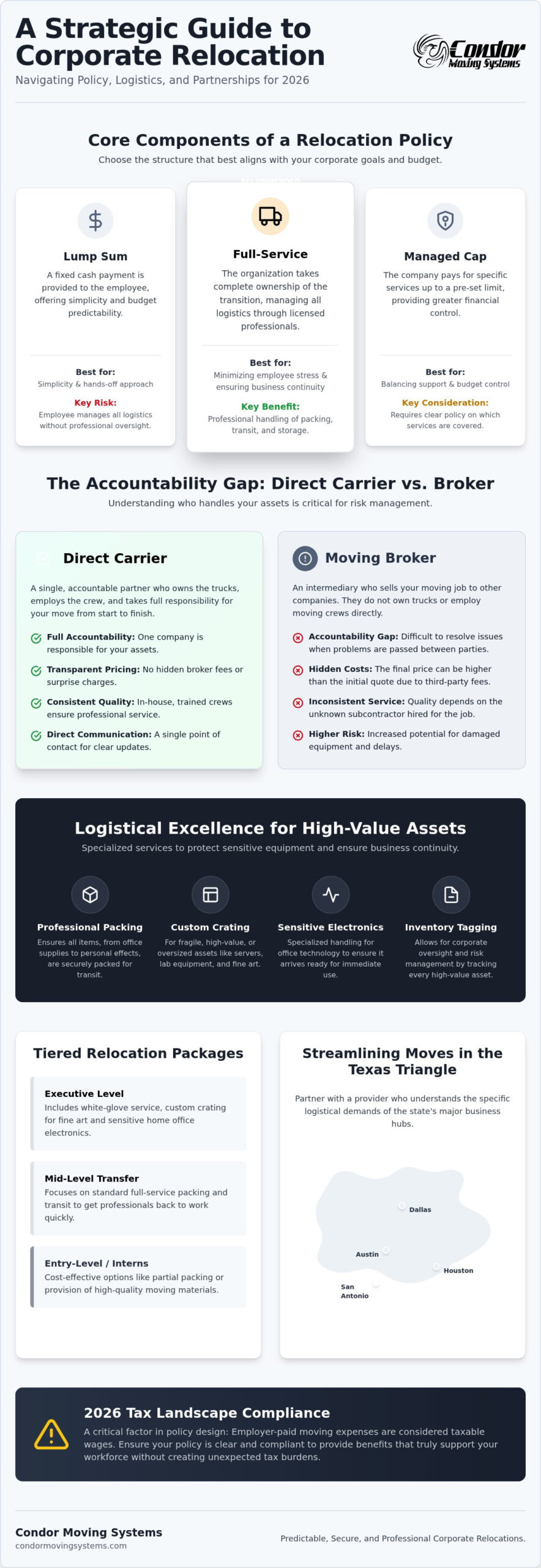
A well-defined policy isn’t just a document; it’s the blueprint for a predictable move. Businesses typically choose between three main structures to manage their workforce mobility. Lump sum policies provide a fixed cash payment, which offers simplicity but often leaves the employee to manage complex logistics without professional oversight. Managed cap models allow the company to pay for specific employee relocation services up to a pre-set limit, providing better financial control. Full-service policies represent the highest standard, where the organization takes complete ownership of the transition to minimize employee stress. This approach ensures that essential inclusions like packing services and temporary storage are handled by licensed professionals.
Accountability starts before the first box is loaded. Clear inventory tagging is vital for corporate oversight and risk management. It allows your logistics team to track high-value assets and ensures that every item is accounted for at delivery. Without this level of detail, resolving claims for damaged equipment becomes a heavy administrative burden that can sour the employee’s experience in their new role.
Tiered Relocation Packages
Tiering your benefits allows for cost control while meeting the specific needs of different seniority levels. Executive-level moves often require white-glove service and custom crating for fine art or sensitive home office electronics. Mid-level transfers usually focus on standard full-service packing and transit to get the professional back to work as quickly as possible. For entry-level roles or interns, partial packing or materials-only options might be more appropriate. This structure ensures that your budget is allocated effectively across the organization. If you’re currently designing a new policy for your team, you can request a detailed estimate to help benchmark your logistical needs.
Policy Compliance and Tax Considerations
The tax landscape for 2026 remains a critical factor in policy design. Since employer-paid moving expenses are considered taxable wages, they must be included in an employee’s W-2 income. To offset this, many companies offer a “tax gross-up” to cover the additional tax burden. This can add 40% or more to the total cost of the move, making it a significant point of negotiation. Understanding how to structure Relocation Incentives is essential for maintaining compliance during corporate audits. Accurate reporting and clear documentation of all reimbursements will help your organization avoid common pitfalls during tax season and ensure the transition is as smooth for your accounting department as it is for the employee.
Direct Carrier vs. Moving Broker: The Accountability Gap
A moving broker is essentially a sales organization that books your move and then sells the contract to a third party. They don’t own trucks, they don’t maintain warehouses, and they don’t employ the movers who enter your office. In contrast, a direct carrier is an owner-operator that manages the entire process with their own equipment and staff. This distinction is the most critical factor in corporate accountability. When you hire employee relocation services, you need to know exactly whose hands are on your assets. If a broker outsources your move to an unvetted subcontractor and your high-value equipment is damaged, determining responsibility becomes a legal nightmare where the broker and the subcontractor point fingers at each other.
Condor Moving Systems eliminates this risk by maintaining total operational control. Since our founding in 2003, we’ve relied exclusively on direct, licensed crews rather than intermediaries. We hold USDOT license 1126171 and TXDMV license 006338906C. Verifying these credentials through official databases is the only way to ensure your provider is a legitimate carrier. A carrier’s reputation is tied to their license; a broker’s reputation is often hidden behind a network of changing subcontractors.
Why Direct Control Reduces Risk
Direct management removes the variables that lead to relocation failure. Because we employ our own teams, we maintain consistent training standards and perform rigorous background checks that brokers simply can’t guarantee across a network of third parties. This model also provides price stability. Brokers often provide low-ball estimates that increase once the actual carrier arrives at the dock, but a direct carrier offers fixed pricing structures based on their own operational costs. You also gain a direct line of communication. You aren’t calling a middleman’s call center; you’re speaking with the dispatcher and driver who have direct responsibility for your cargo.
How to Spot a Broker in Disguise
Identifying a broker requires looking past a polished website. A major red flag is the lack of a physical fleet or a central warehouse in their service areas. If a company provides an estimate without a physical or virtual survey and refuses to share their direct carrier authority, they are likely an intermediary. As of January 16, 2026, a new FMCSA rule requires brokers to maintain $75,000 in readily available trust funds to increase financial responsibility, but even with this security, the logistical risk of outsourcing remains high. Selecting a local moving co based on accountability means choosing a partner with a proven physical presence. Professional employee relocation services shouldn’t involve a game of chance regarding who is actually driving the truck.
Logistical Excellence: Packing, Crating, and Storage
Professional packing is the foundation of a successful move. It ensures that business operations resume quickly without the setback of damaged inventory or lost files. High-quality employee relocation services prioritize the physical integrity of every item by using industry-specific materials and techniques. We do not accept items packed in trash bags; all goods must be secured in proper moving boxes to ensure safe stacking and transport. For sensitive electronics, fine art, or specialty equipment, standard cardboard boxes are insufficient. Custom crating provides a rigid, tailored enclosure that absorbs shock and prevents shifting during transit. This level of protection is essential for maintaining the value of your corporate assets and ensuring that employees can set up their workstations immediately upon arrival.
Certain items cannot be included in the shipment due to safety regulations and liability restrictions. We do not move jewelry, cash, firearms, or hazardous materials. Plants and perishable items are also prohibited because they cannot survive the transit environment and may compromise the cleanliness of the truck. Clearly communicating these non-allowables to your staff early in the process prevents delays on moving day and ensures that everyone is prepared to handle their personal valuables independently.
Strategic Packing for Office Moves
Efficiency in unpacking is just as important as the packing itself. We utilize comprehensive labeling systems that color-code items by department and floor, allowing our crews to place every box in its exact location at the new office. This methodical approach protects sensitive hardware and ensures that data cables and peripheral equipment remain with their respective machines. For a step-by-step breakdown of how to prepare your facility, consult our 2026 Office Moving Checklist. Organizing these details in advance is the best way to safeguard your hardware and maintain data security during the physical transfer.
Managing Storage-in-Transit (SIT)
Corporate moves rarely happen on a perfectly synchronized timeline. When an employee’s new residence isn’t ready for immediate occupancy, Storage-in-Transit (SIT) provides a secure, climate-controlled solution. Our facilities protect household goods from extreme Texas temperatures and humidity, which is vital for preserving wooden furniture and electronics. Billing for these services is typically structured on a monthly basis at a rate of $0.50 per cubic foot. It’s important to verify that your valuation coverage remains active throughout the storage period. Professional employee relocation services should offer seamless integration between transit and storage so that your employees’ belongings are never left in an unvetted environment.
Partnering with Condor for Texas Corporate Relocations
Condor Moving Systems has been a fixture in the Texas logistical landscape since 2003. With over two decades of experience, we’ve developed a deep understanding of the unique requirements within the Texas triangle, Dallas, Fort Worth, Houston, Austin, and San Antonio. While many modern platforms offer software solutions for global mobility, they often lack the physical infrastructure to execute a move. We provide the actual boots on the ground. Our “No Broker” guarantee ensures that your move is handled by our direct, licensed crews from origin to destination. This eliminates the uncertainty of who is actually handling your assets and provides a single point of accountability for your employee relocation services.
Transparency in our financial operations is just as critical as our physical handling. We require a 20% non-refundable deposit to secure your moving date, with the remaining balance structured through transit payments. It’s important to remember that we don’t accept cash, personal checks, or credit cards at the time of delivery. All final payments must be made via cashier’s check, money order, or Zelle. This disciplined approach to billing ensures that there are no surprises or hidden fees during the final stages of the relocation process.
Corporate Benefits and Discounts
We offer specialized support to make your relocation budget go further. Transferring employees who qualify for military or senior discounts can access reduced rates, helping to lower the overall cost of the transition. To facilitate accurate corporate planning, we provide free, no-obligation binding estimates. This means the price you’re quoted is the price you pay, assuming the inventory remains the same. We also maintain a 24-hour emergency answering service. If an employee has a question or a logistical concern in the middle of the night, they have immediate access to a professional who can provide answers and peace of mind.
Getting Started with Your Relocation Program
The first step in a successful partnership is a customized inventory assessment. This allows us to understand the specific volume and crating needs of your move. Whether you require long distance moving services or a local transfer between Texas hubs, we work with your HR or facilities team to finalize a precise transit schedule. We establish a clear delivery window from the start, typically ranging between one and ten business days depending on the distance. By setting these expectations early, we ensure that your employees are settled and your business is operational in its new location without unnecessary delays.
Securing Your Corporate Transition
Mastering the complexities of a 2026 corporate move requires a shift from passive administration to active logistical management. You’ve seen how the accountability gap between brokers and direct carriers can impact your bottom line and your employees’ peace of mind. By choosing a partner that owns its fleet and manages its own crews, you ensure that every desk, server, and household item is protected. Condor Moving Systems is a Pinnacle Mover Certified, FMCSA-regulated full-service mover dedicated to this level of transparency. Operating under USDOT license 1126171, we take full ownership of the process from the initial inventory assessment to the final delivery window.
Providing high-quality employee relocation services is a strategic investment in your company’s future talent and operational stability. When you utilize professional packing and climate-controlled storage, you eliminate the variables that lead to downtime. We’re ready to help you build a relocation program that’s both cost-effective and protective of your most valuable assets. Your next successful expansion begins with a partner who values precision and reliability as much as you do.
We look forward to helping your team transition into their new roles with the professional support they deserve.
Frequently Asked Questions
What is the difference between a relocation company and a moving company?
A relocation company often manages the administrative and policy aspects of a move, while a moving company like Condor Moving Systems handles the physical logistics. Many businesses use the terms interchangeably when hiring employee relocation services, but a direct carrier provides the trucks, crews, and specialized equipment needed to physically transport assets. We focus on the high-stakes execution of the move, ensuring items like pianos or office technology arrive safely and securely.
How much does corporate relocation typically cost per employee?
Corporate relocation costs vary significantly based on the employee’s seniority and the total distance of the move. General industry data for 2026 suggests that entry-level lump-sum packages often range from $2,500 to $15,000, while executive homeowner transitions can exceed $100,000. These figures typically include packing, transit, and temporary storage. Since every corporate move is unique, we provide binding estimates to ensure your budget is based on a precise, flat-rate quote.
Does Condor Moving Systems handle international employee relocations?
No, Condor Moving Systems does not handle international employee relocations. We specialize exclusively in domestic moves, focusing our expertise on local and long-distance transfers within the United States. Our operations are specifically designed to serve major Texas hubs like Dallas, Austin, and Houston with direct, licensed crews. This targeted approach allows us to maintain total accountability and high service standards across our domestic service areas without the complications of international sub-contracting.
What items are prohibited from being moved in a corporate relocation?
Prohibited items include jewelry, cash, deeds, securities, firearms, and hazardous materials like propane or paint. We also cannot move or store living plants, animals, or perishable food items. These restrictions are in place to ensure the safety of our crews and the security of your shipment. We recommend that relocating employees transport their personal valuables and restricted items separately to avoid any logistical delays or liability issues on moving day.
How is valuation different from moving insurance?
Valuation is a level of liability that a mover assumes, while insurance is a separate contract provided by a third party. Our standard coverage is Released Value Protection, which provides $0.60 per pound per item at no additional cost. This is not insurance. If your organization requires Full Value Replacement Coverage for high-value assets, it must be purchased through an external provider before the employee relocation services begin to ensure comprehensive protection.
Can a company pay for the move with a credit card at delivery?
No, we don’t accept credit cards, cash, or personal checks at the time of delivery. The final balance must be paid using a cashier’s check, money order, or Zelle. While you can use a credit card for the initial 20% non-refundable deposit and the 30% pickup payment (subject to a 3% fee), our delivery protocols are strictly limited to guaranteed funds. This ensures a transparent and secure closing to the relocation process for both parties.
How long does a long-distance corporate move typically take?
A standard long-distance corporate move typically takes between one and ten business days to complete. This timeline depends on the total distance and the specific destination, though transitions to extended or remote areas can occasionally take up to 21 days. We provide a clear transit schedule and two specific notifications during the process: once when the shipment is in transit and again 24 to 48 hours before the scheduled delivery arrives at the destination.
Are packing materials like trash bags allowed for corporate moves?
No, trash bags are not accepted as packing materials for any corporate or residential move. They offer no protection for the contents and cannot be stacked safely inside a moving truck, which increases the risk of damage. All items must be secured in professional moving boxes or custom crates. We offer full-service packing solutions and high-quality materials to ensure that every asset is prepared for transit according to professional industry standards.