


What if the biggest threat to business continuity isn’t moving day, but the tasks left unsequenced before it? Lost work time and interrupted customer service are real concerns when staff, equipment, essential records, and building access all need coordination. A practical guide to minimizing business downtime during a move Dallas companies can use starts by identifying which functions must keep running and deciding when each team or asset can move.
A clear continuity plan gives staff defined responsibilities and timelines while keeping essential operations in focus. This guide explains how to map critical functions, schedule a phased move, coordinate employees and building logistics, and plan for technology downtime and contingencies. It also covers how an organized inventory process can help keep workplace contents accounted for. Condor Moving Systems’ direct crews, commercial moving support, packing options, storage, and personalized inventory tagging and tracking help businesses organize the move around operational needs. The goal is a controlled transition, with equipment and workplace contents moved in sequence and a practical plan for resuming work at the new location.
Key Takeaways
- Start minimizing business downtime during a move Dallas by identifying critical functions and dependencies before setting the move sequence.
- Assign one internal move lead and departmental contacts so responsibilities, decisions, and readiness checks have clear owners.
- Compare phased relocation, a single coordinated move window, and temporary-work arrangements against your staffing, equipment, and access needs.
- Build a move-day runbook that aligns staff communications with building access, loading arrangements, and department readiness at both sites.
- Use organized inventory tagging, packing options, unpacking, or storage to match the move process to your operational priorities.
Why minimizing business downtime during a Dallas move starts with continuity planning
Business downtime is any interruption to essential work, customer service, or employees’ access to the resources they need. During a relocation, customers might be unable to reach a team, staff may lose access to important records, or equipment may be unavailable when a service depends on it. The moving schedule matters, but it should follow the operating plan, not define it.
A continuity plan identifies what must keep working, what can pause, and what needs to be ready before each function shifts to the new workplace. The central idea is simple: Move sequence should follow business priorities so essential work experiences as little interruption as practical. A continuity plan is the working foundation for minimizing business downtime during a move Dallas companies undertake. For an overview of the broader planning approach, see Business Continuity Planning.
Identify the work that cannot pause during relocation
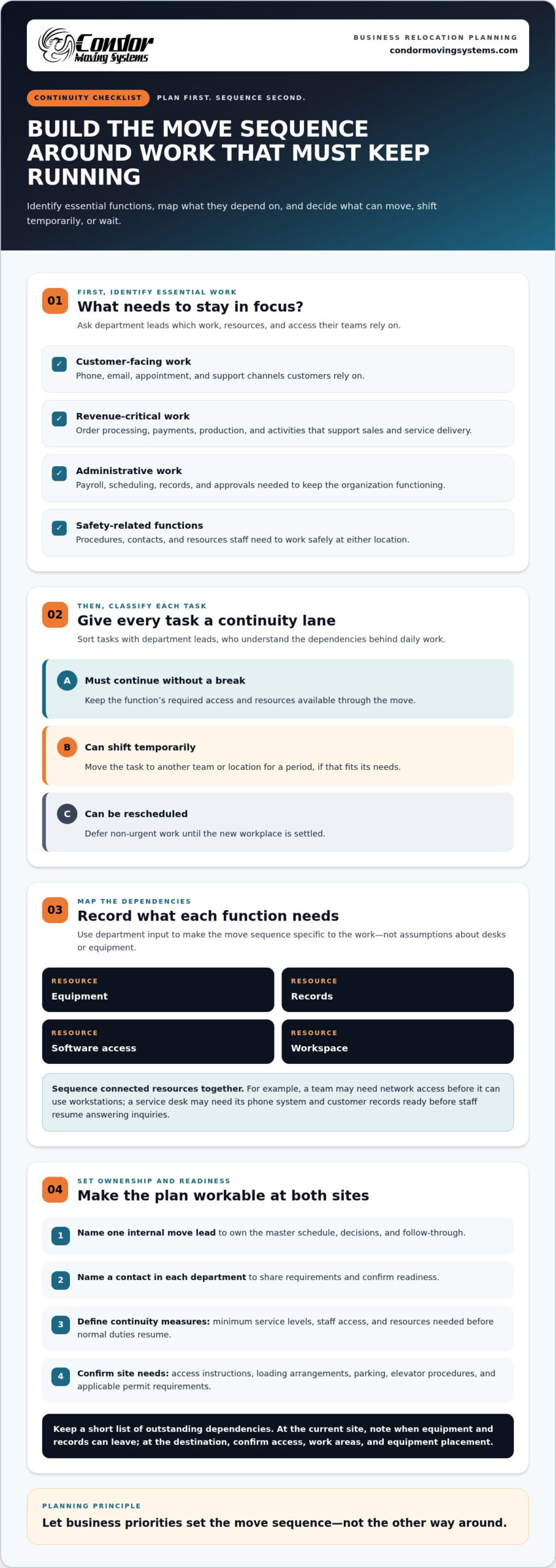
Ask department leads to identify the work, resources, and access their teams depend on. Their input makes the plan specific to your business instead of relying on assumptions about which desks or equipment matter most.
- Customer-facing work: Phone, email, appointment, and support channels customers rely on.
- Revenue-critical work: Order processing, payments, production, or other activities that directly support sales and service delivery.
- Administrative work: Payroll, scheduling, records, and approvals needed to keep the organization functioning.
- Safety-related functions: Procedures, contacts, and resources staff need to work safely at either location.
For each function, record the equipment, records, software access, and workspace it requires. Then sort its tasks into three groups: must continue without a break, can shift temporarily to another team or location, and can be rescheduled. For example, a customer support team may need system access throughout the move, while a non-urgent internal filing project can wait until the new office is settled. Make these decisions with department leads, who understand the dependencies behind daily work.
Set a realistic continuity objective for a Dallas move
Turn priorities into clear measures. Instead of saying “keep service running,” define the minimum level of service the business needs to maintain, which staff need access to work, and what resources must be ready before a team resumes normal duties. Assign an owner to each measure and decide how the team will confirm it has been met.
Account for both workplaces. At the current site, identify when equipment and records can leave without disrupting essential work. At the destination, consider whether staff can access the space, work areas are ready, and equipment can be placed where it is needed. If the new facility requires tenant improvements or renovations before move-in, coordinating early with your contractor and your office movers can help ensure site readiness. Keep a short list of outstanding dependencies so that missing access instructions or unavailable resources don’t surprise the team on move day.
Building rules and site conditions can affect the sequence. Confirm access instructions, loading arrangements, parking, elevator procedures, and any applicable permit requirements with the relevant building contacts and local authorities. Verify current Dallas requirements rather than assuming both locations follow the same process. Additionally, if a new commercial facility requires dedicated energy resilience or standby power to keep critical systems online, a qualified power contractor can assist with essential infrastructure. Once priorities, measures, and site needs are documented, you can build the move schedule around continuity.
Build a phased move plan that keeps essential Dallas business functions running
A phased plan turns continuity priorities into an executable sequence. Give one internal move lead responsibility for the master schedule, decisions, and follow-through. Name a contact in each department to share requirements and confirm readiness, so responsibilities don’t fall between teams. The lead should map dependencies, document assets, set move phases, and check readiness before each phase proceeds.
Start by mapping what relies on what. A team may need network access before it can use workstations; a service desk may need its phone system and customer records ready before staff can resume answering inquiries. Schedule connected resources together, or establish a temporary way to keep the dependent function operating. Condor’s corporate relocation page outlines a broader framework that can inform your planning.
Create a move inventory and department sequence
Build an inventory that records more than what is being moved. List workstations, shared equipment, specialty items, and the destination area or placement required for each. Tag items by department, priority, destination, and setup dependency. An accurate inventory gives the move team a shared reference for what goes where, what needs to be ready first, and which items support essential work.
Use those details to set the packing and relocation order. Identify equipment a department needs immediately at the new site, then coordinate its placement with the department’s setup sequence. Keep essential records and devices accessible according to your business’s handling and security procedures. If packing is part of the plan, align it with these priorities rather than packing every area in the same order.
Protect essential work with temporary arrangements
Decide which tasks can continue remotely or from an alternate location, and which require specific equipment or workplace resources. For each temporary arrangement, name the responsible team and document the devices, records, systems, and communication channels staff need. Share instructions in advance with employees, customers, suppliers, and building contacts, tailoring the information to each audience.
Use the 2026 office moving checklist alongside your department-level continuity plan. Keep the move lead’s working schedule current, including phase owners, dependencies, and readiness checks. Before each phase, verify that the people and resources needed for the next essential function are in place. If you’re shaping a commercial relocation plan around these requirements, Condor Moving Systems can provide a moving estimate for your project.
Compare move schedules and continuity options before choosing a Dallas relocation plan
No schedule removes every interruption. The practical choice is the one that fits the work that must continue, the relationships between teams and equipment, and the scope of the move. To assess minimizing business downtime during a move Dallas businesses undertake, compare each option against the same operating needs instead of choosing a schedule based on convenience alone.
Phased relocation: This can help departments remain operational while others move. Staff coordination is more involved because teams and resources shift in stages. Equipment dependencies may limit the order, and managing access across both locations can add complexity.
One coordinated move window: A concentrated transition can simplify staff and equipment coordination when work can pause or shift temporarily. Continuity depends on how long essential work is interrupted and whether equipment and systems are ready together. Building access and site readiness must align with the move window.
Temporary-work arrangements: Remote work or an alternate location can preserve selected services while workplace contents are moved. Staff need clear access to essential devices, records, and communication channels. Equipment-heavy work may be harder to sustain, and teams need a plan to stay connected during the transition.
Compare the options against your operating requirements. Which customer services must remain available? Can dependent teams move separately, or do they rely on the same equipment and setup? Can staff work elsewhere without losing access to essential resources? The answers help show where a schedule may protect service and where it could create additional coordination or access challenges.
When a phased move may fit a Dallas business
Phasing can suit an organization with departments that can operate independently for a time. For example, one group could remain at the current workplace while another sets up at the destination, preserving selected functions. But if teams share equipment, records, or tightly linked workflows, splitting their moves may create extra handoffs without reducing disruption. Plan for staff coverage and coordination across both sites.
When a coordinated move window may be more practical
A single planned transition may fit a business that can pause or temporarily shift its work, especially when teams need to be set up together. Coordinate building access, equipment placement, and staff readiness as one sequence, then plan how essential services will resume. The office moving company case study offers related context on continuity considerations during relocation.
The right move schedule depends on operational dependencies and the scope of the relocation. Compare each approach against service needs, staff coordination, equipment requirements, and access at both workplaces. Choose the plan whose trade-offs your business can manage instead of assuming one method fits every organization.
Use a Dallas move-day runbook to coordinate people, equipment, and access
A move-day runbook turns the schedule into clear instructions for the people carrying it out. The move lead should maintain one working timeline covering staff communications, access at both sites, department readiness, and key decisions. Include when each team must be ready, who can approve a change, and how to report a delay. This gives staff and building contacts a shared reference rather than leaving them to interpret separate updates.
Organize the runbook around milestones, not assumptions about exact timing:
- Before the move: Send staff packing, labeling, access, and escalation instructions. Share relevant arrival and loading details with building contacts.
- At the origin site: Confirm access, loading arrangements, elevator procedures, and department readiness before contents leave.
- At the destination: Confirm entry, room assignments, equipment placement, and the contacts responsible for receiving each department’s items.
- As departments resume work: Check that priority equipment and resources are in their assigned areas, and report unresolved issues to the move lead.
Coordinate building access, loading arrangements, elevators, parking, and entry instructions at both addresses. Requirements can differ by property, so verify applicable rules and permit needs with building management and the relevant local authority. Don’t assume that a process approved at one site applies at the other. These details can affect where the moving team can enter and how to organize the move sequence.
Assign responsibilities before moving day
Name decision-makers for the origin site, destination site, and each department. Give staff clear instructions on what to pack, how to label items, where to go, and whom to contact if plans change. Keep the working inventory, access details, contact list, and move documents available to responsible leads, with a backup in case the primary contact is occupied.
Confirm readiness at both business locations
Before the move begins, check that the destination is accessible, room assignments are clear, and equipment placement instructions match department needs. Reconcile tagged inventory with departments and destination areas so the team can identify misplaced or unaccounted-for items. For an in-area relocation, local moving services in Texas can support the transportation portion of a coordinated commercial move.
Accurate inventory and address details matter to coordination and the move estimate. Condor requires these details to help avoid extra charges, so keep the item list and both locations’ addresses current as plans change. Share last-minute additions or address corrections with the move lead and update the working documents.
A disciplined runbook supports minimizing business downtime during a move Dallas businesses plan by making access, ownership, and readiness visible before they become move-day problems.
Choose a full-service Dallas mover to support your business continuity plan
A mover should carry out the physical relocation in a way that fits the continuity plan your team has developed. Condor Moving Systems is a full-service mover, and Condor crews handle moves directly. Your internal move lead remains responsible for business decisions, staff communications, and operational readiness, while Condor’s team manages the moving work.
Organized execution also depends on knowing what is moving and where it belongs. Personalized inventory tagging and tracking can connect workplace contents to departments and destination areas, helping coordinate packing, transport, and placement. This supports minimizing business downtime during a move Dallas businesses plan by helping teams identify priority items and align their arrival with setup needs. This is inventory organization, not real-time shipment tracking.
Match moving support to your business requirements
Choose packing support based on your team’s capacity and priorities. Full-service packing can cover the move contents; partial packing focuses on selected departments or items. Materials-only support provides packing supplies, while self-pack lets staff prepare contents themselves. Unpacking can help organize the transition at the destination. Each option affects what employees need to prepare and which tasks remain on your internal schedule.
Storage can also support a staged transition. Short- or long-term climate-controlled storage may help when the new workplace is not ready for every item or when contents need to be held between move phases. Specialty-item handling is relevant for equipment or other high-value pieces that require particular care and coordination. Identify these needs in the inventory so they can be included in the overall move scope.
Turn the continuity plan into a move quote request
Prepare an accurate inventory, origin and destination addresses, building access details, and timing needs. Note which items are essential to early operations, which departments depend on particular equipment, and whether packing or storage will support the transition. Accurate inventory and address details are required to avoid extra charges, so update them if the scope or locations change.
Condor provides free, no-obligation binding estimates with guaranteed flat-rate quotes. Share the move details and operational priorities so the estimate reflects the project scope. Review the written estimate carefully. The signed Estimate of Charges governs if it differs from other information.
A clear scope gives the moving team and your internal leads a stronger basis for coordinating the work. Prepare your inventory, addresses, access information, and continuity priorities when requesting a quote.
Set your continuity priorities before the move begins
Turn continuity goals into clear decisions: which services need to remain available, what interruption your team can manage, and what fallback will keep work moving if a dependency isn’t ready on schedule. That clarity makes minimizing business downtime during a move Dallas businesses face a practical planning objective, rather than an assumption that every task can continue unchanged.
Use those priorities to shape the move scope and identify where your teams need support. Condor Moving Systems’ crews handle moves directly, with personalized inventory tagging and tracking to help organize workplace contents. As a full-service mover operating since 2003, Condor provides commercial moving support aligned with the requirements you outline.
Bring your addresses, inventory, access details, and timing needs together to request a free, no-obligation moving quote. A clear starting point can help your team approach the transition with confidence.
Your business can move forward with a plan built around the work that matters most.
Frequently Asked Questions
How can a business keep serving customers during an office move?
Keep customer contact channels active and make it clear who is handling incoming requests during the transition. For example, redirect calls or shared inboxes to a designated team member, update appointment instructions, and prepare a short message explaining temporary service changes. As part of minimizing business downtime during a move Dallas businesses can identify a backup contact and test the communication route before relocating the staff or equipment that supports it.
When should a Dallas business start planning its move?
Start once the move is being considered and key dates or destination details begin to take shape. Early planning gives department leads time to flag dependencies and gives staff, building contacts, and the moving team a shared basis for coordination. Whether relocating within Dallas or between Dallas and Fort Worth, Arlington, Plano, Frisco, McKinney, Irving, Grapevine, Southlake, Austin, Houston, or San Antonio, include travel, access, and setup needs in the plan.
Is it better to move an office in phases or all at once?
Neither approach is best for every office. Phases can work if teams can function independently while other departments relocate; a coordinated move may suit a business that can pause or temporarily shift its work. Consider how staff use shared systems and equipment. If one team can’t operate until another team’s equipment is installed, splitting those moves may add handoffs without protecting service. Align the schedule with real dependencies.
What information should a business give movers for an accurate estimate?
Provide a current inventory, complete origin and destination addresses, and details that could affect access or the work scope. Include large or specialty equipment, items needing packing, contents requiring storage, and the intended move timing. Be precise about what is included and where items are going. Accurate inventory and address details help prevent extra charges, and the signed Estimate of Charges governs if it differs from other information.
Can a moving company pack office equipment and provide storage?
Yes. Condor offers full-service packing, partial packing, materials-only, and self-pack options, as well as short- and long-term climate-controlled storage. For example, a business can arrange packing support for shared equipment while staff prepare routine desk contents, then store items that aren’t needed immediately at the destination. Unpacking services can also support setup. Include equipment requirements and storage needs in the move scope so they’re accounted for in the plan.
Will the same moving crew load and unload a business move?
Not necessarily. The pickup crew may differ from the delivery crew, so don’t make continuity depend on the same individuals being present at both locations. Instead, keep item labels and placement instructions clear, and identify a company representative at each site who can answer questions and direct items to their assigned areas. Condor crews handle moves directly, providing accountability through the moving process.
Does Condor provide real-time tracking during a move?
No. Condor doesn’t provide real-time tracking or GPS updates. Two scheduled notifications are provided: one while the shipment is in transit and another 24 to 48 hours before delivery. For business coordination, use those updates alongside your internal move lead’s communication plan. Keep department contacts informed about readiness and access, and avoid making customer-service decisions based on continuous location updates that aren’t available.