


In the high-stakes environment of 2026 corporate logistics, a single day of unplanned downtime often costs more than the entire relocation budget. With Texas leading the nation in major corporate growth projects, the pressure to execute a flawless transition has never been higher. You’re likely concerned about the hidden fees common with moving brokers or the potential for catastrophic damage to specialized IT infrastructure. These fears aren’t unfounded; they’re the result of an industry where accountability is frequently outsourced. This guide shows you how to secure your bottom line using professional commercial moving services that prioritize direct-crew handling and logistical integrity.
We’ll show you how to demand a binding, flat-rate estimate that stands up to board-level scrutiny while ensuring your assets are protected by custom crating. You’ll learn the specific steps to maintain total business continuity, from verifying carrier authority under the latest FMCSA standards to executing a phased move that results in zero lost productivity. By the end of this reference, you’ll have the expert insights needed to move your operations with the confidence that every detail is under control. We focus on providing a clear, step-by-step path that replaces logistical ambiguity with the certainty of a well-executed plan.
Key Takeaways
- Understand the critical difference between direct carriers and brokers to prevent insurance gaps and hidden fees during your transition.
- Learn how specialized commercial moving services utilize custom crating and inventory tagging to protect high-value IT assets and servers.
- Develop a phased relocation schedule that ensures zero lost productivity and maintains total business continuity throughout the transition.
- Secure a binding, flat-rate estimate to provide your board with a predictable budget and total financial accountability.
- Discover the specific 2026 regulatory requirements for carrier authority and insurance to ensure your assets remain protected and compliant.
What Are Commercial Moving Services? Beyond Simple Office Relocation
To understand the scope of a business relocation, we first need a clear definition. What is a moving company? While the general term applies to any firm assisting with the transport of goods, commercial moving services represent a specialized subset of logistics. This isn’t just about hauling boxes; it’s a disciplined operation designed to relocate business assets while maintaining operational continuity. A successful move ensures that your revenue-generating activities face the least amount of friction possible during the transition.
There are fundamental differences between residential and commercial moves that every operations manager should recognize. Residential moves focus on personal items and domestic timelines. In contrast, commercial moves involve massive scale, strict technical requirements, and significantly higher liability. You’re often moving expensive IT infrastructure, proprietary data, and specialized equipment that requires specific handling protocols. Because the stakes involve your company’s ability to function, the insurance and accountability standards are much more rigorous than those found in a standard household move.
In this industry, the primary KPI is minimized downtime. Every hour your team spends in a state of transition is an hour of lost productivity. To manage this, professional movers employ project coordinators who oversee multi-departmental shifts. These experts synchronize the move so that critical departments remain functional while others are in transit. This level of coordination prevents the entire organization from grinding to a halt, allowing for a staggered, logical progression into the new space.
Small Office vs. Corporate Headquarters Relocation
The logistical needs of a five-person office differ wildly from those of a multi-floor corporation. A small office move might focus on speed and basic furniture assembly. A corporate headquarters relocation requires scaling crew sizes and specialized equipment like library carts or computer gondolas. For businesses moving between Texas hubs, such as from Dallas to Houston, regional expertise is essential. Navigating the logistics of local moving services in high-density urban areas requires a team that understands local building codes, freight elevator reservations, and traffic patterns. Large-scale moves demand a master schedule where every asset is tagged and tracked to its exact desk location in the new facility.
Specialized Commercial Logistics and Asset Management
Commercial relocation often extends into specialized asset management. For retail or hospitality businesses, this includes the handling of Furniture, Fixtures, and Equipment (FF&E). These items often require assembly and placement according to a specific floor plan. If your new location isn’t ready for immediate occupancy, you’ll need secure warehousing and fulfillment options. We offer climate-controlled storage to protect sensitive business records and electronics from the intense Texas heat. This ensures that your high-value assets remain in a stable environment until they are ready for final installation at your new headquarters.
The Accountability Factor: Why a Direct Carrier Beats a Moving Broker
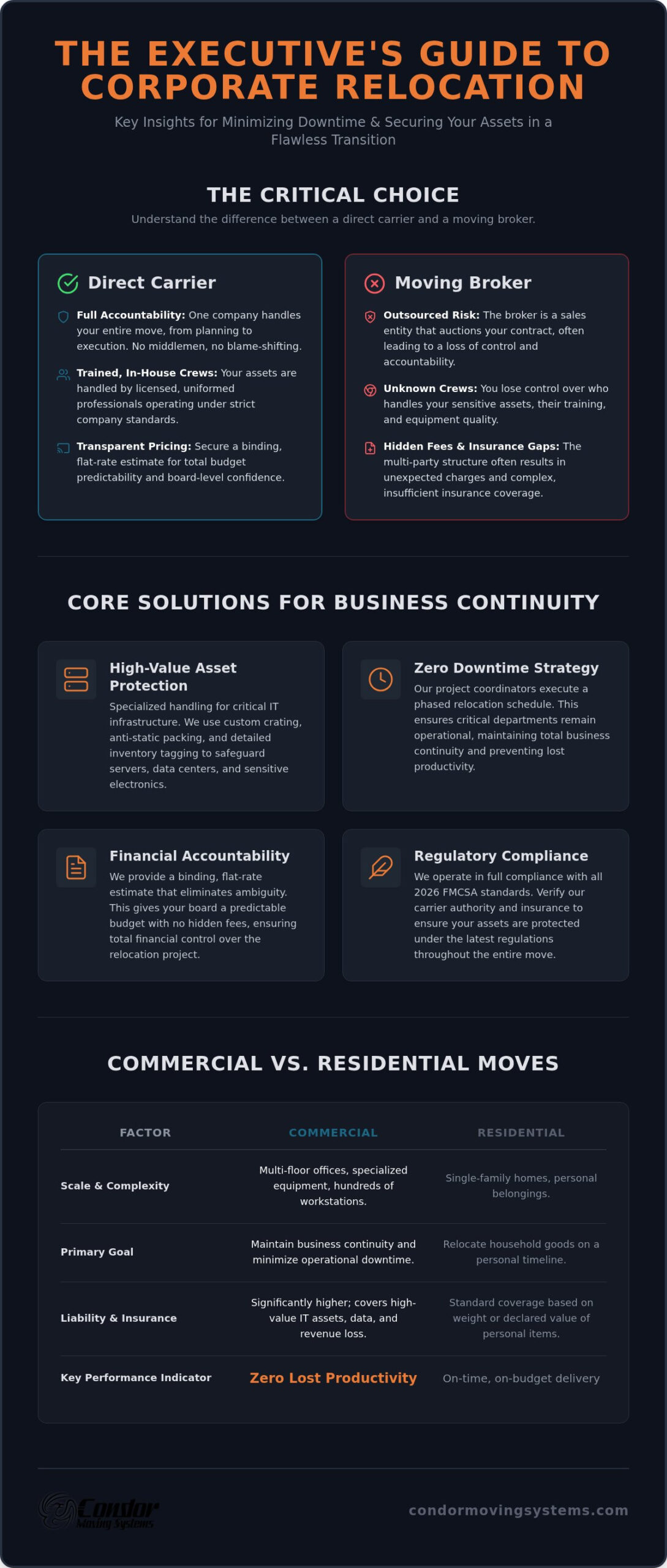
When searching for commercial moving services, the most critical decision you’ll make isn’t about boxes or trucks; it’s about who actually holds the contract. Many businesses unknowingly hire moving brokers, thinking they are dealing with the actual service provider. In reality, a broker is a sales entity that auctions your contract to third-party movers. This creates a significant risk profile. When you outsource your relocation to a broker, you lose control over who enters your facility, their level of training, and the quality of their equipment. This often leads to insurance gaps and logistical delays that can paralyze your operations.
Choosing a direct carrier like Condor Moving Systems eliminates these variables. We provide direct handling by licensed crews who are trained under our specific operational standards. Accountability is built into every step because there is no middleman to deflect responsibility. You can verify our credentials through the Federal Motor Carrier Safety Administration (FMCSA) using USDOT 1126171 and TXDMV 006041428C. Our commitment to transparency is evidenced by our full Texas and federal licensing, giving your board the peace of mind they require.
Binding Estimates vs. Variable Quotes
Budget predictability is a cornerstone of corporate relocation. A variable quote or “rough estimate” is a liability that often leads to budget overruns once the move is underway. We mitigate this risk by providing binding, flat-rate estimates. This process begins with a comprehensive physical inventory where we assess the exact volume and technical needs of your equipment. By securing a binding estimate, you lock in a price that won’t fluctuate based on labor hours or fuel surcharges. Texas businesses should always insist on a no-obligation binding estimate to ensure their financial planning remains intact from start to finish. To begin this process for your organization, you can request a binding estimate from our relocation specialists.
Tariff Liability and Valuation for Business Assets
You must distinguish between carrier valuation and traditional insurance. Under federal law, the standard Released Value Protection covers only $0.60 per pound. For a high-density server rack weighing 200 pounds but worth $50,000, this coverage is clearly insufficient. We offer Full Value Replacement options that provide much higher levels of protection for your specialized assets. Valuation represents the mover’s level of liability, while third-party insurance can provide additional layers of security for high-value shipments. Building a detailed checklist for relocating your business with Condor’s office movers during your planning phase will help you identify which specific items require these enhanced protection levels before the first truck arrives.
Core Commercial Relocation Solutions: IT, Furniture, and Logistics
Effective commercial moving services hinge on technical execution. Our crews manage office furniture disassembly and re-assembly with a focus on structural integrity. You can expect a team that understands the modular nature of modern workstations. We don’t just move desks; we deconstruct and rebuild your workspace to your exact specifications. This ensures that every ergonomic adjustment and cable management feature remains intact after the move. IT equipment relocation requires a different level of precision. Servers, monitors, and sensitive electronics are susceptible to static and physical shock. We use specialized packing materials and anti-static wraps to protect these assets. Every item is organized through a rigorous inventory tagging system. This allows Condor to track every department’s assets, ensuring that a marketing workstation doesn’t end up in the accounting wing.
We also manage specialty items with specific constraints. For example, we move pianos exclusively from ground-floor to ground-floor locations to ensure the safety of both the instrument and the crew. High-value medical gear or lab equipment receives the same level of disciplined handling. By assigning specific tags to every piece of equipment, we maintain a clear chain of custody from the moment an item is packed until it’s placed in its new location.
Professional Custom Crating for High-Value Assets
Standard boxes are often insufficient for high-value business assets. Custom crating is a science that involves building timber-based protection around fragile equipment. This is essential for fine art, glass-top conference tables, and specialized machinery. The ROI of custom crating is clear. It prevents the massive repair costs and replacement delays that occur when specialized glass or sensitive optics are compromised. It’s a proactive measure that protects your most significant capital investments during the transition. If your equipment has unique dimensions or sensitivity requirements, custom crating is the only reliable way to ensure it arrives in the same condition it left.
Packing and Unpacking Services for Business Continuity
We offer full-service or partial packing to match your staff’s availability. To maintain professional standards and asset safety, trash bags are strictly prohibited for commercial moves. They offer zero protection and lead to disorganized unpacking. We use heavy-duty cartons and crates instead. Our unpacking services are designed to get your team back to work on day one. By placing items exactly where they belong based on the pre-move plan, we eliminate the days of “settling in” that typically follow a relocation. This methodical approach ensures your team can resume operations immediately upon arrival, maintaining the business continuity your clients expect. For employees managing their own residential transitions alongside a company move, our experts have also compiled professional guidance on how to pack kitchen for moving to help protect fragile household assets with the same disciplined approach we apply to commercial assets.
Planning for Business Continuity: The Commercial Moving Process
A successful relocation isn’t a single event; it’s a series of synchronized phases designed to protect your operational uptime. When you engage professional commercial moving services, the process begins with a comprehensive pre-move consultation. During this phase, we establish a detailed relocation schedule that aligns with your department-specific needs. This prevents the chaos of a “bulk move” by assigning specific windows for packing, loading, and delivery. We focus on creating a roadmap that your internal stakeholders can follow, ensuring that everyone from IT to HR knows exactly when their workspace will be in transit.
The execution phase moves through three distinct steps. First, we perform inventory tagging and secure packing. We use this time to apply the custom crating solutions discussed earlier to your most sensitive assets. Second, the loading and transit phase begins. For long-distance transitions, we typically operate within a 1-10 business day window, depending on the volume and destination. Finally, we execute a systematic unloading and re-assembly process. Our crews don’t just drop boxes; they rebuild your workstations and place equipment according to your pre-approved floor plan, allowing your team to resume work immediately.
Navigating Logistical Hurdles: Long-Carry and Shuttle Services
Not every office location is easily accessible by a standard 18-wheeler. If your facility has narrow access roads or low-clearance overhangs, we utilize shuttle services to bridge the gap between the building and the primary transport vehicle. You should also be aware of long-carry logistical triggers. A long-carry applies when the distance from the truck to the office entrance exceeds 150 feet or involves more than 14 steps. To maintain safety and operational integrity, Condor does not deliver into attics or basements, nor do we perform hoisting services. Identifying these hurdles during the initial consultation prevents unexpected delays on move day.
Emergency and Same-Day Moving Capability
Urgent logistical shifts require a mover that can pivot quickly. For small or local moving services, same-day crew availability can often save a failing schedule. We maintain a 24-hour answering service to address these urgent needs, providing a direct line of communication for logistical peace of mind. The key to a successful emergency move is accurate inventory reporting. When you provide a precise list of assets upfront, it prevents last-minute equipment shortages and ensures we send the right crew size to handle the job without extra charges. This transparency is the only way to maintain control during a high-speed relocation.
Choosing Condor Moving Systems for Your Texas Business
Since 2003, Condor Moving Systems has provided specialized commercial moving services across the Texas Triangle. With over 20 years of experience serving Dallas, Fort Worth, Austin, and Houston, we’ve built our reputation on operational integrity and total accountability. We don’t operate as a broker; our “Direct Crew” promise means the same professional team handles your assets from the first box to the final desk. This level of control is rare in an industry where outsourcing is common, and it’s the primary reason Texas businesses trust us with their high-value infrastructure and proprietary equipment.
Our payment structures are designed for total transparency, allowing your accounting department to plan with certainty. We require a 20% non-refundable deposit to secure your move date, followed by 30% at pickup and the final 50% at delivery. It’s important to remember that we don’t accept cash, personal checks, or cards at the time of delivery; all financial arrangements must be finalized according to our established protocols. We also offer Military and Senior discounts for qualifying business owners, providing additional value to those who’ve served our country or built long-standing enterprises.
Texas-Specific Expertise: From Dallas to San Antonio
Relocating a business in Texas requires more than just trucks; it requires deep familiarity with local property management standards. We understand the specific requirements for Certificates of Insurance (COI) that most Class A office buildings in Dallas, Houston, and San Antonio demand. Our strategic locations allow us to serve the entire region efficiently, ensuring that your Reliable Local Moving Services for Texas Businesses are executed by a team that knows the local terrain. We’ve navigated the freight elevators and loading docks of the state’s largest corporate hubs, preventing the logistical delays that often plague out-of-state providers.
Getting Your Free, No-Obligation Binding Estimate
The first step toward a seamless transition is an accurate inventory. To prepare for your binding estimate, we recommend creating a comprehensive list of all specialized equipment, IT assets, and modular furniture. This allows our relocation specialists to provide a guaranteed flat-rate quote that protects you from mid-move budget spikes. You can contact Condor directly via our 877-460-6683 support line or through our secure online portal. Once you’ve submitted your inventory, we’ll guide you through the next steps for a stress-free relocation. Don’t leave your company’s continuity to chance; get your moving quote today and secure the professional handling your business deserves.
Execute Your Transition with Confidence
Executing a successful business relocation in 2026 requires more than just logistical coordination; it demands a partnership with a direct service provider that takes full ownership of the process. By prioritizing accountability and avoiding the risks associated with moving brokers, you protect your organization from unpredictable downtime and hidden costs. We’ve explored how specialized commercial moving services utilize custom crating and phased scheduling to safeguard your high-value assets while maintaining operational continuity.
As a licensed full-service carrier, we provide the resources of a large enterprise with the dedicated focus of a specialist. Our 24-hour emergency customer service ensures you have a direct line of communication throughout every stage of your move. You can move forward with the peace of mind that your transition is being handled by a disciplined team with over 20 years of Texas-specific experience.
Your next chapter starts with a plan built on transparency and precision. We’re ready to help you achieve a seamless transition that keeps your business moving forward.
Frequently Asked Questions
What is the difference between a moving carrier and a broker?
A moving carrier like Condor Moving Systems owns the fleet and employs the crews directly, whereas a broker is a sales entity that auctions your contract to third parties. Since 2003, we’ve operated as a direct service provider to ensure total accountability. This distinction is vital for commercial moving services because it guarantees that the team entering your office is trained under our specific safety and operational standards rather than an unknown crew.
How much does a commercial move cost in Texas?
The cost of a commercial relocation in Texas depends on variables like inventory volume (cubic feet) and technical requirements. We provide free, no-obligation binding estimates that offer a guaranteed flat-rate quote. This prevents budget overruns by locking in your price after a professional inventory assessment. Factors such as a 10-20% fuel surcharge and potential long-carry fees are clearly outlined in your initial estimate of charges.
Do you offer custom crating for sensitive IT equipment?
Yes, we provide professional custom crating designed specifically for sensitive IT infrastructure and high-value business assets. Standard boxes often fail to protect fragile servers or glass-top conference tables during transit across the Texas Triangle. Our crews build specialized timber crates around your equipment to mitigate the risk of physical shock. This proactive measure is a core part of our commercial moving services, ensuring your most expensive capital investments arrive in perfect condition.
Can I pay for my commercial move with a credit card at delivery?
No, we don’t accept credit cards, personal checks, or cash at the time of delivery. Accepted payment methods for the final balance include cashier’s check, money order, or Zelle. You can use a credit card for your initial 20% non-refundable deposit and the 30% pickup payment, though a 3% fee applies to those transactions. Finalizing these financial details before the driver arrives ensures a smooth, professional hand-off at your new destination.
What items are prohibited from being moved or stored by Condor?
We strictly prohibit the transport or storage of hazardous materials, perishables, and specific high-value personal items. This list includes:
- Hazardous materials like paint, propane, and chemicals
- Firearms and ammunition
- Live plants and animals
- Perishable food items
- Valuables such as jewelry, cash, deeds, and securities
Ensuring these items are handled separately protects the safety of the crew and the integrity of your business shipment.
How does Condor handle delayed delivery reimbursements?
If your delivery exceeds the estimated transit time provided in your contract, we offer a specific reimbursement for the delay. This compensation is limited to $15.00 per day beyond the estimated window. While our standard transit time for moves within Texas and surrounding regions is 1-10 business days, this provision offers a clear, documented protocol for accountability. We prioritize logistical precision to ensure your team can resume operations on schedule in cities like Austin or Fort Worth.
Do you provide trash or debris removal after the move?
We don’t provide trash or debris removal services following the completion of your move. Disposing of packing materials, boxes, and any office debris remains the responsibility of the customer. To maintain professional standards, we also don’t accept items packed in trash bags for transport. We recommend coordinating with your new building’s property management team in cities like Plano or Arlington to arrange for specialized recycling or waste disposal services once the unloading is complete.
Is valuation the same as moving insurance?
Valuation is a mover’s tariff liability and is not the same as traditional insurance. We provide standard Released Value Protection at no extra cost, which covers $0.60 per pound per item. For comprehensive coverage, you can purchase Full Value Replacement through a third-party provider. It’s vital to understand these distinctions before the move begins; valuation levels cannot be modified or canceled once our crews start the loading process at your facility.