



What can derail an office move before the first box is packed? A missed loading-dock reservation, unclear team responsibilities, or equipment that arrives without a clear destination can all create avoidable disruption. If you’re asking how to plan an office move in Houston, start with the details that shape move day: access rules at both buildings, elevator and parking arrangements, traffic, and the needs of essential operations.
A practical move plan keeps employees informed and work on track. This guide lays out a sequence for assigning owners, documenting inventory, setting decision points, and preparing equipment for transport. You’ll also learn how to coordinate with building management, plan for Houston-specific logistics, and decide whether in-house coordination or professional commercial moving support fits your needs. A clear scope and organized inventory give your team a shared plan and fewer unanswered questions.
Key Takeaways
- Start with the work that must continue, then set move priorities around essential operations and employee needs.
- Learn how to plan an office move in Houston by working backward from your occupancy date and factoring in building access, loading, elevators, and traffic.
- Compare in-house coordination, partial support, and full-service moving based on staff workload, packing, inventory handling, and potential downtime.
- Build a department-level inventory with item identifiers, destinations, handling notes, and responsible contacts. Accurate details help prevent move-scope and charge discrepancies.
- Assign a move-day lead to coordinate building contacts, crew access, schedule changes, and destination placement against the agreed inventory.
Start Your Houston Office Move Plan With Business-Critical Priorities
Define what must keep working before you choose a move date or start booking building access. A date may fit the lease but still create avoidable disruption if it falls during a financial close, a customer deadline, or a period when essential staff can’t be relocated. First identify the work that must remain available, the work that can pause, and the decisions needed to protect both.
For each department, record its critical functions, systems, workstations, records, and equipment. Note dependencies between teams. For example, customer support may need access to its phone system and customer records, while finance may need secure access to accounting systems. The broader concept of relocation services includes the people and organizational changes tied to a move. In an office relocation, that means planning for employees and workflows as well as physical items.
Which business operations must remain available during the move?
Classify each function as essential throughout the move, temporarily pausable, or suitable for a phased transition. Customer-facing support, payment processing, safety procedures, and time-sensitive approvals may need continuity. A department that can work remotely or defer non-urgent tasks may move in a separate phase, provided that doing so reduces disruption without creating access or coordination problems.
Choose a phased move when teams can operate independently and a clear handoff can keep essential services running. A single coordinated move may be more practical when departments rely on shared equipment, records, or systems that are difficult to split. Either way, name the person responsible for confirming when each critical function is ready to resume.
Who owns each decision in the office relocation?
Give the relocation a clear chain of responsibility. An executive sponsor resolves priority conflicts; one move lead maintains the master plan; department contacts confirm team needs and inventories; and a facilities point person coordinates building access at both locations. Assign approval authority for the schedule, inventory, access arrangements, and employee notices so decisions don’t stall between teams.
Keep one shared decision log with the decision, owner, due date, status, and any open question. Record changes there instead of relying on scattered email threads. This gives the move lead a dependable source of truth when a deadline, staff schedule, or building requirement shifts.
Before setting the move sequence, map planning milestones against lease dates, building access windows, staff availability, and business deadlines. Mark decisions that could block progress, such as when building management needs access details or when department inventories must be complete. Then make these first planning decisions:
- Which operations must remain available, and who confirms continuity?
- What work can pause, shift, or move in phases?
- Who approves the schedule, inventory, access plan, and employee communications?
- What lease, building, staffing, and business deadlines shape the sequence?
This is the foundation of how to plan an office move in Houston: protect the work first, then build the logistics around those requirements.
Build a Houston Office Move Timeline Around Access and Operations
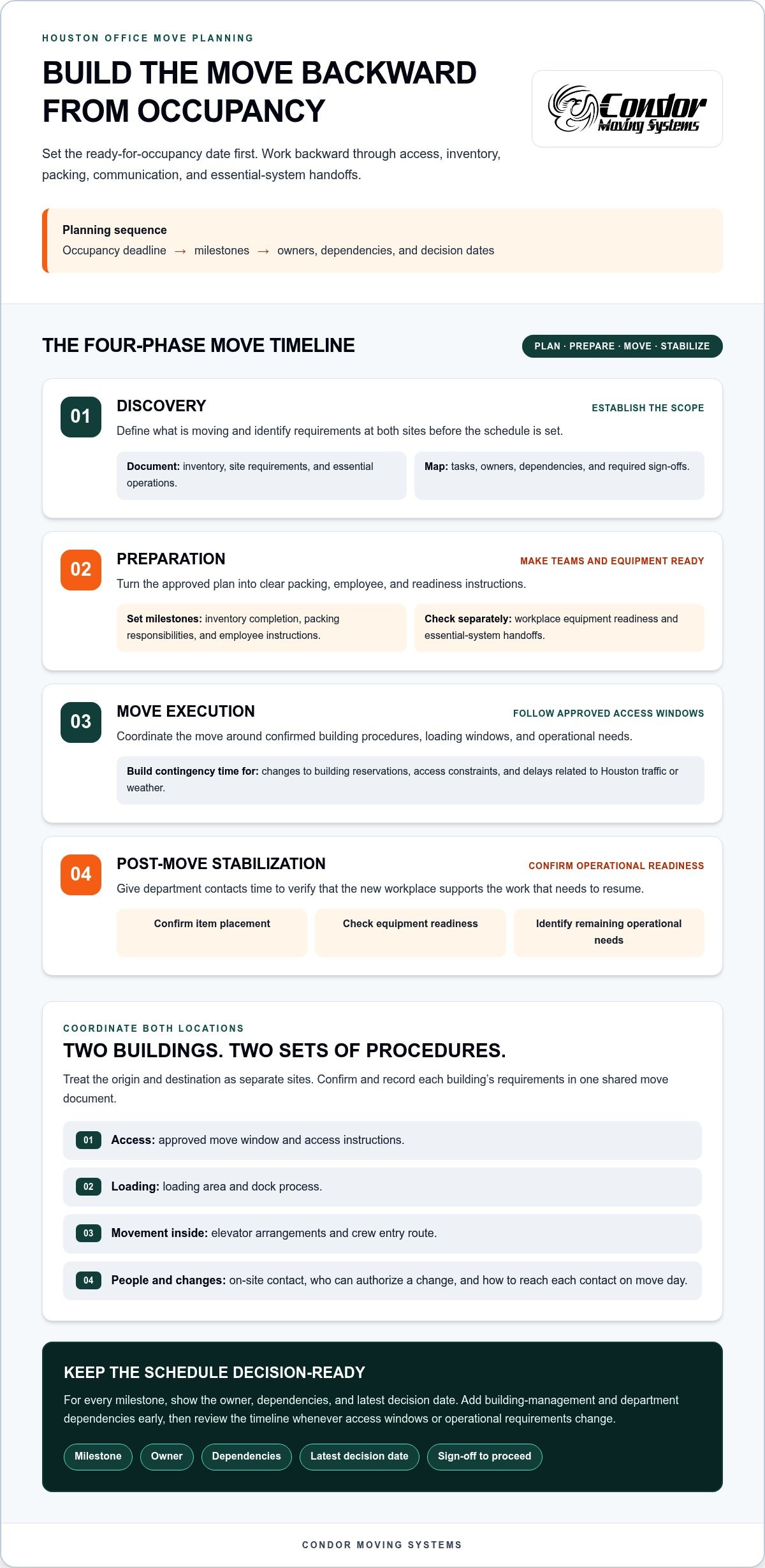
Build a reliable move schedule backward from the date the new office needs to be ready for occupancy. Start with that deadline, then identify what must happen before it: building access approval, inventory completion, packing, equipment preparation, employee communication, and essential-system handoffs. Assign an owner and decision date to each milestone. If a decision depends on building management or another department, add that dependency to the timeline early instead of treating it as a move-day detail.
Structure the schedule in four phases: discovery, preparation, move execution, and post-move stabilization. Discovery establishes the scope and site requirements. Preparation covers packing plans, staff notices, and readiness checks. Execution follows the approved access and loading windows. Stabilization gives department contacts time to confirm placement, equipment readiness, and remaining operational needs. For each phase, record the tasks, owner, dependencies, and sign-off needed to move forward.
What should the Houston move timeline include?
Set decision dates for completing the inventory, confirming packing responsibilities, communicating instructions to employees, and coordinating access at both buildings. Schedule separate readiness milestones for workplace equipment and essential systems, so a packed workstation isn’t mistaken for a department ready to resume work. Build contingency time into the schedule for changes to building reservations, access constraints, and delays related to Houston traffic or weather.
Keep the plan usable: show each milestone, its owner, its dependencies, and the latest decision date. Review it whenever access windows or operational requirements change. For city business resources that may be relevant while managing the move, consult the Houston Business Portal.
How should you coordinate two office buildings?
Treat the origin and destination as separate sites with separate procedures. Confirm each building’s approved move window, loading area, dock process, elevator arrangements, access instructions, and on-site contact. Record the details in one shared move document, including who can authorize a change and how the move lead can reach each contact on move day.
Don’t assume the same vehicle access, crew entry route, or loading process will work at both locations. If one building changes its available window, compare it against the other site’s arrangements and the business schedule before revising the plan. This helps prevent a crew from arriving when a loading area or elevator isn’t available.
To plan around the move scope and access arrangements, use the no-obligation moving quote process with accurate inventory and address details.
Compare Office Move Options by Downtime, Scope, and Control
The right approach depends on more than a preference for keeping decisions in-house. Consider the office’s size, sensitive or specialized equipment, staff capacity, and building access constraints. Compare each option against the same practical questions: who controls the schedule, how much employee time the move will require, who packs, how items are identified and placed, and how much disruption the plan may expose the business to.
| Planning factor | In-house coordination | Partial professional support | Full-service moving |
|---|---|---|---|
| Control | Internal team manages execution and decisions. | Responsibilities are shared by agreement. | A moving team handles the agreed moving scope; the business retains approvals. |
| Staff workload | Higher, with coordination and packing assigned internally. | Reduced for tasks assigned to the mover. | Lower for moving tasks, while internal leads manage business decisions. |
| Packing | Employees pack items under internal instructions. | Professional packing covers selected items or areas. | Packing can be included in the agreed scope. |
| Inventory handling | Internal team creates and maintains item records. | Responsibility is shared for selected inventory. | Personalized tagging helps organize items for the move. |
| Downtime exposure | Depends on staff capacity and coordination. | Can reduce internal workload for assigned tasks. | Can centralize moving tasks, while continuity still depends on business planning. |
When can an in-house move plan be practical?
In-house coordination can suit a smaller, straightforward move when employees have the time and clear authority to manage packing, inventory records, approvals, and schedules. Keep staff focused on coordination and suitable packing tasks. Don’t assign employees lifting or specialist handling that requires trained support. Assess actual capacity, including normal workloads and equipment documentation, rather than choosing this route simply to retain control.
When does professional office moving support add value?
Professional support is useful when the office needs defined help with packing, custom crating, or coordinating tagged items to their destinations. Condor Moving Systems handles commercial moves with its own crews, giving the business a direct point of accountability for the agreed moving scope. For a Houston relocation within Texas, local moving services can fit the plan.
A partial approach can work when internal staff are ready to manage some tasks but need support with specific packing or moving responsibilities. Put the division of work in writing: list what employees prepare, what the mover handles, who updates the inventory, and who resolves exceptions. That clarity helps avoid gaps, such as equipment being packed without a recorded destination or departments assuming another team owns a task.
After identifying inventory and logistics, use the moving quote process to document the proposed scope. A considered comparison is central to how to plan an office move in Houston: match support to operational needs rather than relying on a one-size-fits-all checklist.
Prepare Houston Employees, Equipment, and Inventory Before Move Day
A clear inventory turns a general move plan into instructions people can follow. Organize it by department and room, and give each item or grouped set a consistent identifier, destination, handling note, and responsible contact. Use specific destination labels, such as “Finance, Room 204,” rather than vague notes like “new office.” Specific labels make correct placement easier and help resolve questions without relying on memory.
Accuracy matters. Reconcile the inventory with the agreed moving scope and verify both origin and destination addresses, including suite or floor details. Omissions or inaccurate inventory and address information can affect charges. Condor Moving Systems’ personalized inventory tagging and tracking system can support item organization across departments, while the business remains responsible for providing complete move details.
How should an office inventory be organized?
Group items by department, room, destination, and priority. Add handling notes for fragile, specialty, or high-value equipment so it receives appropriate planning. This stage is also an ideal opportunity to clear out surplus furniture and office clutter rather than paying to transport it; teams coordinating cleanouts can start with a moving inventory that marks what will not make the trip. Keep sensitive identifying details off external labels and follow company policies for records and confidential materials. Before finalizing the inventory, have department contacts compare it with the moving scope and flag items that need special handling or a different destination.
- Identifier and origin: Use a unique label and record the department and current room.
- Destination: Specify the new department, room, floor, or placement area.
- Handling and priority: Note special care needs and whether the item is essential for operations.
- Owner: Name a contact who can answer questions and confirm placement.
What should employees know before the move?
Give employees written instructions with deadlines, labeling conventions, workstation preparation steps, and a named contact for questions. State what they should pack, what they should leave for assigned move personnel, and how personal belongings should be handled. For computers and other equipment, follow internal IT direction on backups, disconnection, and reconnection. Employees shouldn’t unplug or prepare shared systems unless authorized.
Use your organization’s procedures for securing sensitive records, devices, and access credentials. Tell staff how to report an item that is missing, damaged, or placed incorrectly, and where to direct urgent operational questions after arrival. Share access instructions and the move schedule through agreed employee channels, with updates routed through the move lead to avoid conflicting directions.
Prepare a move-day run sheet that the lead can use without searching through messages. Include crew and building contacts, access instructions, the planned sequence, department contacts, and who handles escalations or approves schedule changes. Keep the final inventory and current address details with the plan, then record exceptions as they occur. This gives the team a single reference for checking progress and confirming placement.
To document your office move scope and inventory, use the no-obligation moving quote process.
Coordinate Move Day and Choose a Houston Moving Partner
On move day, one company representative should serve as the central point of contact. This move-day lead coordinates building contacts, crew access, department questions, and schedule changes, while department contacts verify that items reach the correct areas. A single point of contact keeps instructions consistent and gives the crew a clear path for resolving questions without interrupting multiple employees.
What should the move-day run sheet cover?
Prepare a working run sheet that reflects the agreed scope and site procedures. Keep the current version accessible to the move lead and the people responsible for building access. Include:
- Sequence: Planned order for crew arrival, loading, transport, unloading, and priority-area checks.
- Contacts: Move lead, department representatives, building contacts, and the person authorized to approve changes.
- Access details: Approved move windows, entry instructions, loading arrangements, and elevator procedures for each site.
- Escalation path: Who handles access problems, inventory questions, schedule changes, and operational concerns.
Assign a company representative to compare progress with the agreed inventory, record exceptions, and direct placement questions to the right department contact. After unloading, check priority work areas, essential equipment, and outstanding items. Department contacts should confirm placement and report discrepancies through the move lead instead of giving competing directions to the crew.
What should you evaluate in a Houston office mover?
Assess whether the mover handles the work directly and explains responsibilities clearly. Review licensing and insurance, commercial moving experience, inventory processes, packing options, and estimate terms. Make sure the move scope reflects accurate inventory and address details, since omissions or inaccuracies can affect charges. A clear written scope gives both sides a shared reference for what the plan covers.
Condor Moving Systems is a licensed, insured full-service mover operating since 2003. Its commercial moves are handled directly by Condor crews, and its personalized inventory tagging system supports organized item handling. For a local Houston relocation, the company provides a free, no-obligation binding estimate with a guaranteed flat-rate quote; the signed estimate governs the move terms. If the relocation extends beyond Houston, long-distance moving services can support the broader scope.
Use these checks as part of how to plan an office move in Houston: name the decision-maker, establish how questions will be resolved, and verify that the agreed scope matches the move plan before execution.
Move From Planning to a Clear Next Step
A strong relocation plan should leave your team knowing what happens next, who owns each decision, and how the move supports the business after arrival. Bring your working plan into one place and use it to align leadership, department contacts, facilities, and your moving partner. That final alignment can uncover unanswered questions while there’s still time to resolve them.
If you’re considering how to plan an office move in Houston, review the proposed scope as your next step. Share accurate inventory and address details, discuss building access and handling needs, and make sure the written estimate reflects the move you’re preparing for. A documented scope gives your team a dependable basis for moving from planning to execution.
With the right decisions documented and responsibilities clear, your team can approach the relocation with greater confidence and focus on settling into its next chapter.
Frequently Asked Questions
How far in advance should I plan an office move in Houston?
Start planning as soon as you know when the new office needs to be operational. There isn’t one lead time that fits every move, so set decision deadlines based on the size and complexity of your relocation. For example, confirm who approves the move scope before departments finalize their item lists. Review open decisions regularly, and flag dependencies that could affect building access, staff readiness, or the intended occupancy date.
How can a Houston office move minimize business downtime?
Minimize downtime by defining what “ready to work” means for each essential team, not just when its boxes arrive. A department’s restart check might include access to shared files, working equipment, and a contact who can resolve IT or facilities issues. Arrange temporary procedures for work that can’t wait, and set a clear point when the business lead decides whether a team is ready to resume normal operations.
What should an office move inventory include?
An office inventory should connect each item to its department, current location, destination, handling needs, and responsible contact. Add asset identifiers for equipment the company tracks, and note components that need to stay together, such as a monitor and its assigned stand. Include complete origin and destination address details, including suite information. Compare the final list against the agreed move scope so missing or inaccurate details don’t create confusion or affect charges.
Should employees pack their own desks before an office move?
Employees should pack only what the company’s written instructions assign to them. Set a consistent policy for personal belongings, desk contents, and shared equipment, then explain which items must stay untouched for authorized staff. For example, employees can clear personal materials while leaving computer disconnection to the IT team. Tell staff how to handle confidential papers under company policy, where to put access cards, and whom to contact if an item doesn’t fit the instructions.
How do I plan an office move between Houston buildings with different access rules?
Manage each location as a separate site, with its own access notes and contact person. Ask the origin and destination representatives to document entry procedures, loading instructions, elevator arrangements, and any restrictions affecting the approved move window. Keep the details with the run sheet, not solely in an individual’s inbox. If a site changes its procedure, update the plan and notify the move lead, relevant building contacts, and affected department representatives.
Can office moving services include packing and storage?
Yes. A commercial relocation can include packing, unpacking, custom crating, or short-term and long-term climate-controlled storage when those services suit the move. For example, storage may help bridge a gap between access to the old and new premises. Condor Moving Systems provides local and commercial moving in Houston, as well as local service in Dallas, Fort Worth, Arlington, Plano, Frisco, McKinney, Irving, Grapevine, Southlake, Austin, and San Antonio. The estimate and signed terms define the arrangement.