



A corporate relocation can be approved on schedule and still lose momentum when no one owns the moving details. Effective corporate relocation services start with clear responsibilities: the employer sets the policy and business priorities, the employee shares accurate move information, and the mover manages the agreed shipment directly.
That division matters. Unclear handoffs can lead to missing inventory details, avoidable complications, and disruption for an employee expected to settle in and contribute. Coordinating a local or interstate move in Texas also involves practical decisions about timing, packing, shipment size, specialty items, and storage.
This roadmap explains how to plan around the employee’s destination and the company’s needs. You’ll learn how to establish roles, gather the information needed to organize the move, and match support to the shipment, from packing and custom crating to local or long-distance moving and storage.
It also explains what accountability looks like in practice. Condor Moving Systems is a full-service mover that manages the physical move with its own crews. With a clear plan and a moving partner responsible for execution, executives and HR teams can reduce uncertainty and give employees a more organized transition.
Key Takeaways
- Separate company policy decisions from the physical move so employees and moving teams know who owns each task.
- Use corporate relocation services that fit the move’s route, shipment, packing requirements, and need for storage or specialty-item handling.
- Build the schedule around clear milestones, from approvals and inventory through pickup, transit, and delivery.
- Provide a complete inventory and accurate origin and destination addresses to support a clear estimate and organized move.
- Choose direct moving support that takes responsibility for the shipment, with Condor Moving Systems’ own crews handling the move.
What Corporate Relocation Services Cover, and What Executives Need to Decide
An executive move has two outcomes to protect: business continuity and a workable transition for the employee. Planning gets clearer when the company separates policy decisions, such as what support it will fund, from the physical moving arrangements needed to carry out the move.
Corporate relocation services coordinate the logistics of moving an employee’s household from one location to another; broader relocation management may also include company policies and employee support beyond the shipment. The term Relocation services covers a wider field, so executives should define the scope of each move before assigning responsibilities. In this article, corporate relocation services refers to moving logistics, not housing, benefits, or an entire HR program.
Which parts of an employee relocation involve moving services?
The moving plan can include local or interstate transportation, packing, storage, and specialty-item handling. The right combination depends on the shipment’s size, the employee’s destination, and access at both addresses. A smaller shipment may call for a different packing plan than a full household move, while restricted truck access may require a shuttle service. Companies planning an interstate move can review long-distance moving services as one part of the logistics plan.
The employer defines internal policy and approves the support it will provide. The mover handles the agreed physical services. Keeping those roles distinct helps prevent assumptions about who is arranging transportation, packing, or storage.
What should an executive clarify before planning begins?
Start with the move’s basic facts: origin and destination addresses, target timing, and what the employee plans to ship. Then identify who approves the move, who communicates expectations to the employee, and who gathers an accurate inventory. Complete information helps the moving plan reflect the actual shipment and address conditions instead of an incomplete picture of the work.
- Destination and timing: Establish where the employee is moving and the target schedule.
- Shipment and services: Clarify household contents, packing preferences, storage needs, and specialty items.
- Access: Share relevant conditions at both addresses that may affect the move.
- Ownership: Name the person responsible for approvals, employee communication, and inventory details.
A single employee move is also different from an office relocation or a high-volume workforce program. Office and commercial moves involve business equipment and continuity considerations; multiple employee moves add coordination across separate households. For companies coordinating several office setups or employee transfers at once, Condor’s corporate relocation services offer tailored commercial and relocation logistics. Define the scope first so executives can plan the individual shipment without confusing it with a broader company initiative.
How Corporate Relocation Logistics Work from Approval to Delivery
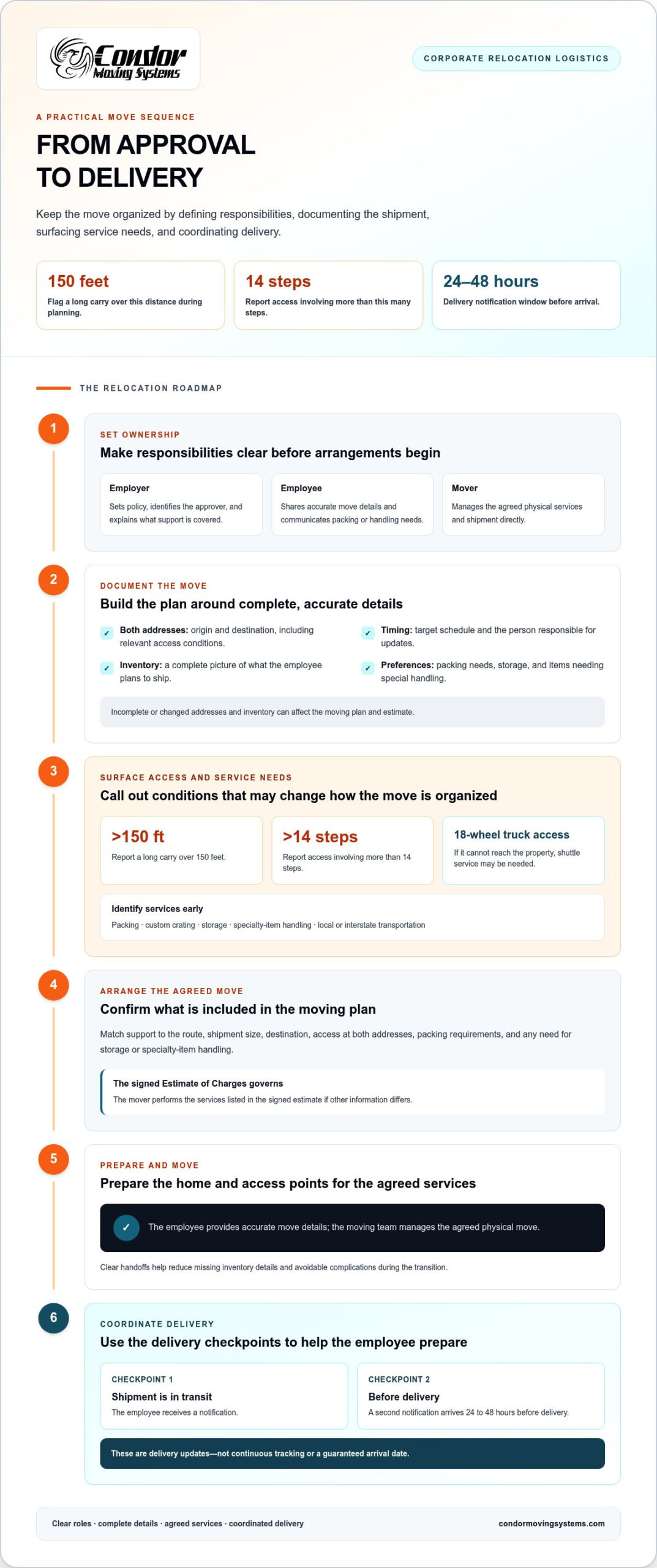
A controlled move follows a clear sequence: define the requirements, document the shipment, arrange the agreed services, prepare the home and access points, then coordinate delivery. Each handoff matters. If the origin address, destination, or inventory changes, the moving plan and estimate may need to change too.
Define, document, arrange, prepare, and coordinate delivery: that sequence keeps the move organized without promising a specific arrival date. For corporate relocation services, the employer sets its policy and approval process, while the employee provides accurate move details and the mover performs the services listed in the signed Estimate of Charges. That estimate governs if other information differs.
Assign responsibilities before arranging the move
The employer should explain what the relocation policy covers, who approves the move, and how updates will be communicated. The employee should provide a complete inventory, both addresses, access details, packing preferences, and any items needing special handling. A clear division of responsibilities reduces missing information and supports an estimate based on the actual move.
Employer-funded incentives are a separate policy decision from household transportation. For federal agencies, the U.S. Office of Personnel Management explains the purpose and structure of relocation incentives. The moving plan addresses the physical shipment, not the employer’s broader compensation or relocation program.
Surface access and service needs early
Access conditions can affect how a move is organized. Report a long carry of more than 150 feet or access involving more than 14 steps during planning. If an 18-wheel truck cannot reach the property, shuttle service may be needed. Identify packing, custom crating, storage, and specialty-item handling early so the agreed services reflect the shipment and its requirements.
Once the move is underway, delivery communication follows defined checkpoints: the employee receives one notification when the shipment is in transit and another 24 to 48 hours before delivery. These updates help the employee prepare for arrival without suggesting continuous tracking or a guaranteed delivery date. Guaranteed delivery dates are available for an additional charge and must be written into the estimate.
- Before approval: Set the policy, approver, and communication owner.
- Before the estimate: Provide complete addresses, inventory, access conditions, and service needs.
- Before pickup: Prepare items according to the selected packing plan and review the signed Estimate of Charges.
- During transit: Use the provided notifications to plan for delivery.
With the move details documented, a moving estimate for a Texas relocation can help translate shipment requirements into an organized service plan.
Matching Corporate Relocation Services to Employee Moves
The right moving plan depends on the employee’s route, shipment, schedule, and level of packing support. Matching those needs to specific services helps the employer set a clear scope, while direct accountability keeps responsibility for the physical move with the company performing it.
| Employee move need | Service option | Planning point |
|---|---|---|
| Move within a local market | Local moving | Consider the shipment size, access at both addresses, and target timing. |
| Move across state lines | Long-distance moving services | Provide accurate origin and destination addresses and a complete inventory. |
| Limited time or help with preparation | Full or partial packing | Set which belongings the crew will pack and which the employee will prepare. |
| Gap between move-out and move-in | Short- or long-term storage | Include storage needs in the plan, including climate-controlled storage where appropriate. |
| Items needing special handling | Specialty-item moving or custom crating | Identify items such as pianos, pool tables, custom bikes, or fragile, high-value belongings. |
Choose services to fit the route and employee
A move within a local market calls for local service; a cross-state relocation calls for long-distance transportation. Across Texas, an employee moving between Dallas, Fort Worth, Austin, Houston, or San Antonio may need a different plan depending on the route and shipment. Packing can be matched to the employee’s time and preferences: full-service packing covers the agreed shipment, partial packing focuses on selected items, materials-only provides packing supplies, and self-pack leaves packing to the employee. These options have different scopes, so define what is included in the move plan.
Storage can bridge a timing gap between leaving one home and entering another. Specialty handling or custom crating can be planned for belongings that need additional care. Identifying these requirements early helps the service plan reflect the employee’s actual shipment.
Keep physical-move accountability clear
Corporate relocation services may involve several parties, but responsibility for the shipment should remain clear. Condor Moving Systems is a full-service mover that directly manages moves with its own crews. The employer can coordinate policy and approvals, while Condor handles the agreed moving services. That distinction gives the employee and company a clear point of accountability for the physical move.
How Executives Can Build a Practical Relocation Timeline and Checklist
A useful relocation timeline tracks decisions and handoffs, not just dates. Build it around the move’s actual route, shipment, packing needs, and access conditions. Avoid assuming a standard booking lead time or a guaranteed delivery date; timing depends on the project and the service arrangements documented in the signed Estimate of Charges. Guaranteed delivery dates are available for an additional charge and must be written into the estimate.
Build the timeline around six milestones
- Planning: Approve the move, name the decision-maker, and explain the employer’s policy and employee responsibilities.
- Inventory and estimate: Record both addresses, shipment contents, access details, packing needs, specialty items, and any storage requirement. The employer and employee should agree that the details are accurate before they’re submitted.
- Preparation: Confirm which items will be packed by the moving crew and which the employee will prepare. Share the agreed scope and any instructions in writing.
- Pickup: Make sure the employee understands the planned pickup arrangements and that the origin address and inventory remain accurate.
- Transit: Set expectations for updates. The employee receives a notification once the shipment is in transit and another 24 to 48 hours before delivery.
- Delivery: Coordinate access at the destination and use the timing in the signed estimate and applicable service arrangements for planning.
Use one brief to prevent crossed wires
Keep the move details in a shared relocation brief. Assign one contact for employer approvals and policy questions, and a separate contact for employee-specific details such as inventory and access. That way, the moving team receives operational information from the person closest to it, while the employer retains control of internal decisions.
- Confirm approvals, the target timing, and who communicates updates.
- Document complete origin and destination addresses, inventory, and access conditions.
- List packing preferences, specialty items, storage needs, and any shuttle or long-carry considerations.
- Review the submitted details with the employee before the estimate is finalized.
Accurate inventory and address details help keep the plan aligned with the actual shipment and can prevent additional charges. If the employee’s move also involves relocating the workplace, use the 2026 office moving checklist to coordinate those separate commercial logistics. A written, staged plan gives corporate relocation services clear decision points while keeping employer approvals distinct from moving operations.
How Condor Moving Systems Supports Corporate Relocation Moves
Condor Moving Systems supports the physical move behind an employee relocation. As a full-service mover for residential and commercial needs, Condor handles local and long-distance transportation, packing and custom crating, storage, and specialty-item moving. The employer remains responsible for its relocation policy, approvals, and employee benefits; Condor manages the agreed moving services, not the company’s broader HR program.
That clear division gives executives a practical partner for corporate relocation services. Condor has operated since 2003 and directly manages moves with its own crews. Its local and long-distance options can be matched to the move’s route, while packing, storage, or specialty handling can be included according to the shipment and employee’s requirements.
What does direct handling mean for a corporate move?
Direct handling means Condor’s crews perform the agreed moving work, with the shipment planned from the inventory and addresses provided. Personalized inventory tagging and tracking help organize items during the move; this does not mean real-time GPS updates. The employee receives a notification when the shipment is in transit and another 24 to 48 hours before delivery.
The signed Estimate of Charges records the agreed services and move details. Review it carefully with the employee before the move proceeds. If it differs from other information, the signed estimate governs.
What is the next step for planning a Texas employee relocation?
Prepare complete origin and destination addresses, an accurate shipment inventory, access details for both locations, and a list of the services the employee needs. Include packing preferences, storage requirements, and any specialty items so the moving plan reflects the actual shipment. Accurate details matter: incomplete or changed inventory and address information can lead to additional charges.
Condor is licensed and insured, regulated by the Federal Motor Carrier Safety Administration, and holds USDOT 1126171, MC 458180, and TXDMV 006041428C. These credentials complement a directly managed moving process, while the estimate sets out the agreed scope for the individual relocation.
For a Texas local or interstate employee move, request a free, no-obligation binding estimate with a guaranteed flat-rate quote. Review the written details and signed Estimate of Charges so the responsibilities and services are clear.
Make the Next Employee Move Clear and Accountable
Strong corporate relocation services begin with clear roles, accurate move details, and support matched to the employee’s route, shipment, packing needs, and timing. Employers set the policy and approvals; a moving partner manages the agreed physical move. A documented inventory and complete addresses help keep the plan aligned with the actual shipment.
Condor Moving Systems is a full-service mover operating since 2003, with its own crews directly handling moves. Condor is licensed and insured, with USDOT 1126171, MC 458180, and TXDMV 006041428C. Employers can request a free, no-obligation binding estimate with a guaranteed flat-rate quote, then review the written scope and signed Estimate of Charges before the move proceeds.
With clear expectations and direct responsibility for the move, your team can give employees a more organized transition and stay focused on business priorities.
Plan an employee relocation in Dallas, Fort Worth, Arlington, Plano, Frisco, McKinney, Irving, Grapevine, Southlake, Austin, Houston, or San Antonio with Condor Moving Systems.
Frequently Asked Questions
Is corporate relocation the same as an office move?
No. Corporate relocation usually means moving an employee and their household for business reasons, while an office move relocates a workplace, its equipment, and its operations. The two may happen together, but they involve different inventories, stakeholders, and planning decisions. For example, a household move between Dallas, Fort Worth, Arlington, Plano, Frisco, McKinney, Irving, Grapevine, Southlake, Austin, Houston, or San Antonio is distinct from relocating an office. Define the scope before arranging services.
Can a moving company handle an employee’s corporate relocation?
Yes. A full-service mover can manage the physical move, including agreed transportation, packing, storage, and specialty-item handling. The employer remains responsible for its policies, benefits, and internal approvals. Condor Moving Systems directly handles moves with its own crews. Share accurate inventory and address details, then review the services and move information in the signed Estimate of Charges, which governs the agreed work.
How do you plan a corporate relocation for an employee?
Start by confirming the origin, destination, target timing, and employer approval process. Gather a complete household inventory, access details for both addresses, and packing or storage requirements. Then arrange suitable moving services and explain the employee’s preparation responsibilities and delivery communications. Whether the move is within Texas or across state lines, accurate details help organize the shipment. The signed estimate and applicable service arrangements govern the agreed move details.
What should an employer include in a corporate relocation policy?
Set out who is eligible, who approves a move, what relocation support the employer covers, and what the employee must do. Explain how moving services are requested, who supplies accurate inventory and address details, and how expectations will be communicated. Keep these policy decisions separate from the mover’s service agreement. A clear policy helps employees understand their responsibilities without suggesting the moving company administers benefits or manages the employer’s broader relocation program.
Can corporate relocation services include packing and storage?
Yes. Moving support can include full or partial packing, packing materials, self-pack arrangements, and storage when included in the move plan. The best fit depends on the employee’s inventory, schedule, and preferred level of involvement. Condor offers climate-controlled short-term and long-term storage. Provide accurate shipment details and review the storage arrangements and any applicable charges in the signed Estimate of Charges before the move proceeds.
How does an employee receive updates during an interstate move?
Set expectations around the mover’s stated communication process rather than assuming continuous GPS access. Condor provides two notifications: one when the shipment is in transit and another 24 to 48 hours before delivery. The employee should know who will share these updates and how delivery preparations will be coordinated. Timing and service details are governed by the signed Estimate of Charges and applicable arrangements, not an assumed guaranteed delivery date. Guaranteed delivery dates are available for an additional charge and must be written into the estimate.
What information is needed for a corporate moving estimate?
Provide accurate origin and destination addresses, a complete inventory, preferred timing, and access conditions at both locations. Include packing preferences, storage requirements, specialty items, and any shuttle or long-carry considerations. These details help the mover prepare an estimate based on the actual shipment and move conditions. Review the information with the employee before submitting it, since incomplete or inaccurate inventory and address details can lead to additional charges. The signed Estimate of Charges governs the agreed services.