



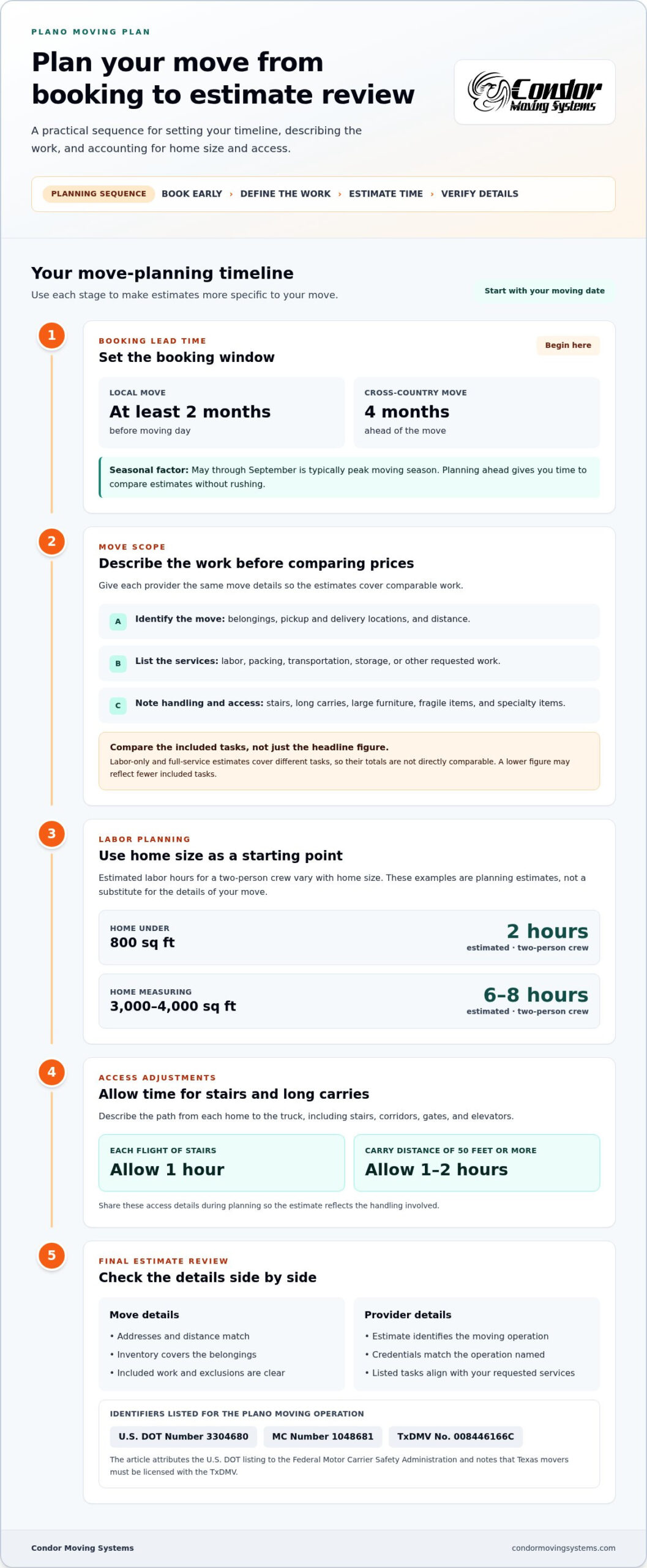
Booking early is a practical first step: plan to hire local movers at least two months before moving day, or four months ahead for a cross-country move. May through September is typically peak moving season, so if you’re looking for affordable movers in Plano, TX, use these timelines to plan ahead and compare estimates without rushing.
Choosing a moving date is only part of the decision. The services included, your home’s layout, and customer feedback can help you understand what to expect and whether an estimate fits your move.
This guide covers when to book, how to compare moving services and estimates, what customer reviews can reveal, and how stairs may affect moving time. You’ll also learn how Condor Moving Systems’ local and long-distance moving, packing, and storage services can support different relocation needs.
Key Takeaways
- Compare estimates by the work included, such as packing, transportation, and storage, rather than by the headline figure alone.
- Use home size as a starting point for planning labor: a two-person crew is estimated to need 2 hours for a home under 800 square feet and 6-8 hours for a home measuring 3,000-4,000 square feet.
- Build extra time into the schedule for access challenges: allow 1 hour for each flight of stairs and 1-2 hours when the carry distance to the truck is 50 feet or more.
- Read customer reviews for details about communication and moving-day execution; the Plano moving team says customers refer it to family and friends 96 percent of the time.
- Use official identification as one part of your estimate comparison: the Plano moving operation lists U.S. DOT Number 3304680, according to the Federal Motor Carrier Safety Administration.
New Plano-area moving labor providers and estimates
Compare estimates by the work they include, not just the amount shown. In Plano, consider the move’s distance, property access, and whether you need labor only or a coordinated move.
Moving Provider Estimates
An estimate should describe the belongings to be moved, pickup and delivery locations, and requested services. Tell the moving company about stairs, long carries, large furniture, and fragile items so the estimate reflects the work involved. Compare the same details across estimates, including whether packing and transportation are included. Labor-only and full-service moving estimates cover different tasks, so their totals aren’t directly comparable.
Residential and Business Moves
Residential estimates focus on household belongings, access at both addresses, and the distance between them. Commercial moves may also involve office furniture, equipment, workstations, and a sequence for relocating departments. List what needs to move and note any items that must be ready first. A clear inventory helps the moving team scope the work and organize the move around the property’s requirements.
Discounted Service Prices
Discounts can change the total, but compare the scope before choosing an offer. Check whether packing, transportation, and handling are included, and whether the estimate covers every item and destination. The price depends on the move and is given after a quote request; distance, belongings, access, and selected services shape the estimate. A lower figure may reflect fewer included tasks, not the same work at a better rate.
Moving every belonging isn’t always the most practical choice. Sort items by condition, usefulness, and difficulty of replacement. For example, weigh the effort of transporting a rarely used chair against its value in your new home. Reducing the inventory can simplify the estimate, while replacing essentials locally may mean extra errands. Keep documents, daily necessities, and items with personal value separate as you plan.
Credentials offer another comparison point. According to the Federal Motor Carrier Safety Administration, the Plano moving operation lists U.S. DOT Number 3304680. It lists MC Number 1048681 and Texas regulatory number TxDMV No. 008446166C. By law, Texas movers must be licensed with the TxDMV, according to the Texas Department of Motor Vehicles. Match listed identifiers to the operation named in the estimate.
Before accepting an estimate, use a simple review process:
- Confirm the addresses, distance, and inventory match your move.
- Separate labor, packing, transportation, and other requested work.
- Compare the included tasks and identify any excluded belongings.
- Review the provider’s credentials and make sure the estimate identifies the moving operation.
Packing, transportation, and storage services
A smooth move depends on coordinating packing, transportation, and timing. Start by identifying what needs professional handling, what will travel with you, and what may need temporary storage.
Mover and Truck Options
Compare a coordinated moving service with a labor-only arrangement by checking who handles transportation. With a coordinated service, the crew and transport are planned together; with labor only, you arrange the truck separately. For a Plano apartment move, note loading access, parking, and the distance from the door to the truck. These details shape how belongings are moved at both properties.
Plano-area moves may involve apartment corridors, office loading areas, or homes with long walks to the vehicle. Measure or describe the carry path at both addresses, including gates and elevators. For a carry distance of 50 feet or more from the home to the truck, allow 1-2 hours. Sharing this detail during planning helps account for the extra handling time.
Transportation and Storage
Transportation planning connects pickup, any storage stop, and final delivery. If your move-out and move-in dates differ, identify which belongings need storage and when you’ll need them again. Separate essentials, such as work equipment or everyday kitchen items, from boxes that can remain stored. This inventory clarifies the sequence and helps prevent needed items from being buried.
A move within Plano may follow a direct route, while a Texas move to another city can require different scheduling. Describe the destination and any intermediate stop, such as a storage unit, before organizing the move. Local and long-distance plans differ in route and delivery coordination, so keep destination details consistent across your inventory and moving arrangements.
Packing can cover the whole home or selected belongings. Before packing begins, group items by room and label boxes with both the room and contents, such as “kitchen, dishes.” Keep fragile pieces together and identify items that need custom crating, such as artwork or unusually shaped objects. A clear inventory also distinguishes packed belongings from items you’ll carry yourself.
Use this sequence to prepare packing and transport:
- Sort belongings into moving, storage, and do-not-pack groups.
- Record fragile, bulky, or specialty items for careful handling.
- Share both addresses, access details, and storage timing.
- Label boxes by destination room and note priority items.
If your Plano move needs packing, transportation, or storage coordinated, request a moving estimate with your inventory and route details.
Customer reviews of movers
Customer reviews can show how a moving team handles details an estimate cannot capture. For a Plano move, look beyond star ratings and read comments about scheduling, communication, belongings, and problem-solving. Specific examples help you judge whether reviewers describe the kind of service your move requires.
Look for recurring themes across reviews rather than relying on one unusually positive or negative account. For example, several customers describing clear arrival updates offer more useful evidence than a single comment saying “great service.” Reviews explaining how crews protected furniture, handled a narrow staircase, or managed a delayed elevator provide practical context for similar conditions at your address.
Check whether a review describes a service relevant to your move. A household move involving boxed belongings may reveal little about transporting office equipment or packing fragile artwork. If you need careful handling, prioritize comments about packing, custom crating, or specialty items. If you’re moving a business, look for details about organized loading and coordination around workplace operations.
Read critical feedback carefully, too. Focus on the issue described and how the moving team responded. A complaint about unclear arrival communication differs from one about damaged belongings or an estimate that didn’t match the described work. Look for a specific account of what happened, any response, and whether the concern was addressed. Don’t treat one review as proof of a consistent pattern.
A Plano moving team says customers refer it to family and friends 96 percent of the time. That figure is a useful signal of customer confidence, but reviews still help explain what customers valued. Look for firsthand descriptions of communication, care, and follow-through rather than relying on a percentage alone. A referral statement describes recommendations; individual reviews give examples behind them.
Use a short review-reading process before making your decision:
- Compare detailed comments about the same service you need.
- Note repeated praise or concerns about communication and handling.
- Look for examples involving stairs, fragile items, or schedule changes.
- Read the response to a specific complaint alongside the original review.
Keep a few review examples beside your estimate as you compare moving services. If a review mentions careful handling of framed artwork, for instance, consider whether your inventory includes similarly delicate belongings. Reviews describe customers’ experiences, while the estimate defines the work planned for your move. Use both to assess whether the proposed service fits your priorities and property conditions.
Estimated labor hours by home size
Home size offers a useful starting point for estimating moving labor. These estimates assume a two-person crew, so compare your square footage with the closest listed range.
Use the figures to begin planning, then consider how much is packed and ready, how belongings are arranged, and what needs special handling. Square footage helps set expectations, but it doesn’t describe every task inside a home. A sparsely furnished property and one filled with furniture, boxes, and fragile items can require different workflows, even at similar sizes.
- Under 800 square feet: 2 hours for a two-person crew.
- 1,000-1,500 square feet: 3 hours for a two-person crew.
- 1,500-2,000 square feet: 4 hours for a two-person crew.
- 2,001-3,000 square feet: 6 hours for a two-person crew.
- 3,000-4,000 square feet: 6-8 hours for a two-person crew.
Use the closest matching range as a planning reference, not a substitute for describing your inventory. For example, a 1,200-square-foot home falls in the 1,000-1,500 range, with a listed estimate of 3 hours. Note whether beds, shelves, and large furniture need moving, and identify items requiring careful handling.
Access can add time beyond the home-size estimate. Allow 1 hour for each flight of stairs, as the moving page recommends. Include stairs at both pickup and delivery when explaining the property layout. A second-floor apartment with a stairway requires a different labor plan than a ground-floor home with direct access.
The listed ranges don’t cover every square footage category. For instance, the provided estimates do not assign a figure to homes from 800 to under 1,000 square feet, or from 2,000 to 2,001 square feet. Don’t interpolate a precise labor time from neighboring entries. Instead, describe the home and its contents accurately so the estimate reflects the actual work.
Prepare these details before requesting a labor estimate:
- Record the home’s approximate square footage and number of levels.
- List large furniture, packed boxes, and fragile belongings.
- Describe stairs and other access points at both addresses.
- Identify items that need disassembly or careful handling.
Clear information helps connect the square-footage range to the work involved. If your home measures 3,000-4,000 square feet, the listed estimate spans 6-8 hours, so the inventory and access details help explain where the job fits within that range. Include the same details when comparing estimates, and review the labor assumptions alongside the planned tasks.
How early to book movers
Thumbtack advises booking movers at least two months ahead for local moves and at least four months ahead for cross-country moves. These lead times give you a planning target and room to organize belongings, compare estimates, and coordinate moving dates.
Season affects your booking window. Thumbtack describes May through September as typically peak moving season, when dates may be in greater demand. If your Plano move falls within that period, start planning early and settle on a preferred date before making other arrangements. A backup date can help if your first choice doesn’t fit the schedule.
For an off-season move, Thumbtack advises booking about four to eight weeks in advance. Use that time to confirm your destination, sort belongings, and prepare an accurate inventory. If your dates are flexible, identify a few workable options instead of planning around one day. Flexibility can make it easier to coordinate moving tasks and property access.
Special items need additional planning time. Thumbtack advises adding two to three weeks to the booking lead time when moving antiques or valuables that are difficult to transport. Make a separate list of these pieces, noting their size, fragility, and handling needs. For example, an antique cabinet or valuable artwork may need special preparation before it can travel safely.
Build a simple timeline around the move date:
- Set a target date and identify backup dates.
- Use the two-month local or four-month cross-country lead time as your booking baseline.
- For an off-season move, plan around the four-to-eight-week recommendation.
- Add two to three weeks if antiques or difficult-to-transport valuables are involved.
- Prepare an inventory and share access details when requesting an estimate.
Once the date is set, coordinate packing and property arrangements around it. Note when keys become available, whether building access needs advance scheduling, and which belongings must remain accessible. These details help define the work and keep preparation organized. If the destination or move-out date changes, update the plan promptly so the timeline reflects the new details.
Start with the lead time that matches your move, then prepare your inventory and preferred dates before requesting an estimate. A clear request gives the moving team a practical basis for discussing the work and schedule.
Condor Moving Systems: Local Moving Services
Condor Moving Systems helps Plano households and businesses plan local and long-distance moves. Services include Office and Commercial Moving, as well as Packing and Custom Crating for belongings that need careful preparation. If your move involves both transportation and packing, coordinating those needs in one moving plan can simplify preparation and clarify the work involved.
When you’re ready to discuss your relocation, share your inventory, addresses, access details, and preferred moving date. These details help shape a plan around your household or workplace needs.
Contact Condor Moving Systems to discuss your move or visit condormovingsystems.com.
Plan Your Next Move With Confidence
A well-prepared move starts with a clear picture of what needs to happen next. Gather your inventory, destination details, access notes, and preferred moving date in one place. This gives you a practical foundation for discussing the work and deciding which services fit your household or organization. If you’re comparing affordable movers in Plano, TX, focus on how each proposed plan addresses your priorities, not just how it looks on paper.
Condor Moving Systems provides Local Moving Services, Long-Distance Moving Services, and Office and Commercial Moving. Whether you’re relocating nearby, moving to another destination, or planning a workplace transition, share the details that shape your move to get started.
With your priorities clearly defined, you can move forward with an organized, manageable plan.
Frequently Asked Questions
How far in advance should I hire movers?
Thumbtack advises booking local movers at least two months ahead and cross-country movers at least four months ahead. For a Plano move during the May-through-September peak season, start organizing your inventory and target date early. If you’re moving antiques or valuables that are difficult to transport, Thumbtack advises adding two to three weeks to the booking lead time. Share date changes promptly to keep the moving plan aligned.
How many hours do I need?
For a home measuring 1,000-1,500 square feet, a two-person crew is estimated to need 3 hours. Treat that as labor time, not a complete door-to-door schedule. Loading, driving, and unloading affect the total day. Before using the estimate, note how many belongings are packed, whether furniture needs careful handling, and how accessible both properties are. Those details help clarify the planned work.
What are the most affordable movers in Plano, TX?
There’s no single mover that costs least for every Plano household. Compare estimates that cover the same work. Assess affordable movers in Plano, TX, by the labor, transportation, packing, and storage included. Condor Moving Systems provides local and long-distance moving services. Compare estimates against your actual inventory and move requirements rather than choosing solely by the lowest headline amount.
What is the average cost of a local move in Plano, TX?
The price depends on the move and is provided after a quote request; key factors include distance, belongings, access, and selected services. An estimate for a local apartment move with an elevator differs from one involving stairs, bulky furniture, or packing. For a useful quote, describe both addresses, list items needing special handling, and identify any storage or packing requirements.
Which Plano moving companies offer free quotes or price matching?
Condor Moving Systems provides free, no-obligation binding estimates and guaranteed flat-rate quotes. The estimate is based on the move details, so provide an accurate inventory and both addresses. Price matching is a separate claim from offering an estimate; compare the written scope and terms rather than assuming two quotes cover identical work. The signed Estimate of Charges governs if it differs from other quote information.
Are there affordable movers in Plano with no hidden fees?
Look for a written estimate that clearly describes the agreed work, and provide accurate inventory and address details to avoid extra charges. Condor Moving Systems provides binding estimates, with the signed Estimate of Charges governing the move. Before signing, review the listed services and shipment details together. For example, include a large item or an additional pickup location in the inventory instead of relying on an informal verbal description.
What licenses and insurance should Plano movers have in Texas?
The Texas Department of Motor Vehicles says Texas movers must be licensed with the TxDMV. Review the moving company’s identity and licensing information on its written documents. Read the contract’s coverage terms carefully, too: Condor’s standard Released Value is valuation, not insurance. Understanding this distinction clarifies how belongings are treated if damage or loss occurs, rather than leading you to assume a general insurance policy applies.
How can I verify reviews and complaint records for Plano moving companies?
Compare detailed customer reviews with the moving company’s exact business name and the service described. Give more weight to specific accounts of communication, handling, or resolving an issue than to brief, star-only ratings. For licensing, refer to the Texas Department of Motor Vehicles’ information on Texas mover requirements. Note recurring themes and compare them with the commitments in your estimate and moving documents.