



The average cost of movers in Fort Worth depends on the size of your move, its timing and scope, and the distance between locations. A small apartment and a large house require different amounts of labor and time, so there is no single flat price for every move.
A clear budget matters, especially when travel and service charges affect the total. Your estimate depends on the move details, including home size, timing, packing needs, fuel, tolls, and locations. Share accurate information about the inventory and addresses so the estimate reflects the work involved.
This guide explains how local moving costs vary by home size, what fees may apply, and how move duration, extra services, fuel, tolls, and Fort Worth locations factor into the total. It also explains why an estimate should reflect the actual work, not just the number of rooms.
Key Takeaways
- Use home size as a starting point for budgeting, then account for how much there is to move and the work involved.
- Understand how hourly rates, booking minimums, trip fees, and billing increments can shape a local move’s total.
- Consider stairs, long carries, packing, and move duration when estimating the labor and time required.
- Learn how fuel and tolls are handled in Fort Worth moving rates so travel charges are clearer in your estimate.
- See why destination, distance, and shipment size lead to different costs for moves between cities.
Local moving costs by home size
Home size is a useful starting point for estimating moving costs, but room count alone does not determine the work. A studio with heavy furniture may take more handling than a lightly furnished apartment, while a larger house usually means more items, loading time, and truck space. The average cost of movers in Fort Worth depends on the shipment and work required, not just the number of bedrooms.
For a local move, an estimate reflects what needs to be packed, carried, loaded, transported, and unloaded. A two-bedroom home with packed boxes near the entrance requires different labor from one with loose items, bulky furniture, and a long walk to the truck. Stairs, elevator access, parking, distance between addresses, and requested packing services can also change the scope. That is why homes of the same size may need different moving plans.
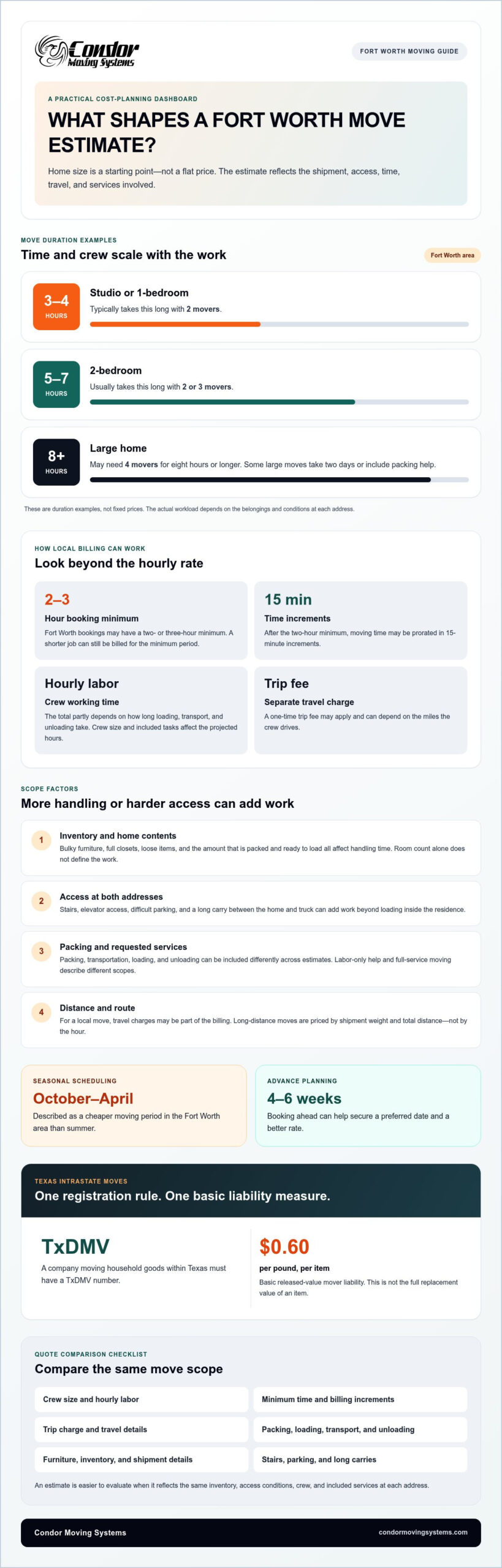
Texas has a specific registration rule for intrastate household moves: a company moving household goods within Texas must have a TxDMV number. Basic released-value mover liability is $0.60 per pound per item. That figure describes the basic liability measure, so it should not be confused with the full replacement value of an item.
Moving costs also depend on whether the relocation stays local or crosses state lines. Long-distance moves are priced by shipment weight and total distance, rather than by the hour. A smaller shipment traveling farther and a larger shipment traveling a shorter route therefore have different pricing factors. For a move from Fort Worth to another city, the estimate reflects both the belongings being transported and the route.
Labor-only help and full-service moving cover different scopes. Labor-only help covers moving labor, while full-service moving can include transportation and additional tasks. Compare estimates only when they describe the same services, since market averages for different scopes are not interchangeable.
Season can affect scheduling. October through April is described as a cheaper period for moving in the Fort Worth area than summer. Booking four to six weeks ahead can help secure a preferred date and a better rate. Your estimate still depends on home size, distance, timing, access, shipment weight, and requested services.
Do movers add surprise fees?
Local moving estimates may combine hourly labor, a minimum booking period, travel charges, and extra services. To compare Fort Worth quotes, make sure they describe the same crew, scope of work, and billing terms.
Fort Worth moving quotes are comparable when they account for the same inventory, access conditions, crew size, and included services. Check whether each estimate explains hourly billing, minimum time, trip charges, time increments, packing, and access-related work.
Local Movers’ Hourly Rates
An hourly rate covers the crew’s working time, so the total partly depends on how long loading, transport, and unloading take. Fort Worth local moves may use crews of two or three movers, and crew size affects how the work is organized.
Compare the number of movers and the included tasks, not just the hourly rate. One estimate might cover furniture loading and unloading, while another also includes packing. A clear scope helps explain differences in projected hours.
Hourly Pricing and Base Fees
Hourly pricing measures labor by time, while a base or trip fee may cover a separate part of the move. Fort Worth bookings may have a two- or three-hour minimum, so a shorter job can still be billed for the minimum period.
After the two-hour minimum, moving time may be prorated in 15-minute increments. A one-time trip fee can also depend on the miles the crew drives. Include both terms in your comparison, since the hourly rate alone doesn’t show the full billing structure.
Comparing Quotes and Estimates
For a useful comparison, align each quote’s crew, included work, and billing terms. Check whether the estimate accounts for furniture, packing, transport, the trip charge, minimum hours, and the time increments applied after the minimum.
If one quote includes packing and another covers loading only, their totals describe different scopes. Review what each charge covers, then compare the same tasks and access conditions across estimates. This makes exclusions and additional services easier to spot before moving day.
Access can affect how long a crew needs. Stairs, a long carry from the home to the truck, and difficult parking add work beyond loading furniture inside the residence. Describe these conditions consistently when reviewing estimates, so the projected labor reflects the same move at each address.
Use a written comparison that separates hourly labor, minimum booking time, travel charges, and optional packing. That structure helps distinguish a changed scope from a changed rate. If you’re preparing a Fort Worth move, request a moving quote with the move details and services you need.
Factors that affect move duration and cost
Move duration depends on more than the number of boxes. In Fort Worth, inventory size, loading access, packing needs, crew size, and travel all shape the work. A useful estimate starts with details such as bedroom count, bulky furniture, stairs, and the distance between addresses. Each can affect how long the crew spends handling and transporting belongings.
A Fort Worth-area studio or one-bedroom apartment typically takes three to four hours to move with two movers. A two-bedroom move usually takes five to seven hours and requires two or three movers. These ranges show why bedroom count matters, but the actual workload also depends on how much is packed and ready to load.
Larger homes can require more labor and a longer schedule. A large Fort Worth-area home may need four movers for eight hours or longer. Some large moves take two days or include packing help, adding work before transport begins. A home with several bedrooms, full closets, and large furniture requires more handling than a sparsely furnished property with the same bedroom count.
Crew size changes the balance between labor and time. Three movers work about 40% faster than two movers, according to the market estimate in this brief. A larger crew may complete loading sooner, but the required crew depends on the shipment and access. Consider both the crew and expected duration when reviewing how an estimate describes the work.
Access at either address can also extend the job. Stairs, a long carry between the home and truck, or limited parking can slow loading and unloading. A second-floor apartment with a long hallway, for example, involves more carrying than a ground-floor unit beside the truck. Share these details so the estimate reflects the actual route from each room to the vehicle.
Booking season affects scheduling and rates. October through April is described as a cheaper period for moving in the Fort Worth area than summer. Booking four to six weeks ahead can help secure a preferred date and a better rate. Season may affect scheduling, while the shipment and work scope determine the crew’s tasks.
For a long-distance move, shipment weight and total distance are key pricing factors, rather than hourly labor alone. A heavier shipment means more belongings to transport, while a longer route increases travel distance. Packing also affects the schedule because items need preparation before loading. An organized inventory, accurate access details, and a realistic packing plan help clarify the work behind the estimate.
Fuel and toll charges
Fort Worth moving rates include fuel and tolls, with no fuel surcharge. These travel costs are accounted for in the rate rather than added as a separate fuel surcharge. When reviewing an estimate, distinguish fuel and tolls from labor, packing, and other listed charges to see which parts of the move shape the total.
Fuel relates to the truck’s travel, while tolls apply to toll-road use along the route. Both can factor into transporting belongings between an apartment and a new address. For a local move, the distance between locations and the crew’s travel still matter to the estimate, even though Fort Worth rates include fuel and tolls.
Included travel costs do not mean every move has the same total. A small apartment move and a larger household move require different amounts of loading, handling, and transport. Inventory, access at both addresses, requested packing, and time needed all affect the work. Fuel and toll inclusion clarifies one part of the cost, not the full scope.
Review how the estimate separates hourly labor, any trip charge, and additional services. A trip charge and a fuel surcharge are different: a trip charge may relate to crew travel, while Fort Worth rates include fuel and tolls without a fuel surcharge. Check what each line covers to avoid counting the same travel component twice in your budget.
Even when hiring movers for an apartment with a short walk to the truck, review the estimate’s labor and travel terms. A home with stairs or a longer carry may require more work, even when the same fuel and toll policy applies. Access changes how belongings reach the vehicle; it does not change the stated inclusion of fuel and tolls.
Route details matter when locations differ. A move across Fort Worth and a move to another city cover different distances, but distance alone does not describe the shipment or labor. For a long-distance move, shipment weight and total distance affect pricing. The route and shipment shape the estimate, alongside the stated Fort Worth inclusion.
Before comparing moving estimates, read the travel terms alongside the listed services and labor. Confirm that fuel and tolls are included, then review any separately described travel or trip charge without assuming it is a fuel surcharge. This keeps the comparison focused on the actual work: packing, loading, transport, access, and delivery.
Price differences by city
A destination changes the route and distance, while shipment size affects the work being priced. Long-distance moves are priced by shipment weight and total distance rather than hourly labor. A Fort Worth move to Houston and one to Denver therefore involve different route distances, even with the same household inventory.
City names alone do not explain a quote. The weight of the belongings and distance traveled are central factors, while the origin and destination determine the route. A move from Fort Worth to Oklahoma City differs in distance and delivery location from one to New York. Compare estimates using the same inventory and destination details, not a city label as if it were a fixed rate.
A local move within Fort Worth uses a different pricing basis from a long-distance move. Local estimates may account for crew time and work at both addresses. Long-distance estimates factor in shipment weight and total distance. This distinction matters when comparing a move across town with a relocation from Fort Worth to San Antonio or Kansas City.
Access at either end can add work regardless of destination. Stairs, a long carry, or limited access can affect loading and unloading, while the route determines how far the truck travels. A Fort Worth apartment with stairs, for example, requires a different handling plan from a ground-level home, even if both moves end in Houston.
Storage can affect the schedule when belongings cannot move directly between addresses. A gap between move-out and move-in dates changes how the relocation is coordinated, while shipment weight and destination remain relevant. For a Fort Worth household moving to Denver, identifying a storage need helps define the services and timing involved.
To compare estimates between cities, keep the details consistent: list the same belongings, provide the same Fort Worth origin and destination, and describe access at both properties. Then compare how each estimate accounts for shipment weight, total distance, loading, delivery, and any storage needs. This gives you a clearer basis for understanding differences between routes such as Fort Worth to Houston and Fort Worth to New York.
City affects the route; the shipment and move plan shape the rest. A local move, an interstate relocation, and a move requiring storage are distinct scopes, so their estimates should reflect those details. Share your Fort Worth origin, destination, inventory, access conditions, and storage needs in a request for a Fort Worth moving quote.
Condor Moving Systems: Local Moving Services
Condor Moving Systems provides local moving services for households relocating in the Fort Worth area, as well as Dallas, Arlington, Plano, Frisco, McKinney, Irving, Grapevine, Southlake, Austin, Houston, and San Antonio. The move can also include packing and custom crating. For relocations beyond the local area, Condor provides long-distance moving services. Office and commercial moving is available for business relocations.
To get started, outline the origin and destination, household or office inventory, access conditions, and packing needs. These details define the work behind an estimate and help identify the moving services that fit your plans. For a local move, include details about both locations and the belongings being moved.
Contact Condor Moving Systems to discuss your move or visit condormovingsystems.com.
Plan Your Fort Worth Move with Confidence
The average cost of movers in Fort Worth is a useful planning reference, but your next step is to define the move you need. Consider what must be transported, whether you need packing support, and how the move fits your schedule. A clear scope gives you a practical basis for planning logistics and making decisions before moving day.
Condor Moving Systems offers local and long-distance moving services for household relocations, along with office and commercial moving for business transitions. Share the type of move and services you need to begin a focused conversation about your plans.
With your priorities defined, you can move forward with a clearer plan and a better understanding of the decisions ahead.
Frequently Asked Questions
How Much Does Hiring a Moving Company Cost in Fort Worth?
A studio move and a large-home relocation involve different amounts of labor, belongings, and truck space. Treat the range as a budgeting reference, not a personalized estimate. Packing, access, and the distance between addresses can change the work involved.
How can I save money when hiring movers?
Choose a less busy moving date when your schedule allows. October through April is described as a cheaper period in the Fort Worth area than summer, and Tuesday or Wednesday bookings can save 10-15% on hourly rates. Booking four to six weeks ahead can help secure a preferred date. These timing strategies apply to moves around Fort Worth; the shipment and requested work still shape the estimate.
How do I keep moving expenses under control?
Keep your inventory and address details accurate, since changes can lead to extra charges. Include bulky furniture, packed boxes, stairs, and access restrictions in your move plan. For relocations involving Dallas, Fort Worth, Arlington, Plano, Frisco, McKinney, Irving, Grapevine, Southlake, Austin, Houston, or San Antonio, provide both exact addresses. Clear details help define the shipment and route before scheduling.
What is the average cost of local movers in Fort Worth, Texas?
That market average represents full-service moving, not labor-only help or an individual household’s quote. The figures describe different service scopes, so compare what each estimate includes, such as transportation, loading, packing, and delivery, before using either to plan your budget.
What are typical hourly rates for movers in Fort Worth?
Some bookings require a minimum of two or three hours, which affects the bill even if the work finishes sooner. Compare crew size, hourly rate, minimum booking time, and billing increments together. An hourly figure alone does not show the full labor charge for a specific move.
How much do Fort Worth movers charge for a 1-bedroom, 2-bedroom, or 3-bedroom move?
These are broad ranges, not fixed prices. The amount being moved, access, packing, and distance between locations affect the work required.
What factors affect moving costs in Fort Worth, such as distance, home size, and stairs?
Home size, shipment volume, distance, and access all affect the work and estimate. Long-distance moves are priced by shipment weight and total distance, rather than hourly labor. Describing stairs, parking, and the route from rooms to the truck helps clarify the move’s requirements.
What extra fees do Fort Worth moving companies charge for packing, supplies, heavy items, or storage?
Supplies, heavy-item handling, and storage depend on the services and items involved, so include those needs in your move details. Condor Moving Systems provides an estimate based on your specific move, with scope and requested services shaping the quoted price.