


A low online estimate is often the most expensive mistake you can make when planning a cross-country relocation. It’s understandable why you might feel overwhelmed while researching the cost of long distance movers; the market is currently flooded with brokers who offer ballpark figures that rarely reflect the final invoice. You’re likely worried about how your shipment will be measured or, worse, the threat of unexpected surcharges that appear only when the truck arrives at your new destination.
We believe that professional relocation requires total transparency and carrier accountability. This resource provides a factual breakdown of how 2026 moving costs are structured and the protections a binding estimate gives you. You’ll learn exactly how to secure a binding, flat-rate estimate that eliminates financial ambiguity. We will also explain why direct handling by a licensed carrier is the only way to ensure your shipment is managed with professional integrity from the initial inventory through to the final delivery at your home.
Key Takeaways
- Understand how the cubic feet of your shipment form the baseline of your estimate to ensure your budget is built on factual data rather than guesswork.
- Identify common logistical surcharges, such as shuttle services for narrow streets, to prevent unexpected expenses during the delivery phase of your relocation.
- Learn how a binding estimate secures a guaranteed cost of long distance movers that won’t change on moving day.
- Evaluate the financial impact of professional packing and climate-controlled storage to determine the most cost-effective way to protect your inventory.
- Learn why direct carrier accountability is the most reliable way to avoid the hidden risks and “hostage load” scams often associated with moving brokers.
How Long Distance Moving Costs Are Calculated in 2026
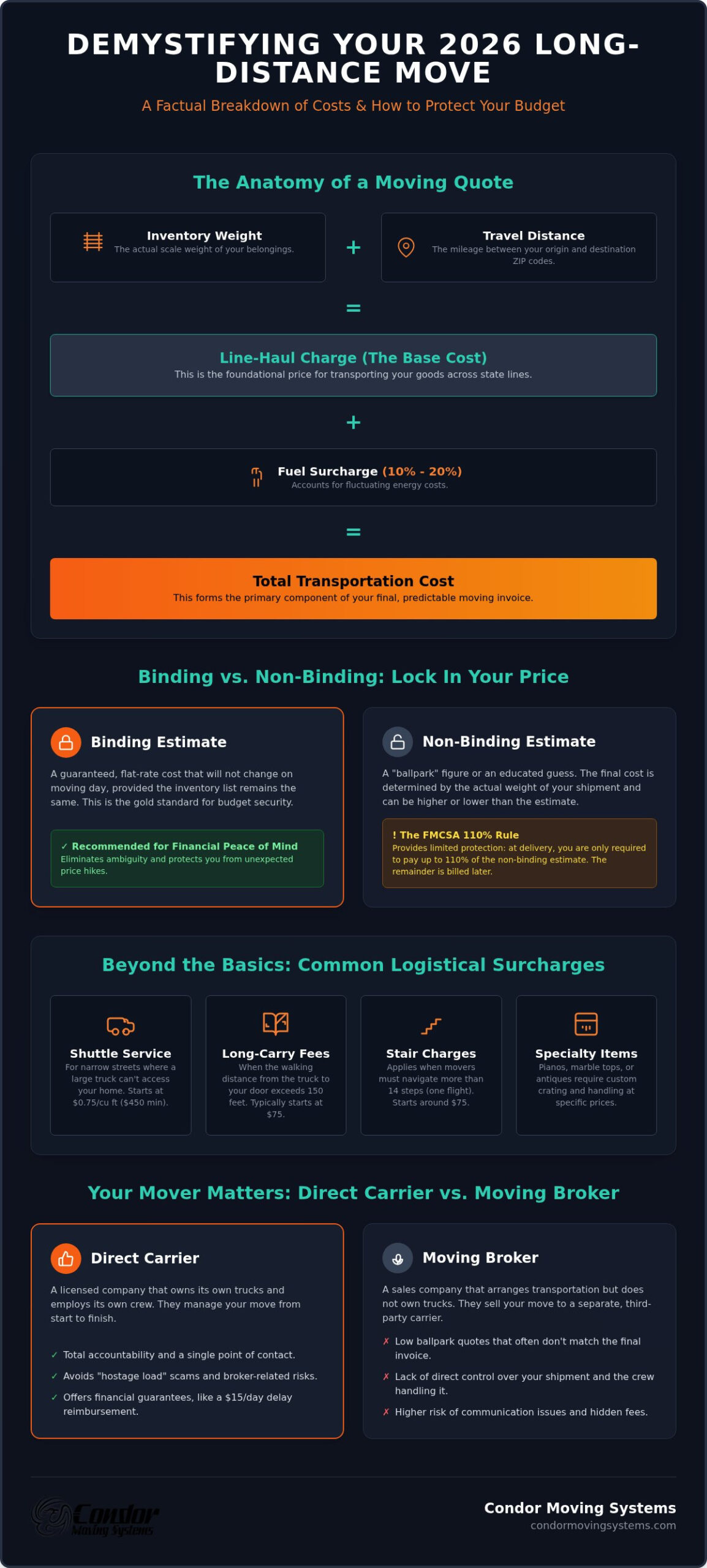
The cost of long distance movers is primarily set by the cubic feet of your inventory. The cubic feet of your shipment set the transportation price for moving your goods across state lines. Understanding how moving costs are calculated is the first step toward a predictable budget. It’s not just about the distance; it’s about the logistical resources required to move your specific volume of goods safely. In 2026, fuel surcharges remain a standard component of these calculations, typically ranging between 10% and 20% of the line-haul rate to account for fluctuating energy markets. To ensure the initial quote remains accurate, we use detailed inventory tagging. This process identifies every item before it’s loaded, preventing the price creep that often occurs when movers rely on vague verbal descriptions.
How Cubic-Foot Estimates Work
Condor measures your belongings in cubic feet — the space they take up in the truck. Pricing by the cubic foot — the space your items occupy in the truck — is the most transparent metric for interstate transport. Truck capacity is planned in cubic feet, so an accurate inventory keeps your estimate correct. This is why accurate inventory lists are mandatory. If you add a heavy appliance or several large boxes after the initial survey, the foreman revises your binding estimate, in writing, before loading. We focus on precise measurements during the walkthrough to ensure your quote reflects the true cubic footage of your shipment.
Mileage and Transit Time Variables
Your cubic-foot price already covers the drive between ZIP codes; the complexity of the route affects the timeline. For standard service areas, transit windows typically range from 1 to 10 business days. Learn how Condor sets transit times: 1–10 business days for most states, and up to 21 business days for Northern California (San Francisco area), Washington, Oregon, Idaho, Montana, Wyoming, North Dakota, South Dakota, Minnesota, Wisconsin, Michigan, upstate New York, Vermont, New Hampshire, Rhode Island, Maine and Massachusetts. When you book long-distance moves with a direct carrier, these windows are managed by the same team from start to finish. We provide a $15 per day reimbursement provision for any delays that extend beyond the estimated delivery window, ensuring you’re protected if logistical complications arise. This financial accountability demonstrates our commitment to meeting established schedules and maintaining the integrity of your relocation plan.
Common Surcharges: Shuttles, Long-Carries, and Access Fees
While the base line-haul rate covers the primary transport between cities, the physical environment of your origin and destination often dictates additional logistical requirements. These surcharges are not hidden fees but rather specific calculations based on the extra labor, time, and equipment needed to navigate property constraints. It’s essential to identify these hurdles early to ensure the total cost of long distance movers remains predictable and transparent.
Access-Related Costs
Access-related costs are frequently required in dense urban neighborhoods or rural properties with restricted entry points. If a standard 18-wheeler cannot safely park within a reasonable distance of your home, a shuttle service is necessary. This involves transferring your inventory to a smaller box truck for the final leg of the journey. Our shuttle rates start at $0.75 per cubic foot with a $450 minimum. Similarly, long-carry fees are triggered when the walking distance from the truck to your door exceeds 150 feet. If your move involves navigating more than 14 steps, stair charges will also apply. These labor-intensive tasks typically start at $75 for the specified distance or elevation. Providing precise address details during your free, no-obligation estimate ensures these factors are documented upfront, preventing financial surprises on delivery day.
Specialty Item Handling
Certain items require specialized protection beyond standard moving pads. Fragile or high-value belongings, such as marble tabletops or large antique mirrors, often necessitate custom crating. This provides a rigid, tailored protective shell for the duration of the transit. Specialty items like pianos and pool tables also carry specific pricing considerations due to their weight and complexity. Note that piano transport is generally restricted to ground-floor to ground-floor moves to maintain safety standards. Federal regulations and safety protocols also prohibit the transport of hazardous materials, live plants, and perishables. Discussing these items during your inventory survey allows for a comprehensive quote that includes all necessary specialty handling while ensuring the total cost of long distance movers is fully transparent.
Binding Estimates: Protecting Your Moving Budget
While it’s a common practice for brokers to offer these ballpark figures to secure a booking, they don’t protect you from significant price hikes on moving day. In contrast, a binding estimate is a legal agreement that guarantees the final price based on the specific inventory list provided during the survey. This is why we provide free, no-obligation binding estimates to ensure the cost of long distance movers remains fixed and predictable. Once you sign the Estimate of Charges, that document governs the financial terms of your relocation, providing the security that your budget will remain intact from pickup to delivery.
The Dangers of Moving Brokers
Many consumers fall for “lowball” quotes from moving brokers who act as intermediaries rather than service providers. Brokers don’t own trucks or employ moving crews; instead, they sell your contract to the highest bidder or the lowest-cost crew. This lack of accountability often leads to “hostage load” scenarios where the price increases dramatically once your goods are already on the truck. To protect your interests, verify that your mover is a licensed carrier with their own operational infrastructure. You can confirm our credentials through USDOT 1126171 and TXDMV 006041428C. Working directly with a carrier provides the pricing transparency and operational control necessary for successful long distance moves.
Securing Your Move Date
Professional logistics planning requires a structured financial commitment to guarantee equipment availability. We require a 20% non-refundable deposit to secure your specific move date on our calendar. This allows us to allocate the necessary resources and dedicated crew members for your relocation. Our payment schedule follows a clear 20/30/50 structure: 20% at the time of booking, 30% at pickup, and the final 50% at delivery. This methodical approach ensures that every phase of the move is funded and managed with total accountability.
Please be aware of the specific payment requirements at your destination to avoid any logistical delays. We don’t accept cash, personal checks, or credit cards at delivery. The final 50% must be paid via cashier’s check, money order, or Zelle. This policy is a core part of our commitment to operational integrity and ensures that the final cost of long distance movers is settled securely and professionally. By following this structured payment rhythm, you can focus on the transition to your new home with total peace of mind.
Additional Financial Factors: Packing, Storage, and Valuation
While the base line-haul and logistical surcharges establish the core budget, additional services like packing and storage often fluctuate based on your specific needs. These elements are critical when calculating the comprehensive cost of long distance movers because they directly impact both the safety of your inventory and your financial protection. We maintain strict operational standards for these services, including a total prohibition on the use of trash bags as packing materials. Trash bags provide zero structural integrity and are a significant safety risk; using them can void your valuation coverage and jeopardize the security of your shipment during transit.
The Cost of Packing Services
Professional packing is a strategic investment that significantly reduces the risk of transit damage. When our crews handle the packing, we take full responsibility for the items’ safe arrival, which simplifies the claims process if an issue occurs. In contrast, items labeled as PBO (Packed By Owner) have limited valuation coverage because the carrier cannot verify the condition of the contents or the quality of the internal padding. For those choosing the DIY route, we offer specialized moving kits and supplies online with free shipping to ensure you have the professional-grade materials required for a long-distance transit. We also provide partial packing services and custom crating for high-value items that require extra stabilization.
Storage-in-Transit (SIT) and Long-Term Options
If your new home isn’t ready for immediate delivery, we provide climate-controlled storage in our secure facilities. These storage rates are calculated at $0.50 per cubic foot per month, allowing for precise budgeting based on your shipment’s volume. You should understand that SIT valuation charges still apply while your goods are held in our facility to maintain continuous protection. We prioritize operational transparency regarding payment; unpaid storage balances are subject to a $25 late fee, and continued non-payment may lead to auction policies as outlined in your contract. This methodical approach ensures your belongings remain secure until you’re ready for final delivery.
Understanding the difference between Released Value Protection and Full Value Replacement is essential for your peace of mind. By default, federal law provides Released Value Protection at no additional cost, which covers your goods at $0.60 per pound. While this meets the basic requirement for the cost of long distance movers, it’s not insurance. Many clients opt for Full Value Replacement to ensure more comprehensive financial recovery for high-value items if an accident occurs during the move.
Requesting a Guaranteed Quote with Condor Moving Systems
Securing an accurate estimate is the final step in moving from the planning phase to active relocation. Determining the final cost of long distance movers requires more than a digital calculator; it necessitates a professional inventory survey that captures every detail of your household. We provide guaranteed flat-rate quotes based on these surveys to ensure that the price you are quoted is the price you pay. This process eliminates the ambiguity often found in the moving industry and establishes a clear financial path for your transition. Eligible customers should also inquire about our military and senior discounts, which we proudly offer to reduce the total expense for those who have served or are transitioning in their later years.
Preparing for Your Estimate
The accuracy of your binding quote depends on a thorough, room-by-room inventory. During the survey, you should identify every item intended for transport, including those stored in attics, basements, or outdoor sheds. This is also the time to disclose any non-allowable items that we cannot transport for safety or legal reasons; this includes jewelry, firearms, and hazardous chemicals. For those planning a move within the state, our Texas local movers apply the same rigorous standards to regional relocations. By being transparent about your inventory from the start, you ensure that your quote remains firm and that our crews arrive with the correct equipment and packing materials for the job.
Finalizing Your Relocation Plan
Once you’ve accepted your quote and paid the 20% non-refundable deposit, we begin the logistical execution of your move. At pickup, our crew will review the Bill of Lading with you and implement our inventory tagging system, where every item is labeled and logged for tracking. We provide a 24-hour answering service so you can receive updates on your shipment’s progress during transit. Remember that the final 50% balance is due at the time of delivery. To maintain operational security and efficiency, we only accept cashier’s checks, money orders, or Zelle for this final payment. We don’t accept personal checks or credit cards at the delivery destination. This structured approach ensures a professional conclusion to your move, allowing you to settle into your new home with total confidence in the integrity of the process.
Get Your Free, No-Obligation Long Distance Moving Quote
Securing Financial Certainty for Your 2026 Relocation
Navigating the cost of long distance movers doesn’t have to be a journey into the unknown. By choosing a direct carrier with established operational standards, you eliminate the risks associated with third-party brokers and bait-and-switch pricing. We’ve demonstrated that a binding, flat-rate estimate is the most effective tool for protecting your budget against unexpected surcharges. As a licensed, full-service carrier, we take full ownership of your relocation from the initial inventory to the final delivery.
Our credentials, including USDOT 1126171 and TXDMV 006041428C, reflect a deep commitment to regulatory compliance and professional integrity. You deserve a moving partner that values transparency and delivers on its promises without hidden complications. We’re ready to provide the steady hand and disciplined execution your family needs for a successful transition to your new home.
We look forward to helping you start this new chapter with total peace of mind and a logistical plan you can trust.
Frequently Asked Questions
What is the average cost of a long distance move in 2026?
The average cost of long distance movers in 2026 varies significantly with the total cubic feet of the shipment. Industry data suggests that a 2-3 bedroom move over 1,000 miles typically ranges between $4,300 and $5,451. For residents in Dallas or Houston, the most reliable way to budget is through a binding inventory survey. This ensures your specific volume is accurately priced rather than relying on generic industry averages.
Are moving estimates fixed or can they change on moving day?
Estimates are fixed only if you secure a binding, flat-rate quote. A binding estimate is a legal guarantee that the price will not change on moving day, provided the inventory remains the same as the original survey. We prioritize transparency for our clients in Fort Worth and Plano by offering binding agreements that eliminate the risk of unexpected price hikes at pickup.
What is the difference between valuation and insurance?
Valuation is the tariff-based liability a mover assumes for your goods, while insurance is a separate policy from a third party. Our standard Released Value Protection covers items at $0.60 per pound at no additional cost. For comprehensive protection for high-value items in Austin or San Antonio, Full Value Replacement is available through third-party providers. This distinction is critical for understanding your financial recovery options if transit damage occurs during your relocation.
Can I pay for my move with a credit card at delivery?
No, credit cards are not accepted for final balances at the delivery destination. The final 50% of your move cost must be paid via cashier’s check, money order, or Zelle. While you can use a credit card for the initial deposit and pickup payment, delivery requires immediate fund verification. This policy ensures a secure and professional conclusion to your move in Arlington or Frisco. Personal checks and cash are also strictly prohibited at delivery.
How do fuel surcharges affect my moving quote?
Fuel surcharges are calculated as a percentage of the base line-haul charges to account for diesel price fluctuations. In 2026, these surcharges typically range between 10% and 20% of the total cost of long distance movers. We integrate this range into your binding estimate so the final invoice remains predictable. This allows families in McKinney or Irving to budget accurately for their cross-country transport without worrying about sudden spikes in transportation costs during the transit window.
Is my deposit refundable if I change my moving date?
The 20% booking deposit is non-refundable and serves as a commitment to secure your specific relocation date. While you can change your moving date based on our current crew availability, the deposit remains tied to the logistical resources we allocate for your shipment. We recommend that customers in Grapevine or Southlake finalize their schedules as early as possible. This ensures your preferred window is locked in and helps avoid potential rescheduling fees associated with last-minute changes.
What happens if my delivery is delayed beyond the estimated window?
If delivery occurs beyond the estimated transit window, we provide a $15.00 per day reimbursement. Standard delivery times typically range from 1 to 10 business days, though deliveries to Northern California (San Francisco area), Washington, Oregon, Idaho, Montana, Wyoming, North Dakota, South Dakota, Minnesota, Wisconsin, Michigan, upstate New York, Vermont, New Hampshire, Rhode Island, Maine and Massachusetts can take up to 21 business days. This provision offers a layer of financial accountability for our schedules. We utilize a 24-hour answering service to keep you updated on the progress of your shipment as it moves toward your new home, ensuring you are never left without information.
Are there extra charges for moving heavy items like pianos or safes?
Yes, specialty items such as pianos, safes, and pool tables incur additional handling fees due to the extra labor and equipment required. Piano transport is specifically limited to ground-floor to ground-floor moves to maintain the highest safety standards. You must disclose these heavy items during your initial inventory survey. This allows us to provide an accurate flat-rate quote for your home in Plano or Houston, ensuring our crews arrive fully prepared with the necessary specialized tools.