


What if the lowest estimate you received for your cross-country move isn’t a bargain, but a trap set by a middleman who will never actually touch your furniture? With roughly 31 million Americans moving annually, the market is flooded with options, yet finding the best long distance moving companies remains a challenge. True reliability isn’t found in the flashiest marketing, but in the shortest line of accountability between you and the crew. You need to know exactly who is driving the truck and who takes responsibility if a specialty item is mishandled during the journey.
We recognize that relocating across state lines is one of life’s most significant logistical hurdles. It’s natural to feel protective of your belongings while worrying about hidden delivery fees or brokers who vanish after booking. This guide promises to equip you with the tools to identify licensed direct carriers and avoid the common pitfalls of the modern moving industry. We’ll preview the 2026 FMCSA digital compliance updates, explain how to secure a binding flat-rate quote, and show you how to ensure your high-value items arrive safely at their final destination.
Key Takeaways
- Learn why the best long distance moving companies prioritize direct carrier models over brokers to provide a single point of accountability for your move.
- Master the process of obtaining a binding quote through comprehensive inventory assessments to eliminate price fluctuations on moving day.
- Distinguish between basic liability and full value replacement coverage to properly protect your investment during long-haul transit.
- Use our professional checklist to spot common industry red flags and verify the credentials of any interstate relocation service.
- Explore the technical requirements for transporting specialty items like pianos and fine art to ensure they receive the necessary custom crating.
Carrier vs. Broker: Why Direct Accountability Defines the Best Long Distance Moving Companies
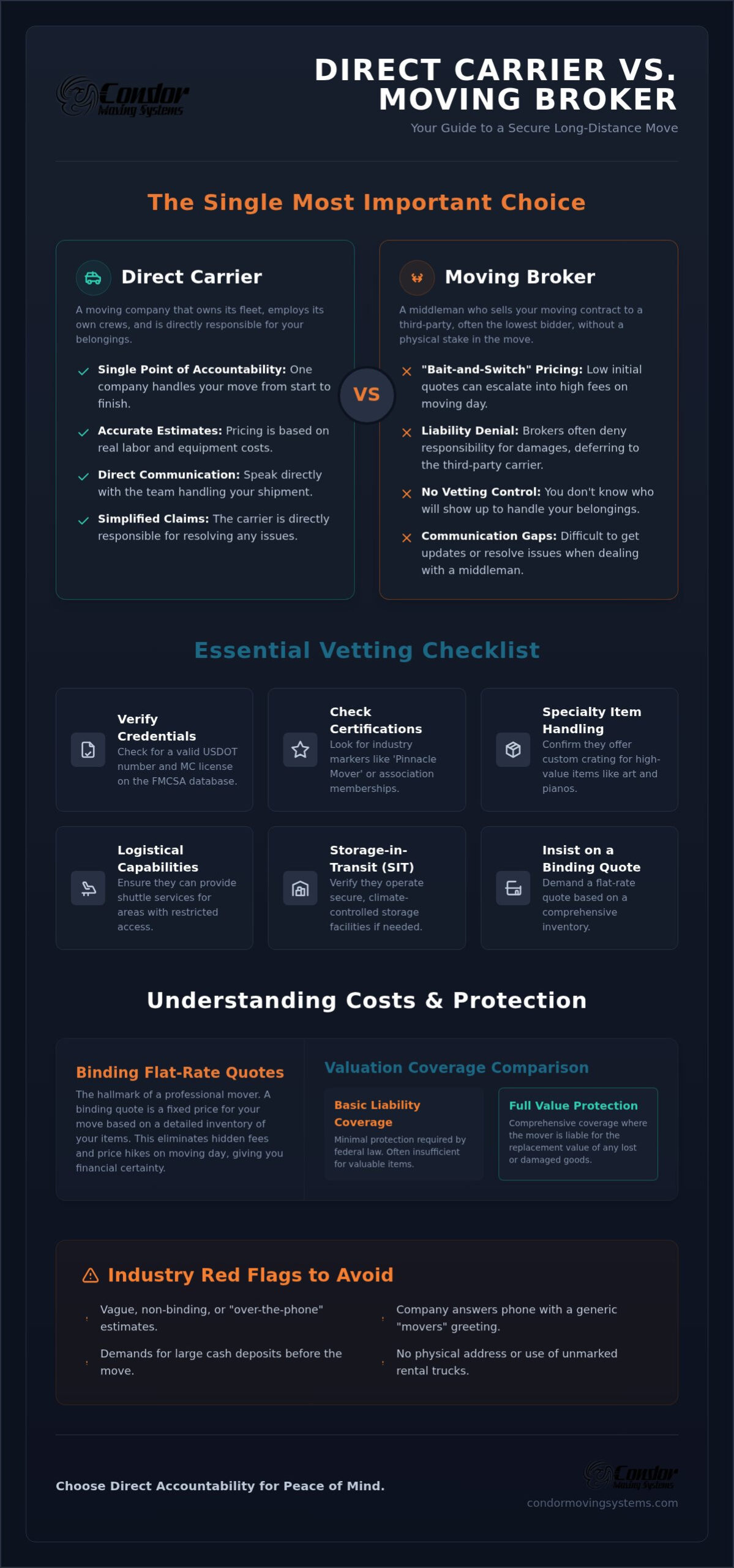
The distinction between a carrier and a broker is the single most important factor when choosing between the best long distance moving companies. A direct carrier is a moving company that owns its fleet, employs its own crews, and maintains direct legal responsibility for your shipment from origin to destination. In contrast, a broker acts as a middleman. They sell your moving contract to the highest bidder or the lowest-cost third-party service they can find, often leaving you with a crew you haven’t vetted and a company that has no physical stake in your move.
Direct carriers offer a level of accountability that brokers simply cannot match. When one company handles the entire process, communication remains clear and consistent. This streamlined approach provides several operational advantages:
- Direct Communication: You speak with the dispatchers and drivers actually handling your shipment.
- Accurate Estimates: Pricing is based on the carrier’s real-time labor and equipment costs rather than market averages.
- Simplified Claims: If damage occurs, the carrier takes direct responsibility for the resolution rather than deferring to a third party.
Because a carrier knows its own capacity and labor availability, the price you’re quoted is far more likely to reflect the final invoice than a broker’s rough estimate.
The Hidden Risks of Moving Brokers
Using a broker introduces several variables that can compromise the safety of your belongings. One of the most common issues is the “bait-and-switch” pricing model. A broker might provide a low-ball quote to secure your deposit, only for the actual moving crew to demand higher fees upon arrival. If items are damaged during transit, brokers frequently deny liability, claiming they’re merely a booking service. Condor Moving Systems eliminates these risks by managing every long-distance move with its own licensed internal crews, ensuring that the team loading your boxes is the same one responsible for their safe delivery.
How to Verify a Direct Carrier’s Credentials
Before signing any contract, you must verify the company’s legal authority to operate. Every legitimate interstate mover must possess a valid USDOT number and MC license, which you can cross-reference through the Federal Motor Carrier Safety Administration (FMCSA) database. Look for additional markers like years in business and verified customer reviews. A true full-service mover, as demonstrated by Condor’s 20-year legacy, is an asset-based carrier that manages every logistical detail from packing and custom crating to final delivery using its own licensed personnel. This transparency is the hallmark of the best long distance moving companies, providing the peace of mind that your assets are in professional hands.
Essential Criteria for Evaluating Professional Interstate Relocation Services
Selecting from the best long distance moving companies requires looking beyond the price tag to evaluate a provider’s actual logistical infrastructure. You need to determine if a company possesses the specialized equipment necessary for a cross-country haul. Standard interstate moves typically utilize 18-wheelers for maximum efficiency. However, if your destination features narrow streets or weight-restricted zones, the mover must be able to provide a shuttle service to transfer goods from the tractor-trailer to a smaller box truck. Confirming these details early prevents delivery delays and unexpected equipment fees.
Complex timelines often require storage-in-transit (SIT) options. If your new home isn’t ready for immediate occupancy, verify that your mover operates secure, climate-controlled facilities. This ensures your belongings remain protected in a professional environment rather than sitting in a trailer. A reliable provider will offer flexible storage solutions that integrate seamlessly with your delivery schedule, maintaining a clear chain of custody throughout the entire process.
Specialty Item Handling and Custom Crating
Standard cardboard boxes aren’t sufficient for high-value or fragile assets like fine art, marble tabletops, or large electronics. Professional interstate movers provide custom crating services, building wooden enclosures tailored to the dimensions of your specific items. This level of protection is vital for absorbing the vibrations and shifts that occur during a thousand-mile journey. While DIY packing might seem cost-effective, the risk of damage using unvetted materials is high. For specialty items like pianos, it’s vital to recognize that professional handling is typically restricted to ground-floor to ground-floor moves to ensure the safety of both the instrument and the crew. Learning how to hire movers with these specific technical capabilities is the best way to safeguard your most valuable possessions. For those transporting exceptionally high-value or oversized items that require more than standard moving services, our custom crating and specialty packing services give those items the extra protection high-stakes cargo needs.
A precise inventory is the foundation of a reliable, stress-free move. The best long distance moving companies will perform a thorough physical or virtual walkthrough to document every piece of furniture and every box. This detailed assessment allows the mover to provide a binding, flat-rate quote. This type of estimate guarantees that your price won’t fluctuate unless you add items to the shipment. You must also provide accurate property details, such as the presence of multiple flights of stairs or long-carry distances from the curb to the door. Providing full transparency during the initial consultation allows you to receive an accurate moving estimate that reflects the true scope of your relocation needs.
Understanding Moving Costs and Valuation: Beyond the Bottom Line
Transparency in pricing is a hallmark of the best long distance moving companies. Beyond the base line-haul rate, you must account for fuel surcharges, which typically range from 10% to 20% of the total cost. Additional logistical challenges also carry specific fees that should be detailed in your estimate. For instance, if the distance between the truck and your front door exceeds 75 feet, a long-carry fee often starts at $75. Similarly, if a full-sized 18-wheeler cannot access your property due to narrow streets, shuttle services are billed at approximately $0.75 per cubic foot. If your timeline requires storage, the industry benchmark is roughly $0.50 per cubic foot per month. For a complete breakdown of how these charges are structured and what to expect on your final invoice, our detailed guide on the cost of long distance movers provides a factual 2026 pricing and budgeting resource.
Every interstate move includes basic Released Value Protection at no extra cost. This federal standard covers your belongings at $0.60 per pound per item. While this is the minimum requirement, it’s rarely sufficient for high-value assets. For example, a damaged 50-pound television would only net a $30 reimbursement under this plan. To mitigate this risk, professional carriers offer Full Value Replacement Coverage, which ensures items are repaired or replaced at current market value. Deciding on the right level of protection is essential for maintaining peace of mind during a cross-country transition.
The 20/30/50 Payment Structure
Professional carriers use a structured payment schedule to maintain operational flow and secure your resources. A 20% non-refundable deposit is required to lock in your moving date on the master schedule. Following this, 30% of the total is due at the time of pickup, with the remaining 50% required before the shipment begins its transit. It’s vital to note that payment methods at delivery are strictly limited to cashier’s checks, money orders, or Zelle. Personal checks, credit cards, and cash are not accepted at the destination to ensure a secure and verifiable transaction for both parties.
Valuation vs. Insurance: What You Need to Know
It’s a common misconception that movers sell insurance. Legally, movers provide valuation, which represents a level of tariff liability. If you require comprehensive coverage beyond the carrier’s standard liability, you may need to seek third-party Full Value Protection. Be aware that items Packed by Owner (PBO) have significant coverage limitations. Unless there is visible external damage to the box itself, most of the best long distance moving companies cannot accept liability for the internal contents, as they can’t verify the original packing quality. This is why professional packing services are often recommended for fragile or high-value inventory.
Selection Roadmap: How to Vet Interstate Moving Professionals
Vetting the best long distance moving companies requires a critical eye for operational transparency. You should begin with a “red flag” checklist to identify potential risks before signing a contract. A company that lacks a physical business address or answers the phone with a generic “moving services” greeting often lacks the infrastructure of a professional carrier. Be particularly wary of movers who demand cash-only payments or large upfront sums beyond the standard deposit. Before the truck leaves your property, you must review the Bill of Lading and ensure every item has a corresponding inventory tag. This document serves as your primary legal contract and proof of shipment, ensuring that every box is accounted for during the cross-country haul.
Understanding transit timelines is equally vital for a seamless transition. At Condor, standard interstate moves take 1–10 business days from the first day you can receive your shipment; deliveries to Northern California (San Francisco area), Washington, Oregon, Idaho, Montana, Wyoming, North Dakota, South Dakota, Minnesota, Wisconsin, Michigan, upstate New York, Vermont, New Hampshire, Rhode Island, Maine and Massachusetts can take up to 21 business days. A reputable provider will offer a $15 per day reimbursement provision for delayed deliveries, providing a level of financial accountability if they miss the contracted window. Clear communication regarding these dates ensures you can plan your arrival without the stress of an open-ended timeline. It’s a sign of a disciplined professional when they take full ownership of the schedule from start to finish. Homeowners who begin their search for long distance movers near me will find that understanding the carrier vs. broker distinction and the latest FMCSA regulations is essential to securing a transparent, accountable relocation in 2026.
Prohibited Items and ‘Non-Allowables’
Movers are legally and operationally restricted from transporting certain items. High-value personal assets such as jewelry, cash, and legal deeds must remain in your possession throughout the move. Firearms are also strictly prohibited from entering the moving truck. Additionally, hazardous materials like propane tanks, paint, and various household chemicals are banned due to the risk of fire or spills during transit. You should also note that trash bags are not accepted as packing materials. They offer zero structural protection and are prone to tearing, which compromises the safety of your entire shipment. Using professional-grade boxes is the only way to ensure your belongings withstand the vibrations of a long-distance journey.
Identifying Service Gaps: Attics and Hoisting
To maintain safety and efficiency, professional movers like Condor do not deliver items into attics or basements. These spaces often have narrow access points or structural limitations that pose a risk to the crew and your property. Similarly, hoisting furniture through windows or over balconies is not performed for safety reasons. Disclosing your full address details accurately is essential to avoid surprises on moving day. If a standard 18-wheeler cannot access your street, the mover will need to arrange a shuttle service, which should be identified and priced during your initial inventory assessment. Providing this information early allows the carrier to prepare the necessary equipment for a smooth delivery.
Why Condor Moving Systems is a Top Choice for Long-Distance Relocation
Condor Moving Systems has operated as a Texas-based direct carrier since 2003, bringing over 20 years of specialized experience to the interstate relocation industry. Unlike brokers that outsource your assets to unvetted third parties, we manage every aspect of the journey with our own licensed crews. This direct handling model is why we are consistently recognized among the best long distance moving companies. We utilize a personalized inventory tagging and tracking system, ensuring every item is accounted for from the moment it enters our truck until it reaches your new doorstep. To facilitate a smooth arrival, we provide customers with a definitive 24 to 48-hour delivery notice, allowing you to prepare your new home for the crew’s arrival.
Our commitment to comprehensive service extends to providing financial accessibility for those who have served or are entering a new stage of life. We offer dedicated military and senior (65+) discounts for eligible relocations, recognizing the unique needs of these communities. Whether you’re moving a small household or a large estate, our long distance moving services are designed to cover every logistical detail across the United States with total accountability. Organizations planning an office transition can also explore our business relocation services to understand how carrier-direct accountability protects sensitive IT assets and ensures zero-downtime moves.
Full-Service Packing and Storage Solutions
We provide a scalable range of packing options to fit your specific needs and budget. Our teams can handle everything from partial packing of fragile items to full-service unpacking in your new residence. For those in high-density urban environments, our specialized apartment moving services address the complexities of elevators, loading docks, and strict building regulations. If your timeline requires a gap between pickup and delivery, we offer climate-controlled storage options for both short-term and long-term requirements. This ensures your belongings remain in a stable environment under our direct supervision until you’re ready for final delivery.
The Condor Commitment to Peace of Mind
Relocation doesn’t always happen during standard business hours, which is why we provide a 24-hour answering service for emergency customer support. You’ll never be left without a point of contact if an urgent question arises during transit. Our dedicated crews handle your items with a level of care that only comes from a company that takes full ownership of the work. We don’t just move boxes; we manage a disciplined logistical operation designed to protect your interests. Choosing a licensed, full-service carrier like Condor Moving Systems is the ultimate way to ensure a secure and reliable transition for your family.
Secure Your Direct Path to a Successful Relocation
Identifying the best long distance moving companies requires looking past the initial estimate to verify the operational integrity of the carrier. You’ve learned that direct accountability is the foundation of a safe move, ensuring that the same licensed crew manages your assets from pickup to delivery. By insisting on a binding quote based on an accurate inventory and verifying a mover’s USDOT credentials, you eliminate the common risks of hidden fees and third-party outsourcing. This structured approach to vetting ensures your transition remains predictable and secure.
Condor Moving Systems operates under USDOT 1126171, providing the direct handling necessary for total peace of mind. We take full ownership of your transition, offering the specialized equipment and expertise required for complex interstate hauls. Our team is ready to guide you through every logistical detail with the transparency you deserve.
Your cross-country transition is a major milestone. Starting with a transparent, direct service provider is the most effective way to ensure your belongings arrive safely at your new home.
Frequently Asked Questions
What is the difference between a moving broker and a direct carrier?
A direct carrier like Condor Moving Systems owns its fleet and employs its own crews, whereas a broker is a middleman who sells your contract to third parties. By choosing one of the best long distance moving companies that operates as a carrier, you maintain a single point of accountability. In cities like Dallas and Houston, this means the same licensed team handles your inventory from pickup to final destination without handing your move to another company.
How much does a long-distance move typically cost in 2026?
Long-distance moving costs are calculated on the cubic feet of your shipment. While industry averages fluctuate, your final price will include the base line-haul rate plus a fuel surcharge that typically ranges from 10% to 20%. To ensure an accurate budget for your relocation from Plano or Austin, we provide free, binding estimates that lock in your rate based on a comprehensive inventory assessment. You can also review our full 2026 cost of long distance movers pricing guide for a detailed breakdown of every fee category you should anticipate.
What items are not allowed to be moved by long-distance companies?
Movers are prohibited from transporting hazardous materials, perishables, and high-value personal assets. This includes propane tanks, paint, chemicals, plants, and perishable food. You must also personally transport jewelry, cash, legal deeds, and firearms. For safety and structural reasons, we don’t accept items packed in trash bags. If you’re moving from Fort Worth or Arlington, please review our full list of non-allowables to avoid delays on moving day.
How do I pay for my long-distance move at delivery?
Final payment at delivery must be made via cashier’s check, money order, or Zelle. We don’t accept cash, personal checks, or credit cards at the destination. This policy ensures a secure and verifiable transaction for your relocation to San Antonio or Irving. Remember that 50% of your total balance must be settled before the shipment begins its transit, with the remaining balance due upon the driver’s arrival at your new residence.
Is my move insured for the full value of my belongings?
Every interstate move includes standard Released Value Protection, which is a tariff liability covering $0.60 per pound per item. This is valuation, not insurance. If you require more comprehensive coverage for your move from Frisco or McKinney, you can purchase Full Value Replacement Coverage through a third-party provider. This ensures your assets are repaired or replaced at current market value if damage occurs during the long-haul journey.
Can I change my moving date after I have paid the deposit?
You can request a change to your moving date, though it’s subject to crew availability and potential scheduling fees. Because the 20% booking deposit is non-refundable, it’s best to confirm your dates as early as possible. If you need to adjust your timeline for a relocation in Grapevine or Southlake, contact our office immediately. We’ll do our best to accommodate your new schedule within our master logistical plan.
How long does it take for a long-distance move to be delivered?
Standard transit times for interstate deliveries typically range from 1 to 10 business days. Deliveries to Northern California (San Francisco area), Washington, Oregon, Idaho, Montana, Wyoming, North Dakota, South Dakota, Minnesota, Wisconsin, Michigan, upstate New York, Vermont, New Hampshire, Rhode Island, Maine and Massachusetts can take up to 21 business days. We provide a $15 per day reimbursement if your shipment arrives beyond the estimated window. Whether you’re moving from Dallas to the East Coast or the West Coast, we provide notifications once your shipment is in transit and again 24 to 48 hours before arrival.
Do you offer discounts for military families or seniors?
Yes, we offer dedicated discounts for active-duty military, veterans, and seniors aged 65 and older. These savings apply to our comprehensive relocation services across our Texas service areas, including Plano and McKinney. We take pride in supporting those who have served and our senior community by providing reliable, professional moving solutions at a more accessible rate. Simply mention your eligibility during your initial consultation to have the discount applied to your estimate.